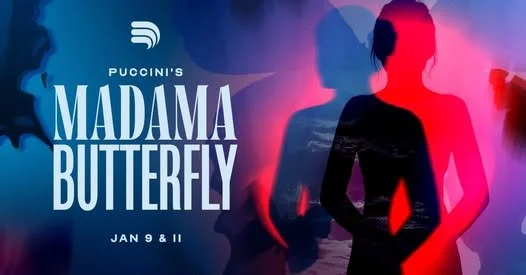
‘Madama Butterfly’ (concert version) @ Dallas Symphony Orchestra
Photos by Sylvia Elzafon
—Wayne Lee Gay
This viewer showed up at the Meyerson Symphony Center Friday night feeling more than a bit skeptical about the evening's offering: a concert version by music director Favio Luisi and the Dallas Symphony Orchestra of Puccini's Madama Butterfly.
I'm a lifelong, dyed-in-the-wool Puccini fan (I saw my first live performance of Madama Butterfly fifty years ago—since then followed by more performances than I can count. I simply didn't see the need for a stripped-down concert version of that hyper-emotional audience favorite. The two major opera companies in Dallas and Fort Worth routinely serve up this box-office standard every five or so years: Fort Worth Opera will present it again in April.
In short, anyone who wants to experience a live, fully staged Butterfly need only wait a few months (or at most a few years) for it to show up again in these parts, as sure as a springtime tornado.
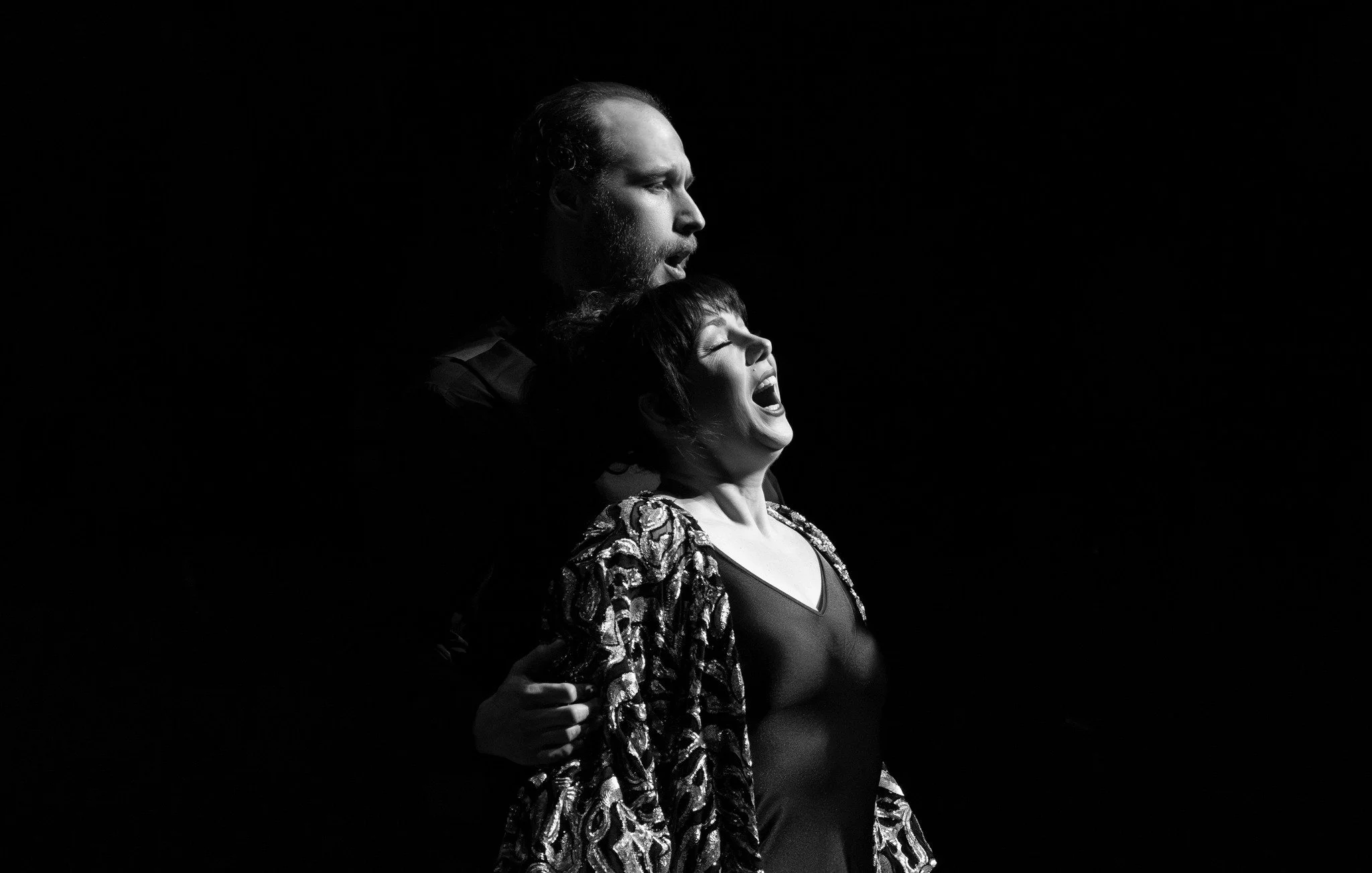
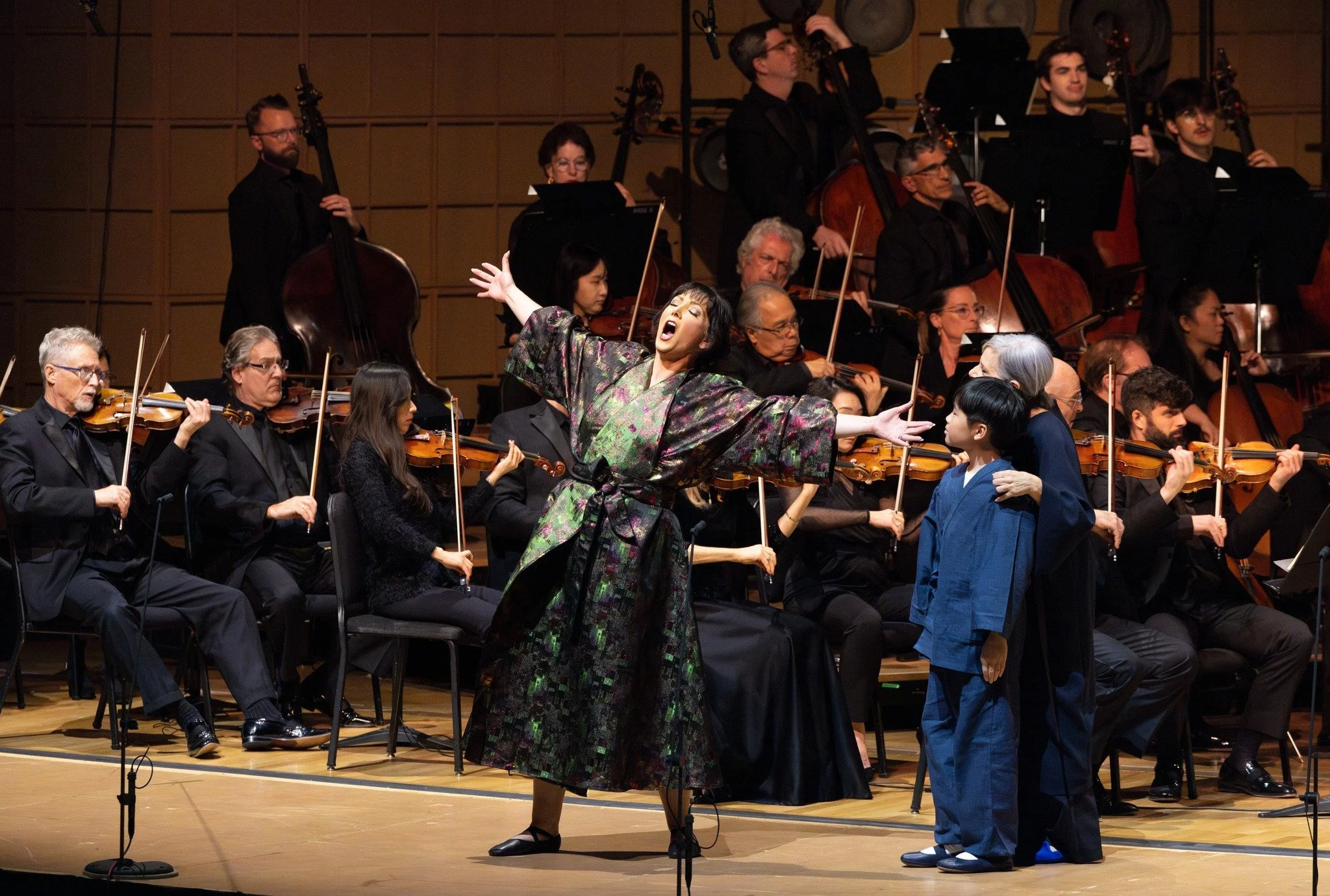
Not quite three hours after taking my seat, I found myself overwhelmed and emotionally drained—in a good way—not only by the entire breadth of the performance, but especially by soprano Jennifer Rowley in the title role. Rowley may well be the best Butterfly (aka Cio-Cio San) I have seen or heard—and we've had some of the best in Dallas and Fort Worth. Her voice is sweet, but with just enough brilliant edge to keep the listener totally engaged. Every note is perfectly placed in terms of volume, pitch, and emotional resonance.
While the role of Cio-Cio San might be dismissed as simply another tear-jerking tragic heroine, the character is incredibly complex: an innocent but passionate teenager (she's ages fifteen to eighteen during the course of the action), clearly psychologically damaged by the downfall of her birth family (her once-prominent father committed suicide), vulnerable to the romantic overtures of an American sea captain—and eventually, fiercely loyal and protective as a mother. Rowley clearly “gets” all of it, both dramatically and vocally.
As is customary these days in a concert version of any opera, there are only a few simple properties onstage—two tables, chairs, a tea set, and a box. (Dramatic lighting effects further enhance the experience.) The male characters wear business suits that wouldn't be out of place in any Dallas office; the chorus, behind the orchestra, is in standard black concert attire, and the principal females wear traditional Japanese robes. Cio-Cio San has the most complex costuming, with a several different robes and a modest black one-piece slip.
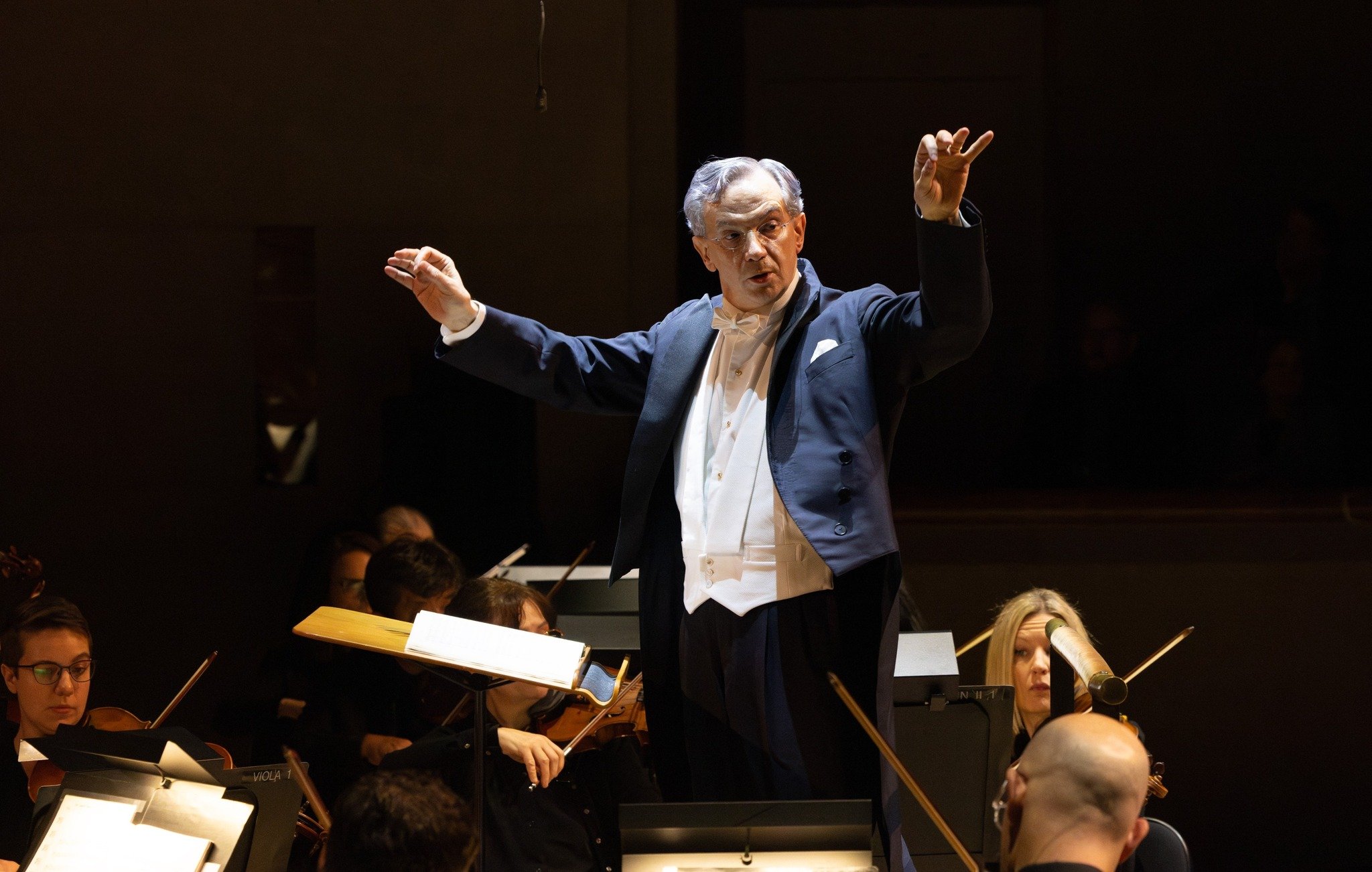
Indeed, the starkly simple production, along with conductor Luisi's intensely insightful reading of the score, underlines the striking ongoing relevance of this opera. Italian Puccini loved America, and like anyone who loves America, was able to view our country with a constructively critical eye: Butterfly is, indeed, a parable of the tragic effects of American-style toxic masculinity and American colonial imperialism. Puccini understood this in 1904; recent weeks have shockingly brought these despicable strains of our national psychology to the forefront in international affairs again.
To wit: early in Act I, Captain Pinkerton sings enthusiastically of the willingness of Americans to travel the world, taking what we want on all levels (including the sexual); at the end of his gorgeously boastful aria, he sings two words as a toast (the only English in this Italian opera): "America forever!" while the orchestra tosses in the rising triad of the Star-Spangled Banner. Under Luisi, the phrase hits like a lightning bolt for the sensitive listener.
The cast supporting Rowley in her role as Cio-Cio San is in general equally effective, with memorable interpretations by mezzo-soprano Manuela Custer as Cio-Cio San's maid Suzuki and baritone Alessandro Luongo as the American consul Sharpless. Tenor Evan LeRoy Johnson as Pinkerton is good in the lower registers but heavy and lacking in nuance in higher passages; he's dramatically capable in the role of the carelessly seductive Pinkerton—so convincing, in fact, that some members of the audience booed his curtain call Friday night, not because of his singing, but because he portrayed his character so well.
The DSO is in fine form for this reading of Butterfly, in which (among other things) Puccini shows his talent as a masterful orchestrator. Yet he was writing for a pit orchestra rather than a full orchestra onstage, and conductor Luisi brings the strings in a bit too heavily in the opening passage—and for a few minutes at the start, the orchestra overbalances the singers, But once into the score, Luisi is nothing less that amazing in his handling of the many fine points of the orchestral writing and the vocal-orchestral synthesis. Together with soprano Rowley, he rides the score forward to a powerful, bitter finale.
WHEN: January 9-11, 2026 (final performance 2 p.m. Sunday)
WHERE: Meyerson Symphony Center, Dallas Arts District
WEB: dallassymphony.org