

Photos courtesy of the Cliburn
—Wayne Lee Gay
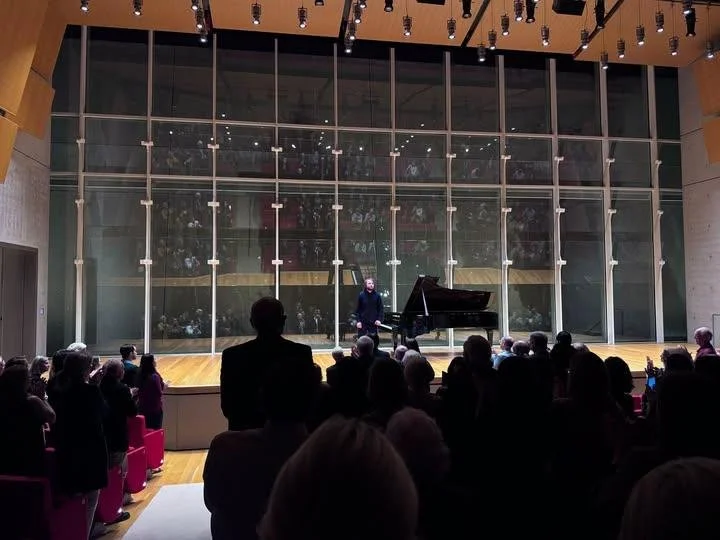
Russian pianist Daniil Trifonov, at age 35 one of the brightest stars in today's classical music universe, presented a brief recital that was always intriguing and sometimes a bit baffling Wednesday night in the Kimbell Art Museum’s Renzo Piano Pavilion.
The “Cliburn at the Kimbell” series presents renowned guest artists in programs of approximately one hour, and performed without intermission. This format has proven effective in many cases, resulting in a healthy meal of music rather than a two-hour gorge.
Trifonov, renowned for his astounding technique and passionate musicality, clearly had something unique in mind in his selections for the evening. The relatively short recital opened with Handel's Suite No. 5 in E Major, a four-movement work originally written for for harpsichord. Here, Trifonov gave a borderline eccentric, pianissimo, and almost otherworldly rendition of the opening Prelude. From there, he gradually broadened in volume through two dance-inspired movements—an Allemande and a Courante—before landing on the Suite's final "Harmonious Blacksmith" variations with a full-bodied reading. There, he reveled in the rippling scales and showy idioms of Handel's most famous keyboard work.
Echoing the two dance movements in the Handel work, Trifonov proceeded to a set of six dance-inspired piano works from twentieth-century Latin America. The Rapsodia Dominicana No. 1 (“Sambumbia”) of Dominican composer Juan Francisco Garcia (1892-1974)—actually a whimsical, occasionally madcap waltz—opened the group; the Valsa da dor ("Waltz of Pain") of Brazil's most famous classical composer, Heitor Villa-Lobos (1887-1959), gave a dark cast to the waltz genre.
Another Dominican, Rafael Landestoy (1925-2018) provided a sentimental El Vals de Santo Domingo and a cheerful, playfully frantic Estudio en Samba. Argentina was represented by the Milango of Alberto Ginastera (1916-83), inspired by a South American folk music genre. Brazilian Mozart Camargo Guarneri (1907-93—-whose parents obviously held musical ambitions for him—was present on the program through his Dança Negra, with its pleasantly infectious ostinato.
Midway through the set, Trifonov inserted one of his own works, obviously inspired by Latin dance idioms—a Tango, thick with modernist harmonies and Russian passion.
Another fascinating aspect of the program arrived with Villa-Lobos' Bachianas Brasileiras (roughly, "Bach-like Brazilian") No. 4 of 1941, a twentieth-century response to the baroque suite form represented by the opening Handel Suite. Trifonov gave a magnificently insightful performance of this darkly grand set of four movements, closing, appropriately with a final Dança.
Trifonov thus wove an impressive, multi-layered intellectual web here. At its heart was a rich array of dance forms as interpreted by twentieth-century Latin American composers in the Euro-American classical tradition. The whole was further enriched by the prologue and epilogue of multi-movement suites by renowned eighteenth and twentieth century composers, creating a conversation between two eras—and all, of course, was performed magnificently by one of our era's greatest virtuosos.
There was, however, an underlying problem in presentation. With lights low, and no onstage announcements or indications (Trifonov sometimes moved from one piece to the next without pause), it was impossible for audience members to read the program book and know exactly which piece was being performed—or, for that matter, to follow along with Buddy Bray's (as always) excellent program notes. I'm sure I'm not the only audience member wishing I could be certain which piece by which composer was being performed at any given moment.
WHEN: November 18, 2026
WHERE: Renzo Piano Pavilion, Kimbell Art Museum, Fort Worth
WEB: cliburn.org