‘Rachmaninoff & Schubert’ @ The Dallas Symphony

—Wayne Lee Gay
Three works demonstrating the sheer beauty of symphonic music provide the focus of this weekend's concerts of the Dallas Symphony Orchestra at the Meyerson Symphony Center, with music director Fabio Luisi on the podium.
First up is Armenian-American composer Alan Hovhaness, represented by his "Mysterious Mountain" (Symphony No. 2) of 1955. Hovhaness was known for his mystical approach to music as well as his prolific output; "Mysterious Mountain" was his Opus 132, and he still had nearly forty years of composing to go before reaching his final Opus 428 with Symphony No. 66 in 1992.
"Mysterious Mountain" lingers on gorgeous string sonorities with ecstatic interjections from various wind instruments in the first movement; in the second, Hovhaness breaks the static serenity with the forward impetus of a resonant fugue, crowned with a soaring dramatic pronouncement of the main theme. The drama fades and serenity returns for the third and final movement.
Hovhaness spent his long career on the outskirts of the classical music establishment, but he clearly anticipated minimalism and the rise of the programmatic maximalism currently dominating new symphonic composition. The DSO last performed "Mysterious Mountain," (arguably Hovhaness's most famous work) three decades ago, and its return to the orchestra's stage is welcome.
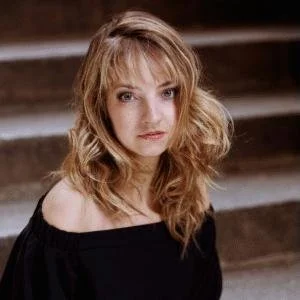
French pianist Lise de la Salle joins the orchestra for Rachmaninoff's Piano Concerto No. 1. Rachmaninoff originally composed the work in 1891 at the age of seventeen. He revised it in 1917, at which point he applied the full expertise he had developed during his mature middle style period. This skillful revision thus features a combination of youthful abandon and mature insight, with thousands of notes to challenge the pianist and awe the listener, integrated with one ear-grabbing tune after another.
For better or worse, De La Salle opts for a steely, athletic approach that sometimes overpowers the lyricism. She owns unending stamina to meet the technical demands, but misses much of the beauty here, ultimately creating more fireworks than passion. (At Friday's performance, she responded to the the first curtain call with an encore in the form of a gentle piano transcription of a Bach organ prelude, showing a more introspective side of her personality.)
After intermission, Luisi and the orchestra turned to Schubert's "Unfinished" Symphony No 8, made up of movements one and two of a work probably intended, in the standard practice of the nineteenth century, to include two additional movements. The most outstanding feature of this symphonic work, discovered decades after the composer's death, is Schubert's endless flow of song-like melodies, encapsulated in his expert management of classical structure.
Besides a masterful grasp of the Schubert’s impetus and drama, conductor Luisi has a few striking and admirable tricks up his sleeve here. He presents the opening cello and bass line at an almost-but-not-quite inaudible pianissimo, and arrestingly stretches the brief horn obbligato in the second movement almost into a fermata. In spite of a few tiny, almost unnoticeable glitches from the orchestra, Luisi produces a satisfyingly complete musical experience here—leaving behind no grand final cadence, but instead giving us an almost whispered farewell, wonderfully communicated by Luisi.
(The orchestra presented an abbreviated version of the concert on Thursday evening, featuring the Schubert and Rachmaninoff only, and beginning at 6:30 pm rather than the usual 7:30 pm. This is part of an ongoing and necessary effort by the DSO toward audience expansion, though it seems a shame to omit, in the name of marketing, a rare performance of the Hovhaness work.)
WHEN: October 22-24, 2026
WHERE: Meyerson Symphony Center
WEB: dallassymphony.org