—Cathy Ritchie
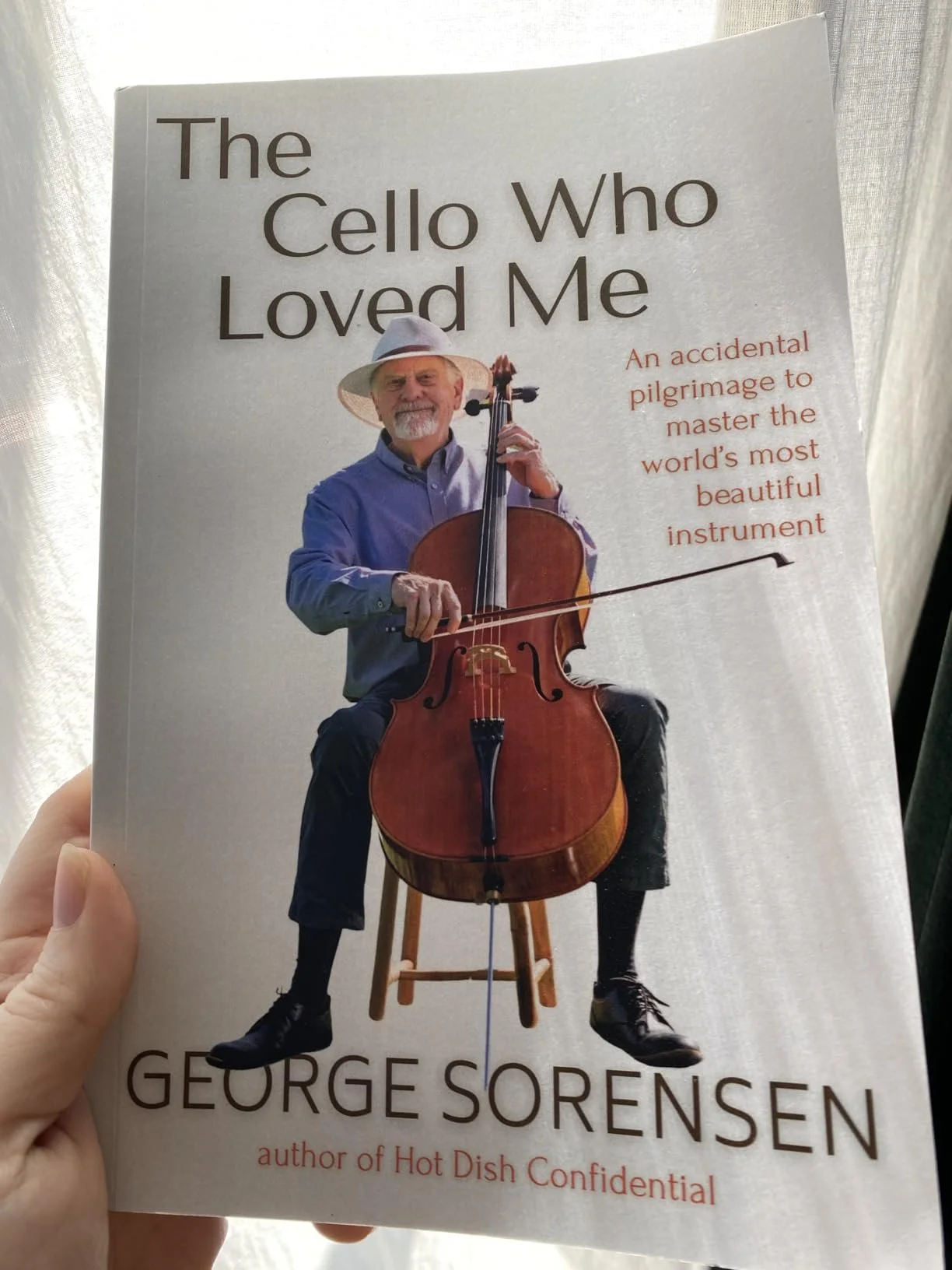
The Cello Who Loved Me:
An Accidental Pilgrimage To Master the World's Most Beautiful Instrument
by George Sorensen (Flexible Press, Minneapolis, 2026)
This shortish book took me a long time to finish—because I hated to see it end. It reminds us that we're never too old to live a long-held dream, or to create a new one.
Author George Sorensen dabbles through music lessons while growing up, but eventually spends his adult working years in Portland, Oregon as a marketing communications manager. Once he retires in his 70s, he enjoys traveling the world. While in Spain one day, he hears a cellist perform a solo outdoors, and finds his life heading in a new direction, powered by an inner determination to master this particular instrument. He wants to perform for his friends, and Sorensen’s book—The Cello Who Loved Me: An Accidental pilgrimage to Master the World’s Most Beautiful Instrument—chronicles his journey towards that goal.
As he put it: "A lightning bolt of revelation didn't knock me to the ground. I simply realized I'd been attracted to something for a long time without being aware. Perhaps it was to fill a void I didn't know I had."
Though he already can read music, Sorensen now tackles many other tasks: connecting with a compatible teacher; locating a high-quality rental instrument; visiting luthiers and watching cellos and other string instruments being made by hand; studying audio and video recordings of history's greatest cello artists; participating in short-term music camps; and much more. His life becomes All Cello, All The Time.
He does eventually master his new instrument, an enormous accomplishment for a man in his eighth decade. His learning process continues to this day.
While Sorensen offers a lay person's A-Z primer on cello history and what the instrument contributes to the string orchestral family, I think the author's greatest attribute is his overall writing style. His "voice" is companionable and charming, full of friendliness and puckish humor. He appears to be sitting amongst his readers, simply chatting away like a BFF. A nice bonus. (For another memoir with a similar theme, I highly recommend 2014's The Late Starters Orchestra by Ari L. Goldman.)
George Sorensen at 70+ years has lived a dream he didn't even know he had, but one that is bringing joy into his life full force. His book is a reminder of the happiness that music offers, and an inspiring lesson—whatever our birth certificates may think they know about us—that there’s more to us than we and the world may think.
LIBERATION
by Bess Wohl (Dramatists Play Service, 2026)
This year, playwright Wohl joined the select group of female winners of the Pulitzer Prize for Drama. Her stage play LIBERATION is both a nostalgia journey and an intriguing thought piece for today's America, not to mention a fine ensemble acting challenge.
In 1970, seven varied Midwestern women become an unexpected consciousness-raising group in keeping with the emergence of women's rights/issues as an important (and much-discussed) topic in society. Fifty years later, the daughter of one participant journeys back to the locale in a quest to understand why things somehow went wrong.
The play's timeline shifts swiftly from past to present and back again, and I sometimes became confused about what was happening and when—but sources assure me that the onstage, the play’s lighting and special effects leave no doubt as to when we're in 1970 and then 50 years hence.
The characters are multicultural, and the text offers each actor substantial solo and group moments. However, major spoiler alert: at the beginning of Act 2, as a gesture of the aforementioned liberation, the entire cast performs nude for a brief time.
LIBERATION offers an intriguing history lesson blended into a question: did the terms of the various “raising of consciousness” discussions of 1970 serve us well in the decades that followed? Our newest Pulitzer winner guides us towards an answer.