A.R. Gurney’s ‘The Dining Room’ @ GXR Productions
—Jan Farrington
A.R. Gurney’s early ‘80s play The Dining Room was an affectionate but ironic look at the world of WASPs—the generations of White Anglo-Saxon Protestants who filled the columns of the nation’s social registers for generations—and claimed a significant part of the wealth and status of the country. WASPs were especially thick on the ground in our northeastern cities and the posh suburban towns nearby, and Gurney knew that world well.
Director George X Rodriguez picked The Dining Room for his company’s second production (a compelling Texas premiere of Luis Alfaro’s The Travelers came first) and gravitated toward something both old and new. What would happen if…the six actors cast to play 18 scenes and fifty-plus characters were not the whites-only performers of Gurney’s original?
Answer: nothing much. The script didn’t catch fire. The audience didn’t riot. The Daughters of the American Revolution didn’t turn up to make citizens’ arrests. All in all, though the WASP edge had definitely been filed down, the change revealed another truth: that families of many backgrounds have rituals and customs they treasure and cling to—and kick at the prospect of younger generations tossing them onto the trash heap of history.
Take stately great-aunt Harriet (Bowman-Shelton) explaining the dining customs of this well-to-do family to her nephew (taking a video for his school project). She recalls generations of maids laying out inherited cloth napkins, serving meals on ancestral china, clearing away—and then bringing out the finger bowls. That stops him cold. Finger bowls? Aunt demonstrates the delicate wiggle of fingertips in water. She is as high-toned as the Queen of England—and both characters are Black. The scene is grand and hilarious with nary a WASP in sight.
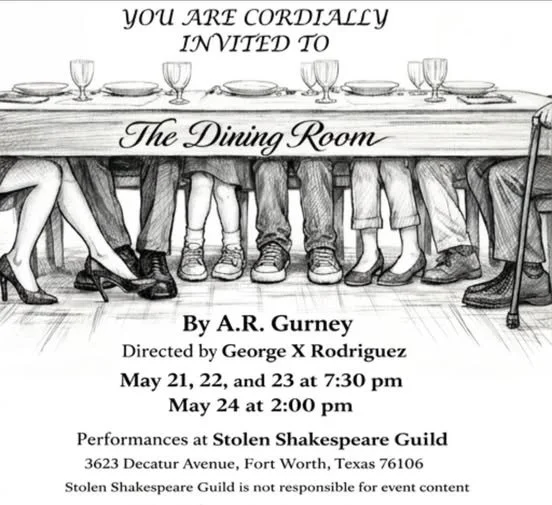
And so it goes through this very engaging cavalcade of short scenes and American characters, moved forward a few decades into our own day, or perhaps the last few decades. (The play’s original dining table was said to have been crafted in 1898; this one is a historic-replica version from 1948). What’s important is the idea of family life and passed-down traditions—and how each generation adapts or lets go of them.
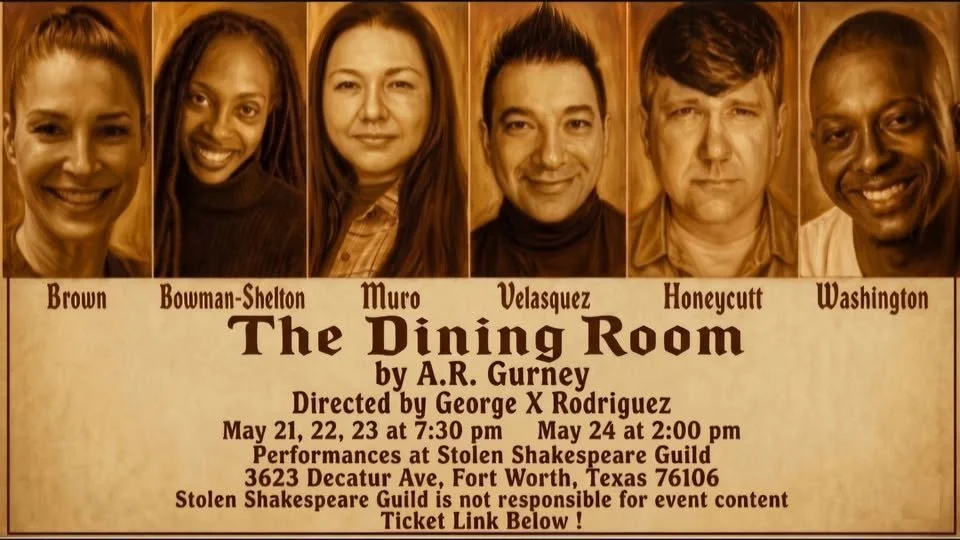
Mary Muro, AJ Bowmano-Shelton, and Jennifer Brown play the women characters of the stories, with Kevin Velaxquez, MT Washington, and Rodney Honeycutt claiming the men’s roles. Director Rodriguez, who told the audience he’d specifically asked these performers to be in the show, has chosen well. I can’t provide chapter and verse on all the people and vignettes portrayed, but will do my best to give you a good sampling.
A wife (Brown) plunks an electric typewriter down at one end of the giant table. Her husband (Honeycutt) pulls back in alarm—and comes up with endless reasons for her to find another spot, closer to the rampaging kids, maybe. After a minute or two we begin to wonder if he’s upset by her sudden pursuit of college credits and a job, not her “violation” of the sacred family table. … A stockbroker (Honeycutt) turned carpenter (he’s changed careers to find himself) goes under the table to admire its construction—with a realtor (Muro) who’s trying to sell the house. Both have things to say about how little-used the dining room is these days. … A grandfather (Velasquez) warily welcomes a grandson (Washington, sitting nervously at the far end of the table), and asks what he wants. “Mostly,” he says, his descendants come around for money. His knife-sharp mockery is a master class in how to leave the younger generation a shivering puddle.
And so it goes. I never ran out of interest in these short stores, each one whisking past in a few minutes of stage time, and overlapping at their beginnings and ends with characters from the next story. (It had a whiff of Top Stoppard’s time-traveling Arcadia, where actors flit in and out with a huge table centering the action in two different centuries). When not in action, actors calmly came back from the wings and seated themselves in six chairs arranged at two sides of the stage, waiting for the next cue.
Some scenes are were lol-funny, others sad and touching, a few bittersweet or full of wishes that we saw wouldn’t be granted. Gurney’s sharp, relatable dialogue is as good as ever, and the America that director Rodriguez creates for this version of The Dining Room is one we nod our heads over, and recognize completely, for good or ill. Time goes on, families change…but some bits of “humanity” are eternal.
WHEN: May 21-24, 2026
WHERE: 3623 Decatur Avenue, Fort Worth TX (Stolen Shakespeare space)
WEB: check Facebook for George X Rodriguez and details of upcoming shows