‘Laughter on the 23rd Floor’ @ Allen Contemporary Theatre

Photos by Andie Pace Photography
—Charlotte Taylor
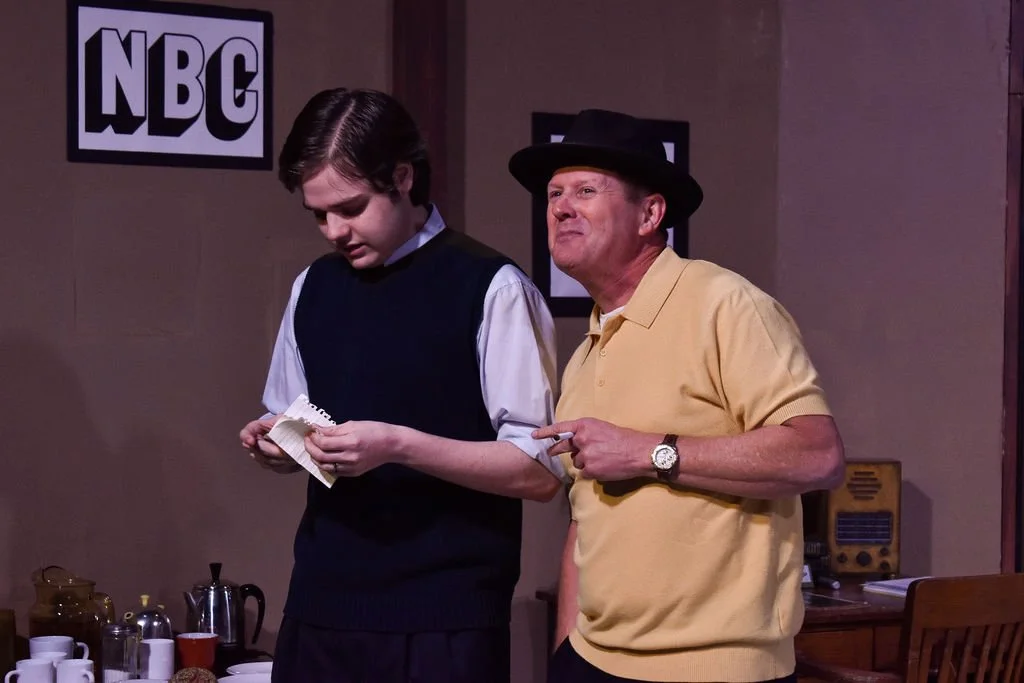
Allen Contemporary Theatre’s Laughter on the 23rd Floor is like so much of Neil Simon’s catalog — an autobiography wearing a play’s clothes. This time Simon is pulling from his years as a junior writer in Sid Caesar’s legendary writers room on Your Show of Shows. In place of Sid we get Max Prince (played by the incredible Alex Eding) who spends two acts fighting NBC execs who want his sharp, sophisticated comedy watered down into something Middle America can swallow.
And he’s losing. It’s 1953, and the threats aren’t just coming from the network suits. McCarthyism is in the air, and every writer in that room knows a single joke landing on the wrong desk could end their career. The pressure to be safe isn’t hypothetical.
Seventy-some years later we watched as Stephen Colbert’s show was cancelled days after he called out his network’s parent company for what looked a lot like a juicy political bribe. Jimmy Kimmel was pulled off the air over a joke that made the wrong people uncomfortable. The 23rd Floor isn’t a museum piece. It’s a rerun.
Each of the fictional characters here is (supposedly) based on a real comedy writer who passed through Sid’s writers room, among them Mel Brooks, Larry Gelbart, Sheldon Keller, Carl Reiner, Mel Tolkin, Woody Allen, that whole legendary crew. And like a lot of Simon’s plays, we get narration from a Simon stand-in. Here it’s young Lucas Brickman, played by Owen Wildoner as likeable and easy to root for.
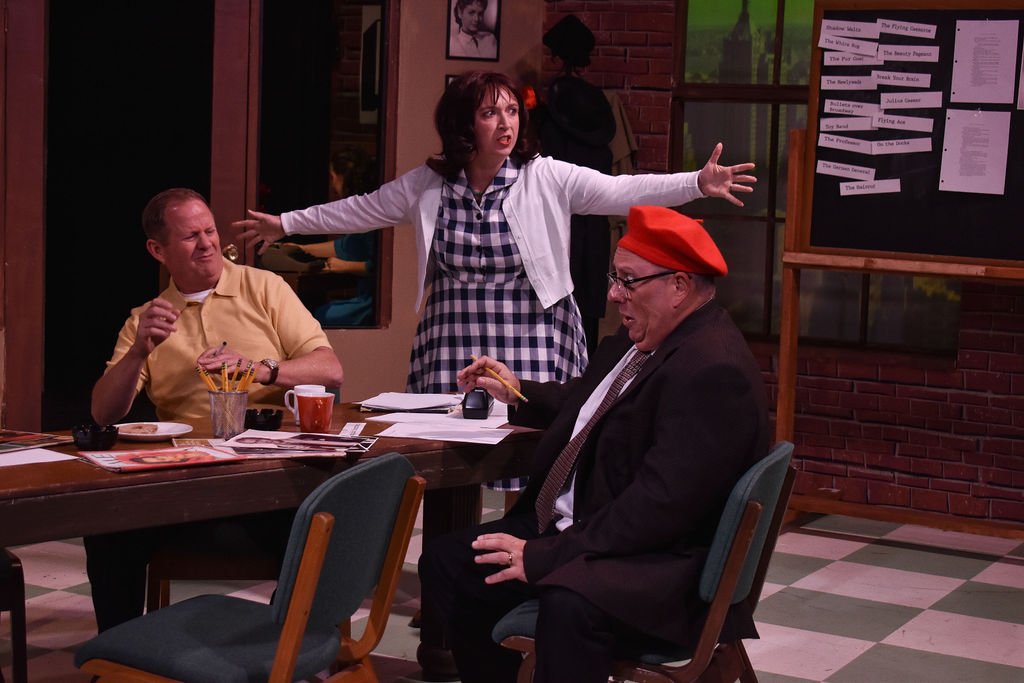
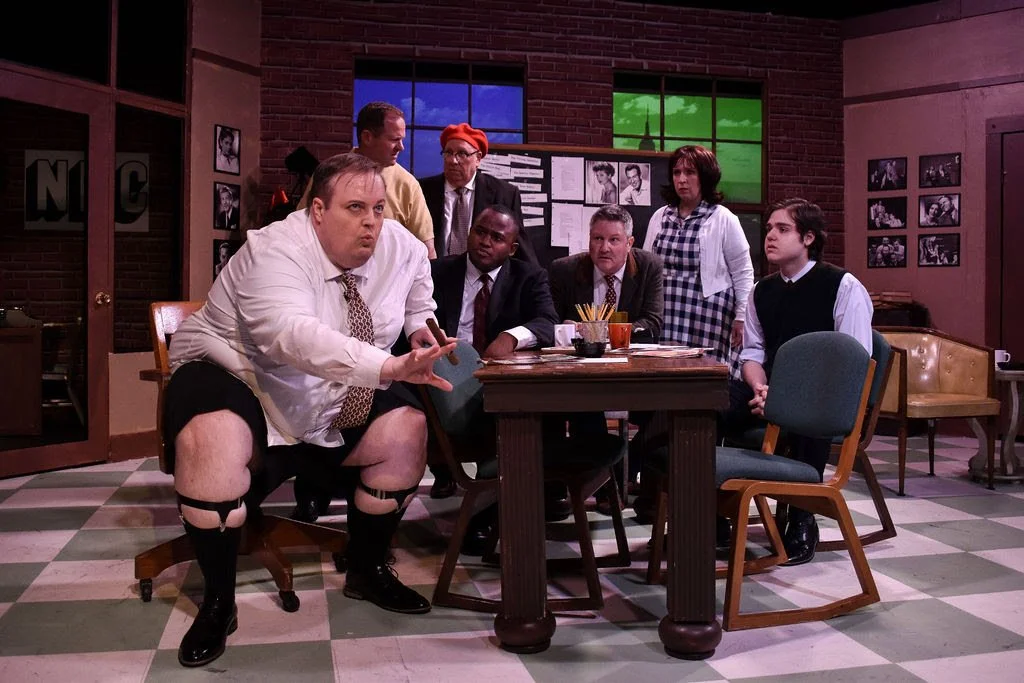
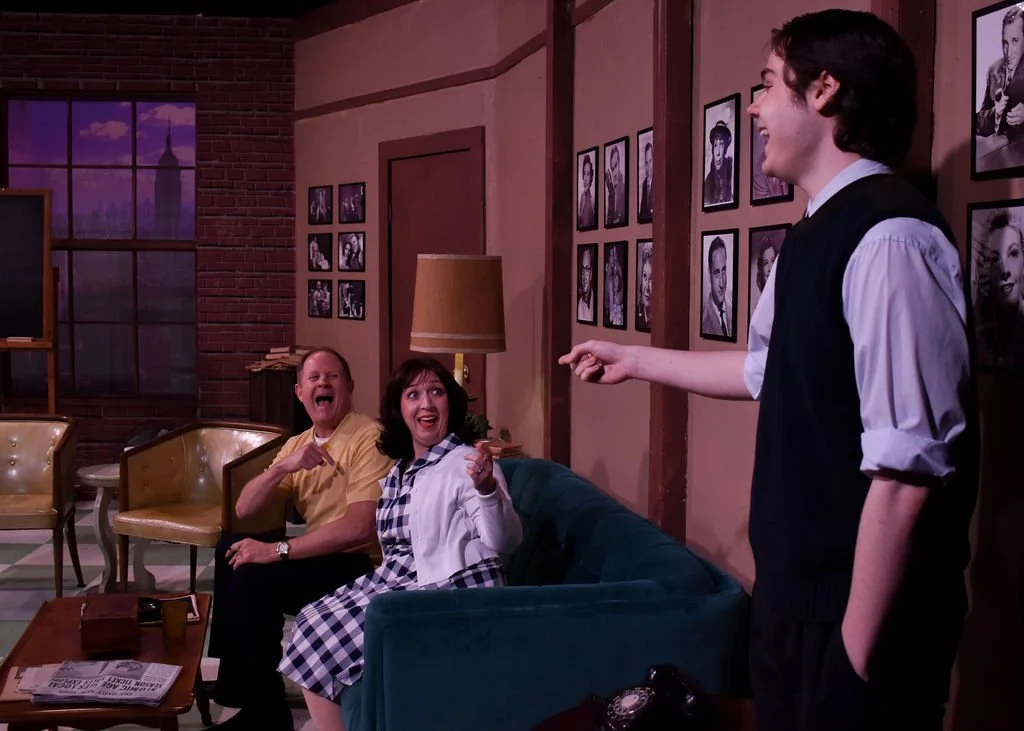
Can we talk about the set for a second? It matters more than set designs usually get credit for. Director Leigh Wyatt Moore co-designed it with Eddy Herring (who also plays Val, the Russian member of the writing team). Together they built a mid-century writers room with real texture and (more importantly) real room to move.
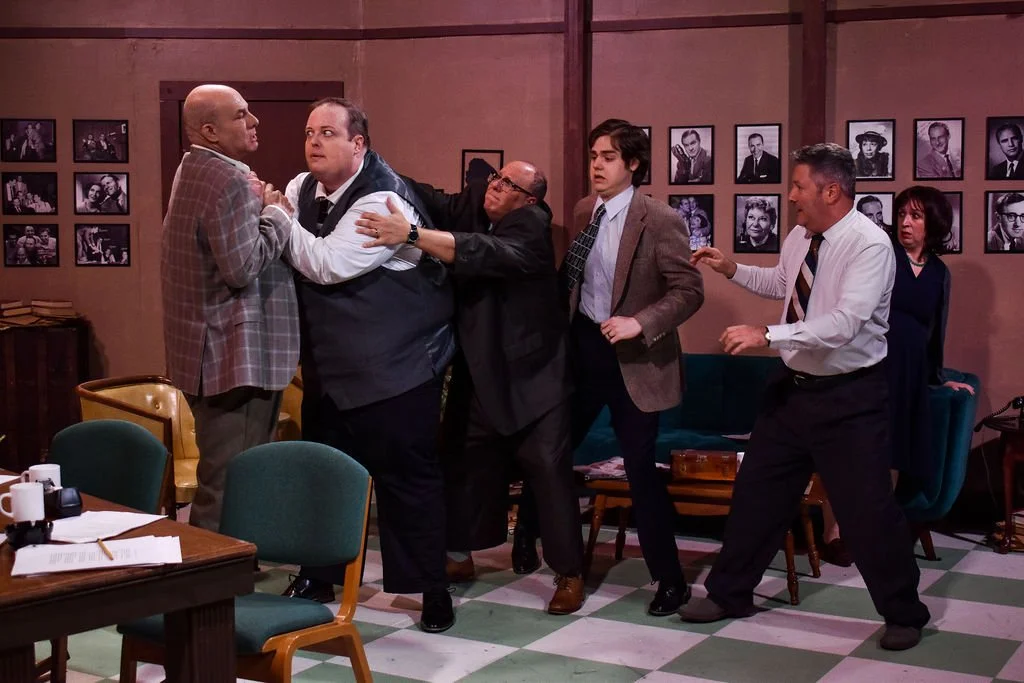
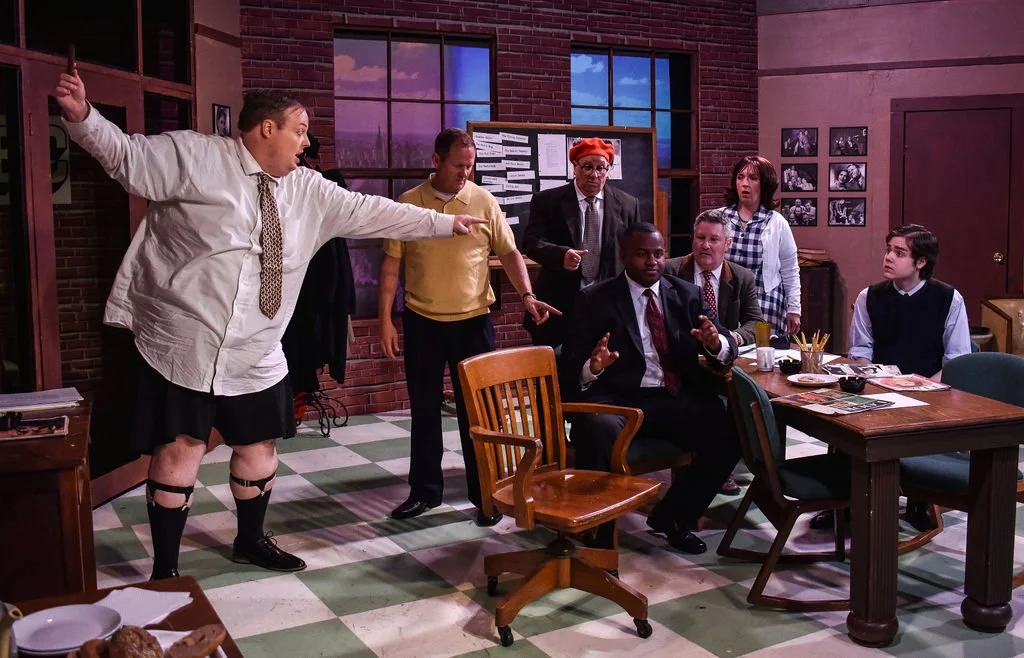
That matters, because this play gets a little rough. The layout gives the actors space to work instead of boxing them in against furniture, and you feel that decision pay off the second things turn physical. One wall displays rows of autographed photos of previous “guests” of the show in a sepia tone perfect for the time period. Reagan Wren’s scenic painting gives the room its texture and flavor without being cliche, and Sara Jones’ props fill it out with the kind of specificity that makes a space feel lived-in instead of staged.
And things do get physical. Eding’s Max Prince is a performance built for the whole stage, not just the punchlines. His physicality, the voice, the sheer range of expression he moves through in a single scene is the kind of performance that makes you understand why an entire room of talented writers would organize their anxieties around keeping one man happy.
Max’s battle with the network stopped being just a running gag somewhere along the way. Scotch and sleeplessness have replaced talent as his main line of defense, and Eding plays that well — a man visibly propped up by a cigar, liquor, and pure refusal to quit. The bill comes due in Act Two, when exhaustion finally overtakes Max and he nods off mid-sentence, standing up, in the middle of the writers room. Small moment. Says everything.
He’s burning the candle at both ends just to keep a third one — the show itself — from going out. Eding’s scenes with Kenneth Fulenwider (Ira Stone) prove the two have real comedic chemistry. Ira’s a hypochondriac comedy writer (based on Mel Brooks) whose co-workers dread his lateness and his daily rundown of ailments and impending doom. Their “fight” scene is where quality really shows: the pacing, the escalating physical levels between them, the turn from something that should read as chaos into one of the funniest sequences of the night.
Milt (Brian Hoffman) has a punchiness to his delivery that feels right for New York in this era. And he captures the character beautifully: overconfident in Act One, knocked off his pedestal a bit by Act Two. Hoffman finds the vulnerability underneath without ever losing his swagger.
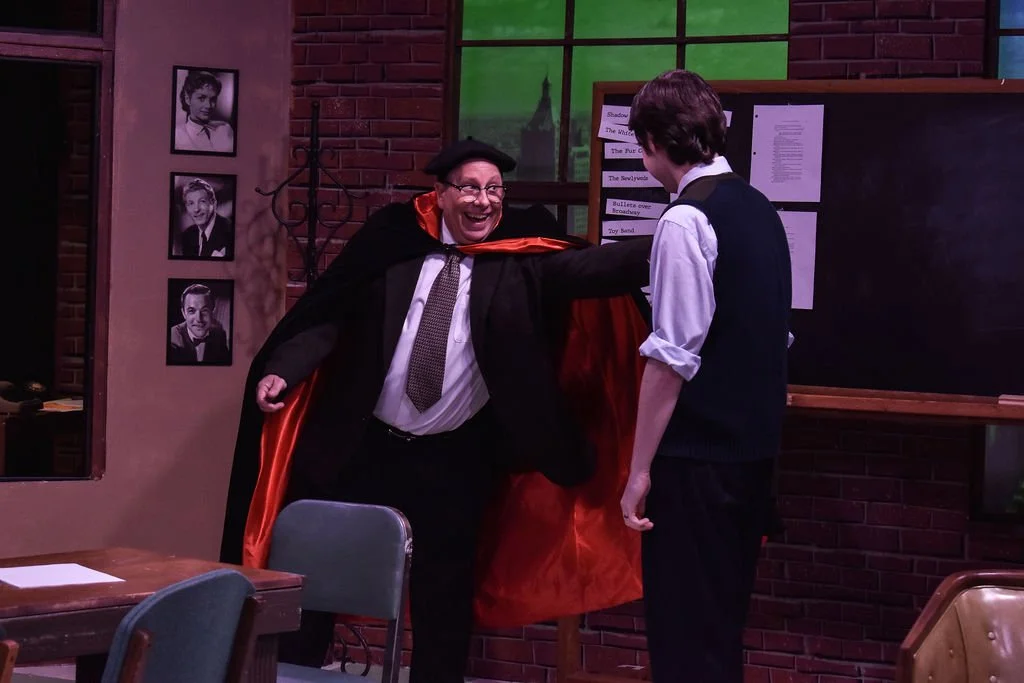
Kenny (Christian Black) — the character is inspired by Larry Gelbart — shines in his scene with Eding, where the two cold-read an upcoming Julius Caesar parody sketch for the show with the other writers. Black’s comic timing, and his ease with Shakespearean text, make it one of the standout bits of the evening.
Carol (Molly Bower) might’ve been the surprise of the night for me. I’ve seen Bower in other roles, but this one felt the most real and authentic. She’s playing the only woman in a room full of men decades before #MeToo gave that experience a name — and Bower plays the role (based partly on Selma Diamond) so well we come to see her as the only adult in a room full of overgrown “boys.”
This is such an ensemble piece I can’t skip over Herring (Val) and Joe Barr (Brian), the remaining writers who work so well with the rest of the cast to keep the whole thing balanced. Every actor finds a distinct, fully-realized version of their real-life counterpart, and the group works together seamlessly — which, in a play this dialogue-heavy, is no small thing.
Courtney Walsh’s costumes helped create distinctive characters, from Milt’s rotating parade of suits and accessories (a bullfighter cape and berets among them) to era-appropriate dresses for Carol and Helen (played by Hanna Mancuso); she’s Prince’s secretary, who is eager to prove she belongs in the room, not outside the door.
It was obvious from the audience’s constant laughter that director Moore does a great job of managing the rolling punchlines in Simon’s script. And she highlights something else with this production too: more than seventy years later, the controversies that kept the Show of Shows writers room in an uproar haven’t ended; struggles between media and government over free speech continue — and as always, some Laughter is a good thing to have around.
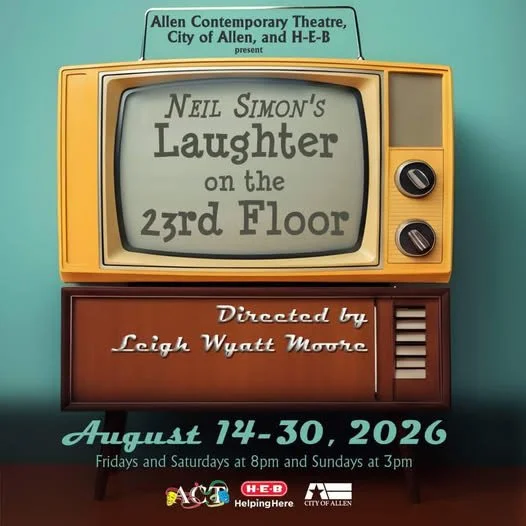
WHEN: August 14-30, 2026
WHERE: ACT, 1210 E. Main Street, Allen TX
WEB: https://allencontemporarytheatre.net/