‘Lungs’ @ The Elevator Project (Wyly Studio)
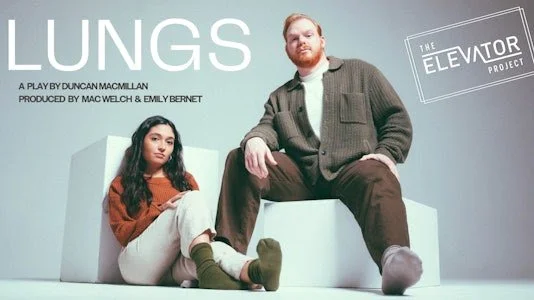
Show art courtesy of Mac Welch
—Jan Farrington
She (un-named but lettered with a “W”) talks at the high speed of a soccer ball coming for your head. He (called “M,” of course, like a million restroom doors you’ve passed through), gets in far fewer words—though we don’t sense he’s wanting to say much more…until he does.
They (a “T”?) are the young couple in playwright Duncan Macmillan’s Lungs, fretting and angsting and perhaps even grieving over their own futures, and the future of our messed-up world. And with fine pacing and emotional content from director Mac Welch, plus intricate, intensely physical staging from movement director and co-producer Emily Bernet—with a fine assist from intimacy coordinator Claire Fountain—what could have been a total talk-fest is transformed by a muscular visual interpretation of what they’re going through. The addition adds almost no playing time to the 90-minute piece—but makes a marvelous difference.
Actor Alyssa Carrasco plays W, and actor Thomas Magee is M. Lungs is part of this season’s The Elevator Project from ATTPAC, “presented by Mac Welch” in the sixth-floor Wyly Studio Theatre.
The two actors’ performances are intricate and engaging (kudos to Macmillan’s talent for creating a complex but natural flow of dialogue), though both get us burbling quietly in frustration at times. She is a non-stop (stream of consciousness) verbalizer—her spoken thoughts (and they are all spoken) smacking together, coming apart, zigging sideways. He listens intently, but his expression is alternately wondering (what is she talking about?) and intense (why can’t I understand this?). He admits fairly often to not “getting” her drift—and even as we see that he understands himself (and W) better over time, M never believes he’s the brains of the outfit.
No wonder he’s unsure. They’re trying to talk about becoming parents (in IKEA of all places, fortress of the nesting instinct). They’re struggling to sort through the impact this decision might have on a) their own lives, and b) the world they fear for. This is a high-risk conversation to have just now (as if you hadn’t noticed), much less to get through without raised voices and rethinking-our-relationship rants.
W and M step gingerly among the embedded traps of gender roles in parenting, who might go “a bit more full-time” to support a family—and most macro, their duty (as good, smart people) to populate the future, while keeping a grip on their ever-looming carbon footprint. “I could fly to New York and back every day for seven years and still not leave a carbon footprint as big as if I have a child,” she says.
To refer to Macmillan’s past work, they are trying to compare the “brilliant things” about their connected lives with the risks/benefits that “making another person” might have on everything, from our own happiness to the world’s shrinking resources. Small, large, personal, public, micro, macro—who among us has it all in perfect balance?
Carrasco and Magee have a paused-breath way of catching one another’s eyes, showing us this jittery couple’s intimate bond. As their thoughts and opinions snap that connection, the moment is given impact as M and W swing into a few seconds of motion—embracing, reaching, clutching hands quickly pulled apart, swirling to the ground, turning away fiercely—the variations seem almost endless, and add to our mindfulness of where they are with one another. These actions go by so swiftly that we absorb rather than analyze.
In rare moments of stillness, Magee seems strained and uncertain; Carrasco vibrates in place with her need to talk or move. Again, Macmillan’s script is excellent—but I wonder if it would come off as well without being continually activated by Bernet’s thought-provoking physicality.
Time passes at variable speeds: it lingers on single moments and discussions at times, but at others passes so quickly we might miss a major moment of loss or decision. The couple-ness breaks, forms again, thinks about what’s next. (Keep up, please.) “The way you need me,” he tells her, “that there’s nothing else on the planet for you at that moment…I love I can make you feel that way….And then sometimes…and I’m just being honest here okay but sometimes it looks like you’re about to hack off my limbs…and bury me in the woods.”
Are these two “meant to be together” or should they walk away to find separate futures? Something to talk about on the ride home, where for many, things will inevitably turn into some hard truths about “us.”
Lungs—both the title and some brief moments in the play suggest a message: we have them, let’s use them—breathing to calm down (or at least, to organize our anger), to find equilibrium, to gather thoughts. Breathing is a through-line in the play, a human connection to one another and the two people onstage.
And btw, I highly recommend finding a way to read Mac Welch’s director’s note in the program—one page of beautifully written and moving thought about the play and his/our universe. Theater makes community, not just on stage but in the seats. I felt that at Lungs—and felt lucky to be there.
WHEN: January 22-25 (with a sad number of bad-weather closures), 2025
WHERE: Wyly Studio space, 2400 Flora Street (Dallas Arts District)
WEB: attpac.org (The Elevator Project)