‘Malcolm X & Redd Foxx Washing Dishes at Jimmy’s Chicken Shack in Harlem’ @ Dallas Theater Center




Show photos by Andy Nguyen
—Jan Farrington
No missing the celebratory tone of the world premiere opening (last night at the Wyly Theatre) of Jonathan Norton’s Malcolm X & Redd Foxx Washing Dishes at Jimmy’s Chicken Shack in Harlem. The full house was buzzing with excitement, Dallas Theater Center executive director Kevin Moriarty put on his best tuxedo sneakers, and playwright Norton (the DTC’s interim artistic director) was nearly lost in a circle of pre-show hugs, kisses, and jazz-hands excitement.
Good thing the play was worth all the fuss.
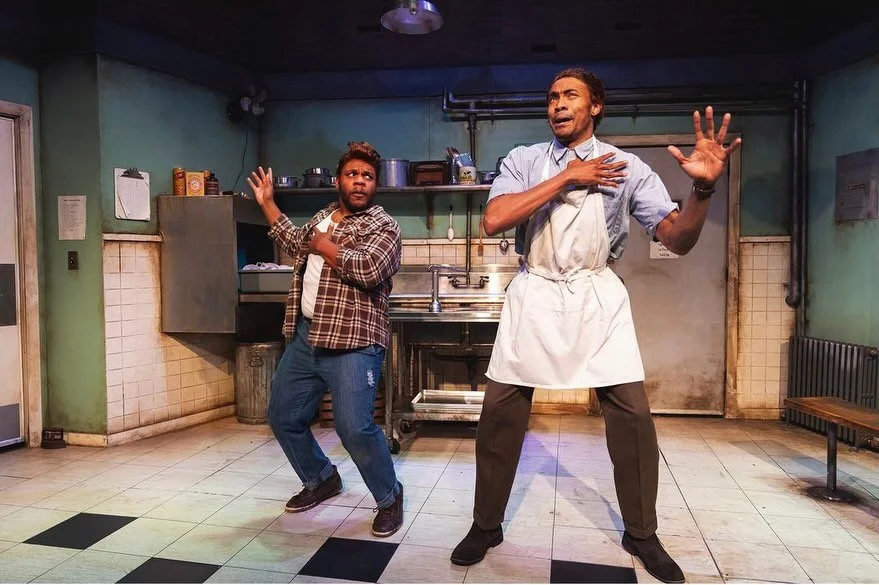
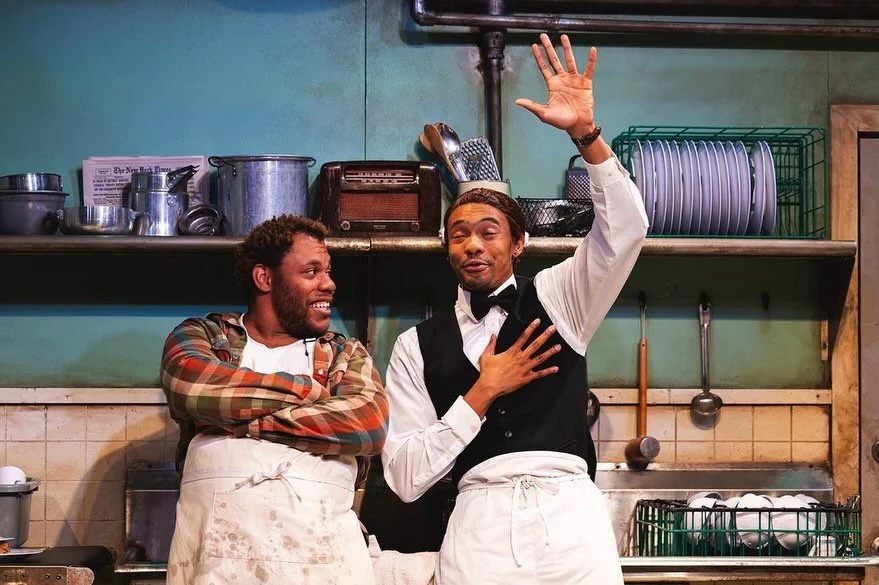
Malcolm & Redd, directed by Dexter J. Singleton and starring Edwin Green as “Little” (the doomed activist Malcolm X) and Trey Smith-Mills as “Foxy” (the future comedian/TV sit-com star Redd Foxx), moves forward in an electric rush of scenes and blackouts—full of laughs and anger and the details of a wartime ‘40s New York City that made life brutal for young Black arrivals. Hard enough to find work and stay out of trouble with white people and the police; almost impossible to dream of fame and fortune, or even making some small mark on their world.
But they did, and Norton creates them for us in vivid colors and tones, right at the edge of lives that might be, or might get lost in the Harlem shuffle. History isn’t “done” yet.
Green and Smith-Mills are very different physical presences onstage: Green’s Malcolm is nicknamed “Toothpick” for good reason: he’s light-footed and graceful, even in a sudden lunge with a switchblade (Malcolm hasn’t decided if he’s really done with his bad-ass earlier persona “Detroit Red”). Will the Temple he’s joined change his search for goodness and justice, or be just a first stop on his road to radical activism in the 1960s?
Smith-Hills is a solid guy with a great grin, and somehow both heavy-footed and agile onstage; he’s quick to reject Malcolm’s helpful suggestions (“You need to bathe”) on how he might make more of himself—but we can see the mugging, broad comedian peeking through. Foxx taps a kiss onto the photo of his brother, Fred D. Sanford Jr., whose baseball career was cut short (in no certain order) as he a) did time for burglary, and b) went off to fight WWII. And in the banter and insults traded between the two young men, we hear them laying out the signature pieces of Foxx’s future comedy and TV career, from “I’m coming, Elizabeth” to many more.
Jonathan Norton imagined the story and wrote the words—but these two actors are the nuts and the cherries on top of his double-scoop sundae.
They’ve both had tough lives from childhood on (Malcolm’s mother, trying to fight an insurance company for her dead husband’s benefits, is finally thrown in jail for it)—and though they’re not easily discouraged, both do better with the other one around to push and point toward something better. “Our people gonna come home one day,” says Redd to Malcolm as the air-raid blackout ends and the lights come on.
In a very real way, this dishwashing room is their safe space from the dangers they face in the city—riots, gangsters, and the assumption that wherever they go, they’re likely to be worked over by people who don’t want them around. Their traumas make them wary of the world (no surprise), but of one another, too—and the two actors show us that again and again, in sudden fights that start out of nowhere, and a reluctance to take risks in the world outside that one room.
Malcolm & Redd is a big, speculative story for Norton, who has gained a growing national reputation for stories and people closer to home: a kid whose family runs a neighborhood candy shop in the front room of their Pleasant Grove home (penny candy); some church ushers letting loose “out back” during a service (Delivered’t). But this isn’t the first time Norton’s taken a look at America’s civil rights history through the eyes of Black characters: his 2015 play Mississippi Goddamn focused on a fictional couple who live next-door to Medgar Evers and his family. Big history told in small details.
A true historical fact sparked Norton’s imagination. These two young men, Malcolm Little and John Sanford, really did work together in 1943 in the back room of Jimmy’s Chicken Shack at 148th Street and St. Nicholas Avenue (very close, if we can cram in another bit of theatre lore, to Alexander Hamilton’s still-there home on a nearby hill). At the front of this speakeasy, jazz greats Art Tatum, Earl Hines, Charlie Parker and others played (leaving the swinging door cracked open is a major quarrel between the two dishwashers).
Kimberly V. Powers’ set design—which I believe has traveled along with the “rolling world premieres” of the play at TheatreSquared (AR), City Theatre (PA), and Virginia Stage Co. (VA)— is crammed with the right stuff, from an old tube radio to taped-up posters with instructions for wartime air raid/blackout drills. If we didn’t already know the Shack was a legendary dive, the sewage that burbles up from the drain on the floor (way too close to my feet!) would have spelled things out: D-I-S-G-U-S-T-I-N-G working conditions.
Claudia Brownless’s costumes are varied and character-perfect, and peak with Foxy’s scarlet, feathered fedora and ice cream suit. And the just-right music choices by Howard Patterson (and others, I’m sure) are snippets of jazz piano and blues classics. When “My Momma Done Tol’ Me” started up (one of my deep-voiced Dad’s favorites, and actually titled “Blues in the Night”)—I had to take a breath.
As the Dallas Theater Center’s new artistic director Jaime Castañeda comes in this fall, Norton will continue as the company’s resident playwright and literary manager. He’s proved well able to juggle both admin and artistic jobs at one go—so we don’t see any reason why we shouldn’t expect play, after play…after play from this hometown hero soon. Right, Jonathan?
WHEN: May 8-June 7, 2026
WHERE: Wyly Studio Theatre, Flora Street, Dallas Arts District
WEB: dallastheatercenter.org