‘Next…but first, coffee’ @ Over the Bridge Productions (The Elevator Project)
—Teresa Marrero
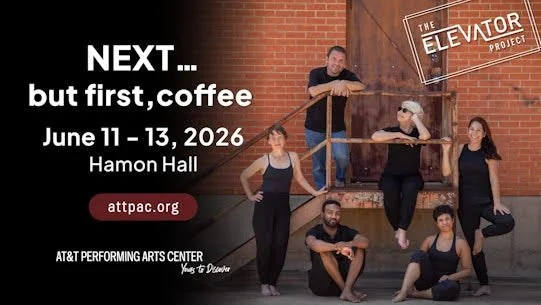
In NEXT... but first, coffee, director Lori Sundeen Soderbergh and a collaborative ensemble transform the collective experience of the COVID-19 pandemic into a poignant meditation on isolation, uncertainty, and resilience. The work was performed June 11-13 in the intimate black box space of Hamon Hall (inside the Winspear Opera House) as part of the Elevator Project, an initiative of the AT&T Performing Arts Center.
Created by Soderbergh in collaboration with ensemble members Willow DuBose, Abel Flores, Jr., Sorany Gutierrez, Jaiquan Laurencin, Jennifer Mabus, and Soderbergh herself—with Flores also contributing to the script, and Armando Monsivais on sound/music—the work revisits a period that remains both historically recent and emotionally unresolved. Through movement, gesture, spoken text, and sound, the piece invites audiences to remember not only what happened during the pandemic but also how it felt to live through it.
The title initially suggests a lighthearted pause before the next task. During months of lockdown, when time itself seemed suspended, small acts acquired outsized importance. Implicitly, a cup of coffee (among other daily rituals) became a marker of continuity, a way to distinguish one day from another amid social isolation and uncertainty. However, rather than telling a linear story based on the title, NEXT... but first, coffee builds meaning through a sequence of embodied images.
The performance begins with a short film entitled ‘connection’ by Soderbergh in collaboration with the Texas Land Conservatory and filmed in the Oak Cliff Nature Preserve, a green and wooded space suggesting that our primary connection is with mother Earth.
This is sharply followed by an ill-fated New Year’s celebration party in which each of the ensemble members shares their goals and aspirations for the coming year. Ironically, the audience knows what will become of them.
The character of the newscaster, Chip Germ, artfully performed by Abel Flores Jr., begins with optimism and an initial denial that the emerging cases of the deadly disease are nothing more than a passing phase. Flores’ interjections during the passing of time highlight the loss of confidence in media news, eventually deteriorating into a mood of blatant cynicism. I found both this trope and his performance brilliant.
The following scene featured Jennifer Mabus, an accomplished Argentine tango dancer well-known in the Dallas community, and dancer (though not a tango dancer per se) Jaiquan Laurencin. Together, Laurencin and Mabus create the true sense of connection, the chest to chest closeness, required of authentic Argentine tango. Towards the end, this connection necessarily suffers from the distancing requirements of the pandemic—brilliantly conveyed by employing a fold-out measuring tape the dancers use to maintain their fragile connection. As a tango dancer myself I related to this segment, which reminded me of the loss of personal connection with my tango community for an entire year. It was painful.
Another poignant and hilarious segment featured the ensemble in a now-emblematic toilet paper scarcity scene. Who doesn’t remember the hoarding craze that hit grocery stores nationwide over the diminishing availability of T.P.? The world pushed us to the limit of human ridiculousness as we faced our trite (but oh so important) need for paper pushed to the limit the ridiculousness of human nature when faced with something as trite (but oh so important) as having enough paper to wipe our bums.
In a lush demonstration of wastefulness, the dancers unroll the paper all over the performance space, engaging audience members to hold the rolls. Soderbergh wraps up the scene dressed in All-American kitsch, offering a tray with red and blue cups of Kool Aid. “They are both the same,” she says, a possible allusion to our current system of dual political parties. While some accept the beverage, at the end Mabus throws the remaining liquid on the tray, visibly wetting her face.
Mabus follows with a mourning modern dance solo built around absence, represented by an empty chair. In the talk back, she shared that part of this mourning is for the death of her father (although his passing was not Covid-related). More chairs enter the scene as a dance movement element, each one steered by a performer.
Willow DuBose also performs a powerful solo dance playing within and without the confines of four 4-foot-long sticks laid on the floor. She accepts and dismantles this square formation.
Then comes a longer scene, with Gutierrez entering happily upon that which the audience can perceive as a beach, with percussive music by Monsivais. She carelessly throws a plastic bottle into the water, only to return wearing numerous empty plastic bottles strung together to form a skirt. Another string of trash, this one made of plastic bags, is added and worn by Gutierrez, culminating in a gallon water jug suffocatingly placed over her head. She is literally covered with plastic trash as ensemble members, dressed as revelers, join the action, taking innumerable ‘selfies” (some with the audience), and ignoring the tragic situation in front of them.
The last segment, ironically entitled ‘Paradise,’ was a short film by Soderbergh in collaboration with Olivia Johnson and drummer Kena Sosa. In a wasteland of a location featuring auto wreckage and arid, unfertile dirt, the piece is a forewarning that bookends the first short film: the deterioration of our environment.
The ensemble's collective presence is the production's greatest strength. Each performer contributes a distinct physical vocabulary while remaining attuned to the larger group dynamic. Together they evoke the emotional contradictions of the pandemic era: boredom and anxiety, solitude and solidarity, fear and hope. Particularly effective are moments when repetitive gestures accumulate into choreographic patterns. What begins as mundane activity gradually reveals itself as an expression of emotional endurance.
The sound design and music by Armando Monsivais deepen the work's atmosphere of uncertainty and reflection. Rhythmic passages propel the action forward while quieter moments allow audiences to sit with memories that many would prefer to forget. The sonic landscape underscores the performance's central concern: how individuals and communities adapt when familiar structures disappear.
What distinguishes NEXT... but first, coffee from many artistic responses to the pandemic is its refusal of sentimentality. Rather than presenting a straightforward narrative of loss or recovery, the piece captures the ambiguity of a period that altered social relationships, perceptions of time, and understandings of community. Its collaborative creation process mirrors the very forms of mutual support that helped many people endure those difficult years.
In the end, the work serves as both remembrance and reflection, and asks us to consider what traces of that experience remain with us still.
Creative team not previously mentioned: Lighting director Christopher Ham, Sound director, Jonathan Thomas, Techincal suppprt, Laurend Flechtinger and Jordan Pipkins. Additional music by Michael Wall. Dance in ‘connection’ film by Claudia Orcasitas and Adam Rich. Tango music by Astor Piazzola.
Dr. Teresa Marrero has developed her craft as a dance and theatre performance critic since 2013. She publishes her work in various sites nationally and internationally in English and in Spanish. Her 2013 to 2019 reviews are digitized within the Portal of Texas History at the University of North Texas. https://texashistory.unt.edu/search/?q=Dr.+Teresa+Marrero&t=fulltext&sort= Search Dr. Teresa Marrero. Connect with her at dr.teresa.marrero@gmail.com