‘Potestad’ @ Teatro Dallas (22nd Int’l Theater Festival)
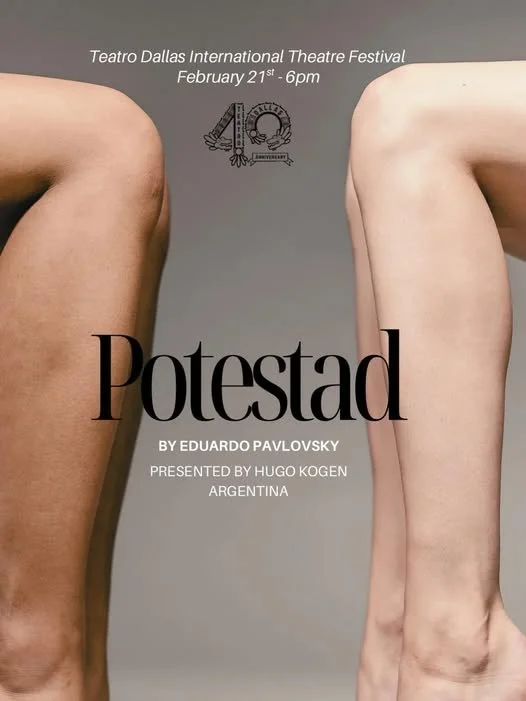
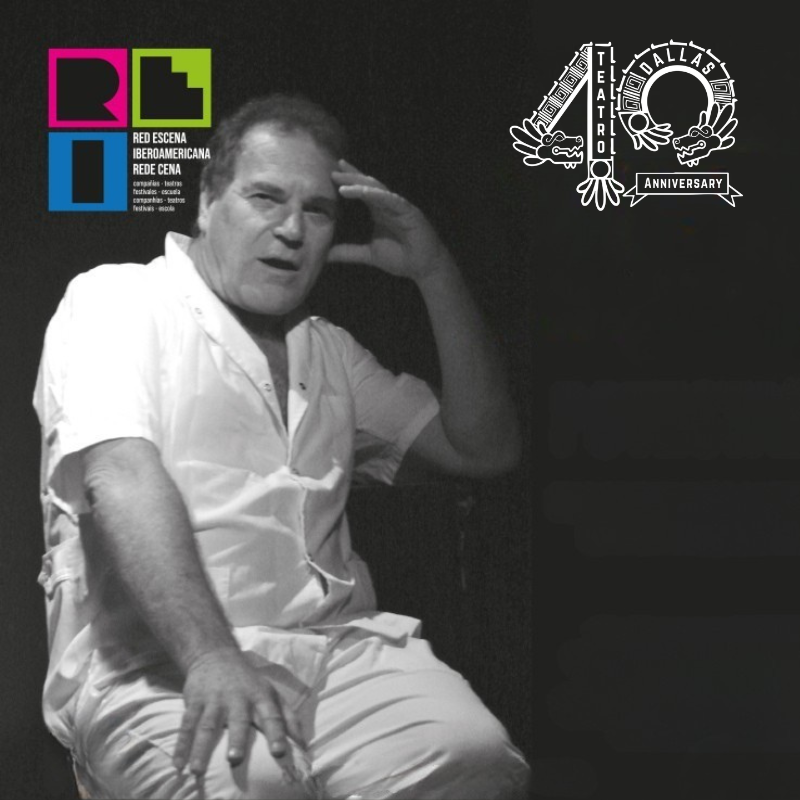
Show poster courtesy of Teatro Dallas; Argentine actor Hugo Kogan
—Teresa Marrero
[Ver la versión en español al final.]
As the closing offering of Teatro Dallas’s 22nd International Theatre Festival on February 21, Potestad delivers a searing meditation on memory, complicity, and the psychic wreckage left by Argentina’s military dictatorship. Written in 1985 by Argentine psychoanalyst and playwright Eduardo Pavlovsky in the immediate aftermath of the Dirty War (1974–1983), a brutal and blood military coup, the play probes one of the regime’s most disturbing legacies: the systematic appropriation of children from the families of the disappeared. In Teatro Dallas’ stark staging in the Latino Cultural Center’s mainstage theatre, Argentine actor Hugo Kogan commands the space in a riveting one-man performance that exposes the fractured interior world of a man entangled in state violence, his complicity with it, and its consequences. The result is less a historical reconstruction than a claustrophobic psychological excavation that refuses the audience the comfort of distance. The play is performed entirely in Spanish with no supertitles.
About the title
Potestad is a deceptively simple title that reveals the play’s central irony. In Spanish, the term denotes authority or legal paternal rights (patria potestad), framing the protagonist’s self-image as a loving father within a discourse of sanctioned control. Eduardo Pavlovsky uses the word to expose how the logic of Argentina’s dictatorship infiltrated the private sphere, turning care into a structure of possession. The character’s insistence on his moral legitimacy, ie. his love for Adriana, his ´daughter,´ becomes a psychological defense that masks the violence underpinning his family narrative. Ultimately, the title indicts the dangerous ease with which domination can be reframed as love.
Brief Plot Synopsis and Staging
Potestad unfolds as an intimate monologue delivered by a seemingly devoted typical Argentinean, 63- year old father (Kogan), who recounts fragments of domestic life with his wife Ana María and his young daughter, Adriana. There are three chairs draped in white; the one on the stage right represents Ana Maria, the middle one Adriana, and the far left, the Himself, a macho guy who some believe is repressing his homosexuality. He speaks of his relationship with his wife years ago and how that has significantly cooled off, seemingly after an impotent marriage leaves them childless. He addresses the audience, breaking the fourth wall, narrating the invisible movements of the absent wife and daughter. The wife lives with a headset on studying English; Adriana sits studying History. Isolated from each other, everything the audience understands is filtered through Him.
As the narrative develops, the audience comes to understand that this man is not the child’s biological parent but one of the many civilians who appropriated children from Argentina’s disappeared. As the medical doctor called by the dictatorial regime to declare the young mother dead, he accidentally finds a baby left behind. In his eyes, it is a ‘gift from God” for his childless family. Until one day there is a knock on the door, and two men take the child (now a young girl) away.
Who are these men?
We soon learn it is now time for Him to pay the price. Due to the ongoing effort to locate and restore these children by the Madres and later Abuelas de Plaza de Mayo, founded in 1977 during Argentina’s military dictatorship, the Madres/Abuelas launched a systematic campaign to identify children who had been illegally appropriated after their parents were disappeared. Their work combined legal advocacy, archival research, and the pioneering use of genetic testing to establish biological identity through the National Genetic Data Bank. These two men are part of the legal reappropriation of these children by their biological families.
Psychoanalytic Framing
Written by Argentine psychoanalyst and playwright Eduardo Pavlovsky (who played the lead role for years), Potestad operates as a theatrical case study in repression and psychic splitting. The protagonist’s language loops compulsively, circling the traumatic kernel he cannot consciously confront. His affectionate paternal discourse functions as a defensive screen, a carefully maintained narrative that both reveals and conceals the violence underwriting his family life. The play’s power lies less in external action than in the slow, disorienting exposure of denial, self-justification, and emotional distortion that sustain the character’s fragile sense of innocence.
Pavlovsky structures the monologue around what might be understood as a disturbed experience of duration: time does not progress so much as thicken and stall. Memory surfaces in fragments, corrections, and sudden tonal shifts, producing a subjectivity that feels simultaneously intimate and profoundly unreliable. The character’s insistence on normalcy based on his identity as a loving father becomes itself the symptom of his illness.
In performance, Hugo Kogan leans into this instability, allowing moments of warmth to curdle almost imperceptibly into unease. The result is not a portrait of monstrous otherness but something far more unsettling: a study of how bureaucratic violence, and emotional need can coexist within the same psychic structure. Pavlovsky’s dramaturgy thus refuses catharsis, instead leaving spectators suspended inside the protagonist’s unresolved and ethically troubling interior world, leaving him utterly alone.
In the end…
As presented by Teatro Dallas, Potestad lands with quiet but devastating force. The production trusts the text’s psychological rigor and Kogan’s disciplined, powerful performance, resisting sensationalism in favor of a slow, cumulative dread that lingers well beyond the final moments. For Dallas audiences, the piece arrives not as distant history but as a sobering reminder of how state violence has embedded itself in private lives and everyday language during the current time of ICE raids and illegal deportation of children and families.
In its austere precision and moral unease, this closing festival offering affirms the enduring urgency of Pavlovsky’s work, and leaves spectators with the uncomfortable recognition that the most haunting performances are those that refuse to let us look away.
Versión en español
Como propuesta de clausura del 22.º Festival Internacional de Teatro de Teatro Dallas, presentado el sábado 21 de febrero de 2026, Potestad ofrece una incisiva meditación sobre la memoria, la complicidad y los estragos psíquicos dejados por la dictadura militar argentina. Escrita en 1985 por el psicoanalista y dramaturgo argentino Eduardo Pavlovsky inmediatamente después de la Guerra Sucia (1974–1983), la obra examina uno de los legados más perturbadores del régimen: la apropiación sistemática de niños de familias de desaparecidos.
En la sobria puesta de Teatro Dallas en el Mainstage del Latino Cultural Center, el actor argentino Hugo Kogan sostiene el escenario en un potente unipersonal que expone el mundo interior fracturado de un hombre implicado en la violencia estatal, su participación en ella, y las consecuencias. El resultado es menos una reconstrucción histórica que una excavación psicológica claustrofóbica que niega al público la comodidad de la distancia. La obra se presenta íntegramente en español y sin sobretítulos.
Sobre el título
Potestad es un título engañosamente simple que condensa la ironía central de la obra. En español, el término alude a la autoridad o a los derechos legales paternos (patria potestad), enmarcando la autoimagen del protagonista como padre amoroso dentro de un discurso de control legitimado. Pavlovsky explora esta ambigüedad para revelar cómo la lógica autoritaria del Estado penetró la esfera íntima. La insistencia del personaje en su legitimidad moral, particularmente en su amor por Adriana, su supuesta hija, funciona como una defensa psíquica que encubre la violencia que sostiene su relato familiar. Así, el título denuncia la peligrosa facilidad con que la dominación puede reformularse como afecto.
Sinopsis y puesta en escena
La obra se desarrolla como un monólogo íntimo pronunciado por un aparentemente devoto padre argentino de 63 años (Kogan), quien reconstruye fragmentos de su vida doméstica con su esposa, Ana María, y su hija, Adriana. La escenografía es mínima: tres sillas cubiertas de blanco representan a los personajes ausentes. Desde la derecha escénica, Ana María; al centro, Adriana; a la izquierda, Él. El protagonista se dirige directamente al público, rompiendo la cuarta pared mientras describe los movimientos invisibles de su familia: la esposa estudia inglés con audífonos; la hija, historia. Todo lo que el público percibe está mediado por su perspectiva.
A medida que avanza el relato, emergen fisuras inquietantes. El público descubre gradualmente que este hombre no es el padre biológico de la nena, sino uno de los civiles que se apropiaron de hijos de desaparecidos durante la dictadura. Médico de profesión, fue convocado por el régimen para certificar la muerte de una joven madre. Allí encuentra a la bebé abandonada e interpreta el hecho a través de una racionalización escalofriante, como un “regalo de Dios” para su matrimonio sin hijos. La ilusión doméstica se quiebra cuando, años después, dos hombres llaman a la puerta y se llevan a la joven.
¿Quiénes son?
Pronto entendemos que se trata del proceso histórico de restitución impulsado por las Madres y Abuelas de Plaza de Mayo, cuya labor desde 1977 ha permitido identificar y devolver a muchos de estos niños a sus familias biológicas mediante acciones legales, investigación archivística y el uso pionero de pruebas genéticas. La irrupción de estos hombres marca el momento en que la ficción privada del protagonista colapsa frente al proceso jurídico de la restitución.
Marco psicoanalítico
No sorprende que la Potestad de Pavlovsky, quien además interpretó el papel durante años, funcione como un estudio teatral sobre la represión y la escisión psíquica. El lenguaje del protagonista se repite de forma compulsiva, rodeando el núcleo traumático que no puede confrontar. Su discurso paternal afectuoso opera como pantalla defensiva: una narrativa cuidadosamente sostenida que simultáneamente revela y oculta la violencia que estructura su vida familiar. La dramaturgia se organiza en torno a una experiencia alterada del tiempo. Más que avanzar linealmente, la temporalidad se expresa y se estanca; la memoria surge en fragmentos, correcciones y desplazamientos tonales que producen una subjetividad íntima pero profundamente poco fiable. La insistencia del personaje en la normalidad, en su identidad como buen padre, se convierte, precisamente, en el síntoma emfermiso.
En escena, Kogan habita esta inestabilidad con notable precisión. Momentos de aparente ternura se enturbian casi imperceptiblemente, generando una incomodidad creciente. Lo perturbador no es la monstruosidad explícita, sino la inquietante convivencia entre afecto ordinario, violencia burocrática y necesidad emocional. La puesta rehúsa cualquier catarsis fácil y mantiene al espectador atrapado dentro de la lógica defensiva del protagonista y su derrumbe psicológico.
Al final…
Tal como la presenta Teatro Dallas, Potestad impacta con una fuerza silenciosa pero devastadora. La producción confía en el rigor psicológico del texto y en la actuación disciplinada de Kogan, evitando el sensacionalismo en favor de una inquietud acumulativa que perdura más allá del cierre. Para el público de Dallas, la obra no llega como historia lejana, sino como un recordatorio sobrio de cómo la violencia estatal se infiltra en la vida privada y en el lenguaje cotidiano en estos tiempos de redadas del ICE y deportaciones ilegales de niños y familias. Con su precisión austera y su incomodidad moral, esta presentación de clausura del festival reafirma la vigencia del trabajo de Pavlovsky y deja a los espectadores con la perturbadora conciencia de que las actuaciones más inquietantes son aquellas que nos obligan a no apartar la mirada.
Teresa Marrero es Profesora de Teatro y Cultura Latinoamericana y Latine en el Departamento de World Languages, Literatures and Cultures de la University of North Texas. Teresa.Marrero@unt.edu