‘Spectrum’ @ Teatro Dallas (Int’l Theater Festival)
Photos courtesy of Teatro Dallas
—Teresa Marrero
[NOTE: The review is also presented in Spanish below.]
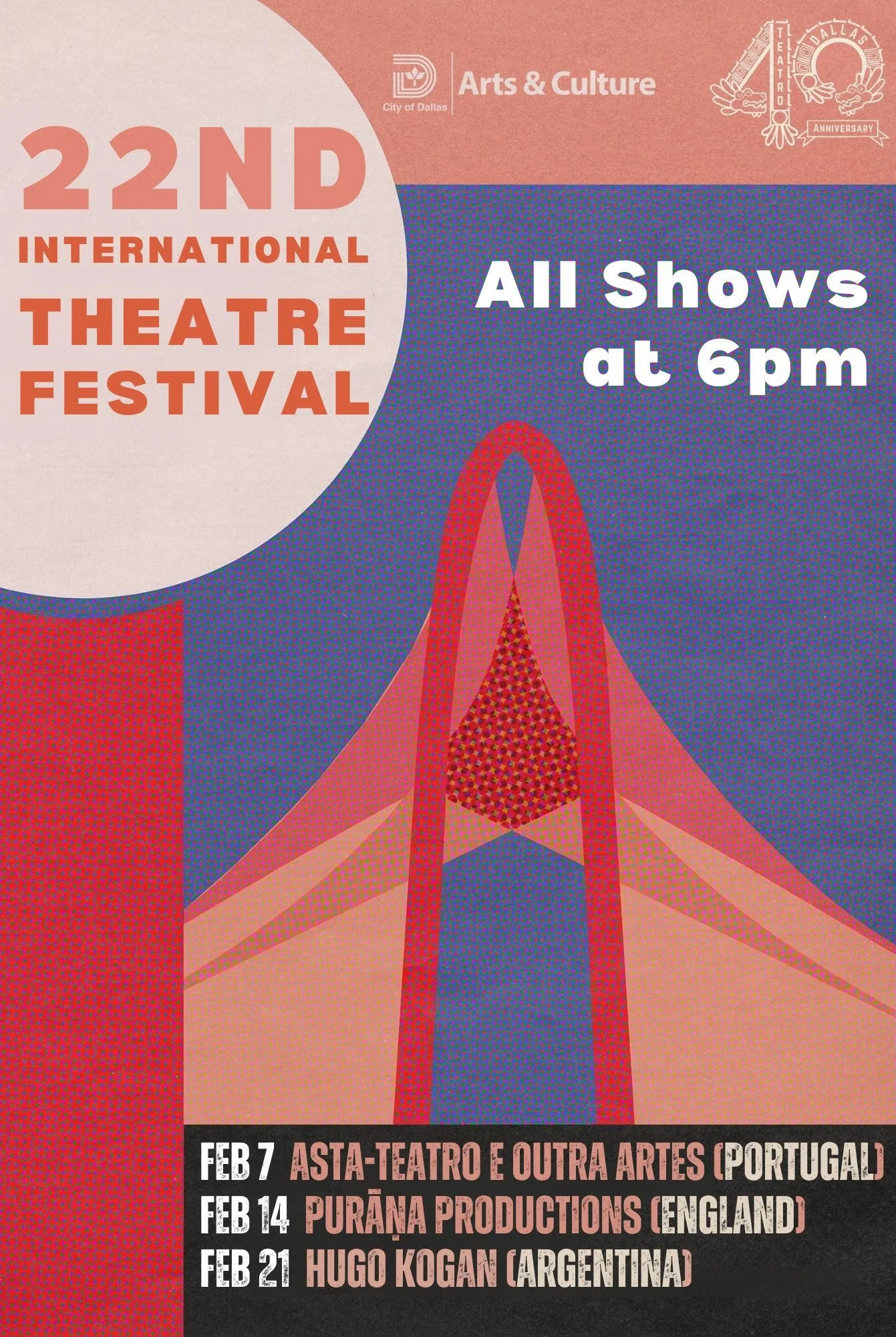
Teatro Dallas celebrates its 40th anniversary season with its legendary International Theater Festival, currently in its 22nd year. Under the guidance of TD’s board of directors and its current artistic producer Mac Welch, we are seeing a broadening of aesthetic possibilities, united by Teatro Dallas´ penchant to thrill and challenge audiences.
This year´s festival began with SPECTRUM (Portugal) presented by ASTA (Teatro e Outra Artes) with a one-night-only on February 7. Next up are STRATEGIC LOVE PLAY (England) presented by Purāna Production on February 14, and POTESTAD (Argentina) presented by Hugo Kogan on February 21. Again, one night only for each (link below).
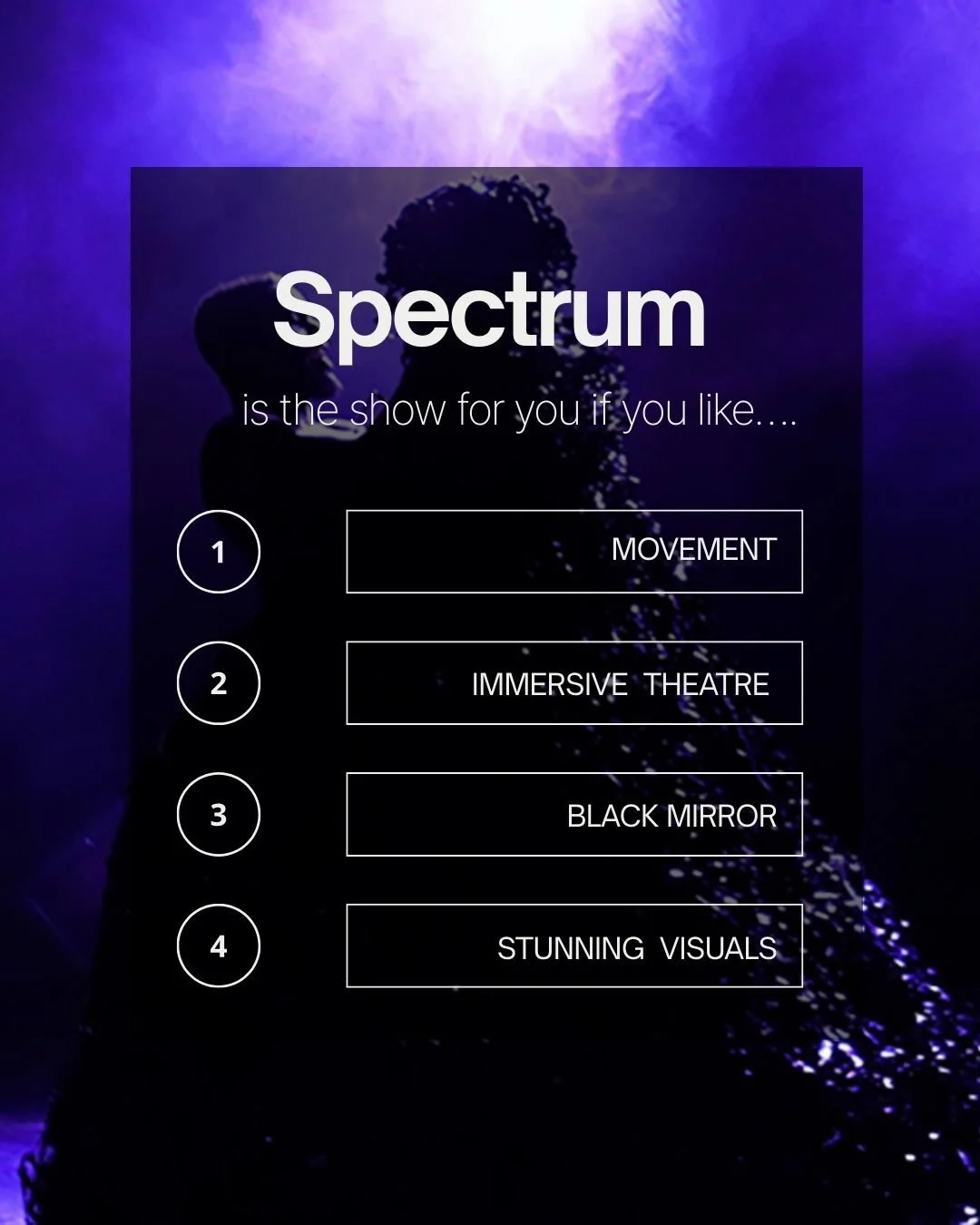
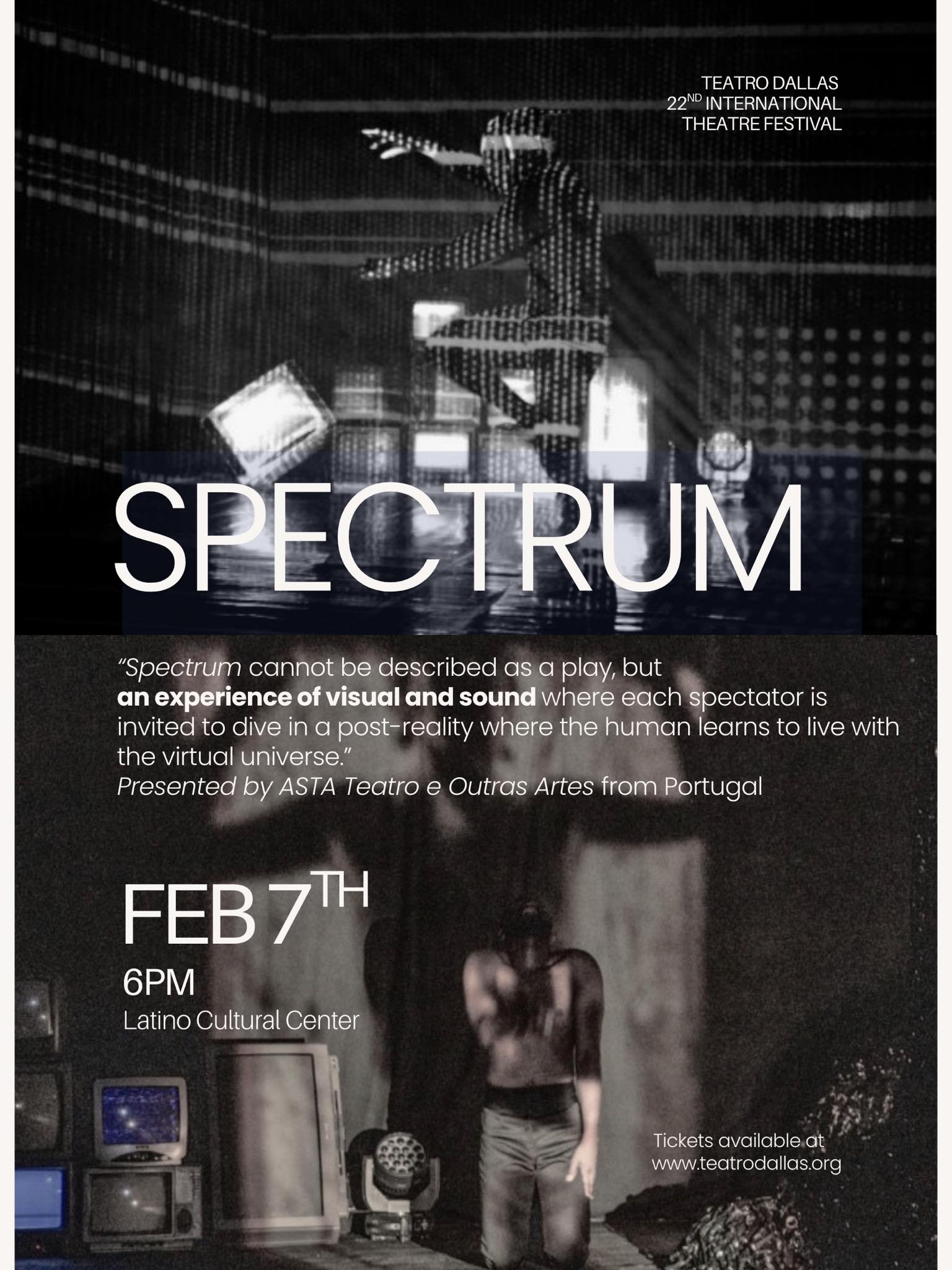
And what a beginning! SPECTRUM’s performance cannot be read as traditional theater or dance. Not a single word was spoken. It is, however, an immersion of the senses into an allegorical world of light and shadows, of electronic presence, and of a single human being mediating its existence within it, as we are invited to witness it on the Latino Cultural Center’s mainstage.
Philosophical underpinnings: the Platonic Ideal
Prior to perception, there is form, alluding to Plato´s model that the physical world is a dim reflection of our visible, material reality. This is no ordinary performance piece, and in my notes, I wrote ¨this is a philosophical treatise for our technological times.¨
Before SPECTRUM announces itself as performance, it makes itself perceptible. Darkness and sound open the moment. Sound arrives, a low, insistent vibration that registers in the body before it resolves into rhythm. Darkness parallels as modulation rather than illumination, interrupting the field of vision with pulses and flickers that recalibrate attention upon computer monitors placed on the floor, slightly off center.
When a single performer (Edmilson Gomes) moves into the audience´s visual field, he does not enter it but rather emerges from it. He (although at this point the gender is not identifiable) does so not as a character entering a scene, but an amorphous body already in relation to the darkness that envelops everything but the static sights and vibrations emerging from the computer screens. The body necessarily negotiates within an environment that precedes him. Movement appears responsive, shaped by sonic pressure and visual constraint, unfolding in the same perceptual field as the spectator.
There is no narrative threshold to cross. Instead, watching SPECTRUM becomes an exercise in presence, an invitation to remain in each moment with sensation—sound, light, and movement that co-exist and accumulate in lived time/space.
Perceptual Experience Over Narrative and Humanity’s Futuristic Place
What does the performance ask my body to do before it asks my mind to interpret?
In my case, I surrendered, even though I experienced physical discomfort at times. While I could deal with the darkness and the jarring, incoherent images being emitted from the monitors, at one point I needed to cover my ears. Not because of the loudness but because of the vibrational emissions. I felt a need to protect myself. Here, technology functions as presence rather than tool, co-equal to performers, machines, images, spectators.
This is how things appear and act. The program proposes ¨a reflection on the place of humanity in a future world where ´homo sapiens´ gives way to cybernetic sapiens.” Trapped within a surreal world, I could see hope at the end, when the dance takes the performer to interact with an amorphous larger-than-life figure to whom he makes love, despite difference and separation. This is not a “happy ending.” It is the resolution of a moment in time to be repeated again and again.
Meaning and the Director´s Vision
One can venture to ascribe meaning at the end, in conversation with other audience members and with the director Rui Pires, who shared insights. As it happens, SPECTRUM is the practical part of his doctoral dissertation in Media Arts at the Teatro Universitário da Beira Interior, in the city of Covilhã, Portugal. As such, this project required extensive financing (not forthcoming from limited university budgets), and so he and partners created the nonprofit association of ASTA, which has functioned since 2019.
As we spoke after the show, Pires shared his vision for this piece, one based on Plato´s Cave allegory of forms, a notion that the audience walked into the theater knowing, and one which TD’s Cora Cardona explained right after the performance. I did not begin my review with this information because, in my opinion, the experience supersedes meaning. Even if we were not aware of Plato’s Cave allegory, this piece makes a statement on its own.
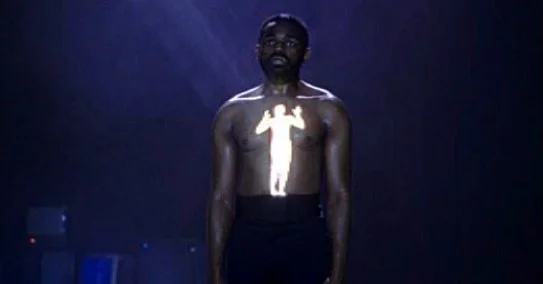
When I asked Pires about the creative process, he explained that this was a collaboration between all the contributors, including that of the dancer/performer/choreographer Edmilson Gomes. A statuesque figure of a man, his unceasing movements became increasingly uncategorizable, flowing constantly. Personally, I loved his wing-like arm movements, which reminded me of Icarus’ attempt to fly towards that unreachable goal. And the projection upon his chest of a tiny image of him moving, followed by multiple, larger than life images was an imaginative and brilliant concept.
The performance piece ended in the same ambiguous indeterminacy as it began, leaving the audience in silence and wondering if it had indeed ended. Then the thunderous applause followed, our humanity expressing itself in joy and appreciation.
Contributors to SPECTRUM include but are not limited to: Assistant director João Gomes; Video, Henrique Vilão and Tiago Damas; Music, Henrique Vilão; Images and Design, Tiago Damas; Light Design, Pedro Fonseca/Colectivo AC; Scenic design, Rui Pires; Props, Sergio Novo; and Executive producer, Carmo Teixeira.
WHEN: February 7-21, 2026
WHERE: Latino Cultural Center, 2600 Live Oak Street, Dallas
WEB: teatrodallas.org
Teresa Marrero is Professor of Latin American and Latinx Theater and Culture in the Department of World Languages Literatures and Cultures at the University of North Texas. Teresa.Marrero@unt.edu
——————————————
Con SPECTRUM, un tratado filosófico sensorial para nuestros tiempos tecnológicos Teatro Dallas celebra su 40ª temporada con su ya legendario Festival Internacional de Teatro, que este año cumple su 22ª edición. Bajo la dirección de su junta directiva y de su actual productor artístico, Mac Welch, observamos una ampliación de las posibilidades estéticas, unidas por la inclinación de Teatro Dallas a conmover y desafiar al público. El festival de este año comienza con SPECTRUM (Portugal), presentado por ASTA – Teatro e Outras Artes el 7 de febrero. Próximamente el 14 de febrero, está STRATEGIC LOVE PLAY (Inglaterra) presentado por Purāna Production, y luego POTESTAD (Argentina), presentado por Hugo Kogan el 21 de febrero. Todas en función única. https://teatrodallas.org/productions/22itf/
¡Y qué comienzo! Es imposible leer esta propuesta como teatro o danza tradicionales. No se pronuncia una sola palabra. Se trata, sin embargo, de una inmersión sensorial dentro de un mundo alegórico de luces y sombras, de presencia electrónica y de un solitario ser humano que mediatiza su existencia dentro de ese entorno, mientras somos invitados a presenciarlo en el escenario principal del Latino Cultural Center.
Fundamentos filosóficos: el Ideal platónico
Antes de la percepción, existe la forma, en alusión a un modelo platónico según el cual el mundo físico es una tenue proyección de otra realidad más profunda. Esta no es una pieza escénica convencional y, en mis apuntes escribí: “esto es un tratado filosófico para nuestros tiempos tecnológicos”.
Antes de anunciarse como espectáculo, SPECTRUM se hace perceptible. La oscuridad y el sonido abren el momento. El sonido llega como una vibración baja e insistente que se registra en el cuerpo antes de resolverse en ritmo. La oscuridad funciona como modulación más que como iluminación, interrumpiendo el campo visual con pulsaciones y destellos que recalibran la atención hacia monitores de ordenadores colocados en el suelo, un tanto descentrados. Cuando un único intérprete (Edmilson Gomes) emerge en el campo visual del público, no entra sino surge. (En ese momento su género resulta indistinguible, no se sabe si es hombre o mujer).
Tampoco aparece como un personaje que irrumpe en una escena, sino como un cuerpo amorfo ya en relación con la oscuridad que lo envuelve todo, salvo las imágenes abstractas y las vibraciones que emanan de los ordenadores.
El cuerpo negocia necesariamente dentro de un entorno que lo precede. El movimiento parece responder a la presión sonora y a la restricción visual, desplegándose en el mismo campo perceptivo que el espectador. No hay umbral narrativo que cruzar. Sin embargo, SPECTRUM se convierte en un ejercicio de presencia: una invitación a permanecer en cada instante con la sensaciones sonoras, lumínicas y de movimiento que coexisten y se acumulan en el tiempo/espacio.
Experiencia perceptiva por encima de la narrativa y el lugar futurista de la humanidad ¿Qué le pide la obra a mi cuerpo antes de que entre el intelecto intente interpretar?
En mi caso, me entregué al proceso, aunque por momentos experimenté incomodidad física. Si bien podía manejar la oscuridad y las imágenes abruptas e incoherentes emitidas por los monitores, en cierto momento necesité cubrirme los oídos. No por el volumen, sino por las vibraciones. Sentí la necesidad de protegerme. Aquí, la tecnología funciona como presencia más que como herramienta. Se presenta como una co-presencia entre el intérprete, las máquinas, las imágenes y los espectadores. Es así como las cosas aparecen y actúan. El programa propone “una reflexión sobre el lugar de la humanidad en un mundo futuro donde el homo sapiens cede paso al sapiens cibernético.” Atrapada en ese mundo surreal, pude vislumbrar esperanza hacia el final, cuando la danza conduce al intérprete a interactuar con una figura amorfa, de tamaño superior al humano, con quien hace el amor pese a la diferencia y la separación. No se trata de un “final feliz” sino la resolución de un instante destinado a repetirse una y otra vez.
El sentido y la visión del director
El sentido puede construirse al final, en conversación con otros espectadores y con el director Rui Pires, quien compartió algunas claves. Resulta que SPECTRUM constituye la parte práctica de su disertación doctoral en Artes Mediáticas en el Teatro Universitário da Beira Interior, en la ciudad de Covilhã, Portugal. Como tal, el proyecto requirió una financiación considerable (no siempre disponible en presupuestos universitarios limitados), por lo que él y sus colaboradores crearon la asociación sin fines de lucro ASTA, activa desde 2019.
En nuestra conversación posterior a la función, Pires compartió su visión de la pieza, basada en la alegoría platónica de la caverna, un concepto que el público habrá conocido y que Cora Cardona explicó inmediatamente después de la presentación. No inicié mi reseña con esta información porque, en mi opinión, la experiencia precede al significado. Incluso sin conocer la alegoría de la caverna, la pieza se sostiene y enuncia por sí misma.
Cuando le pregunté a Pires sobre el proceso creativo, explicó que se trata de una colaboración entre todos los participantes, incluido el bailarín/intérprete/coreógrafo Edmilson Gomes. De figura estatuaria, sus movimientos incesantes se volvieron cada vez más inclasificables, en un fluir constante. Personalmente, me cautivaron sus movimientos de brazos semejantes a alas, que evocaban el intento de Ícaro por volar hacia un objetivo inalcanzable. Asimismo, la proyección sobre su pecho de una diminuta imagen de sí mismo en movimiento, seguida por múltiples imágenes ampliadas y desmesuradas, resultó un concepto imaginativo y brillante.
La pieza concluye con la misma indeterminación ambigua con la que comienza, dejando al público en silencio, preguntándose si efectivamente había terminado. Luego llegó el aplauso atronador, nuestra humanidad expresándose en gozo y reconocimiento.
Entre los colaboradores se encuentran: Dirección asistente: João Gomes; Video: Henrique Vilão y Tiago Damas; Música: Henrique Vilão; Imagen y diseño: Tiago Damas; Diseño de iluminación: Pedro Fonseca / Colectivo AC Diseño escenográfico: Rui Pires; Utilería: Sergio Novo; Producción ejecutiva: Carmo Teixeira
Teresa Marrero es Profesora de Teatro y Cultura Latinoamericana y Latinx en el Departamento de World Languages, Literatures and Cultures de la University of North Texas. Teresa.Marrero@unt.edu