‘Strategic Love Play’ @ Teatro Dallas (Int’l Theatre Festival)
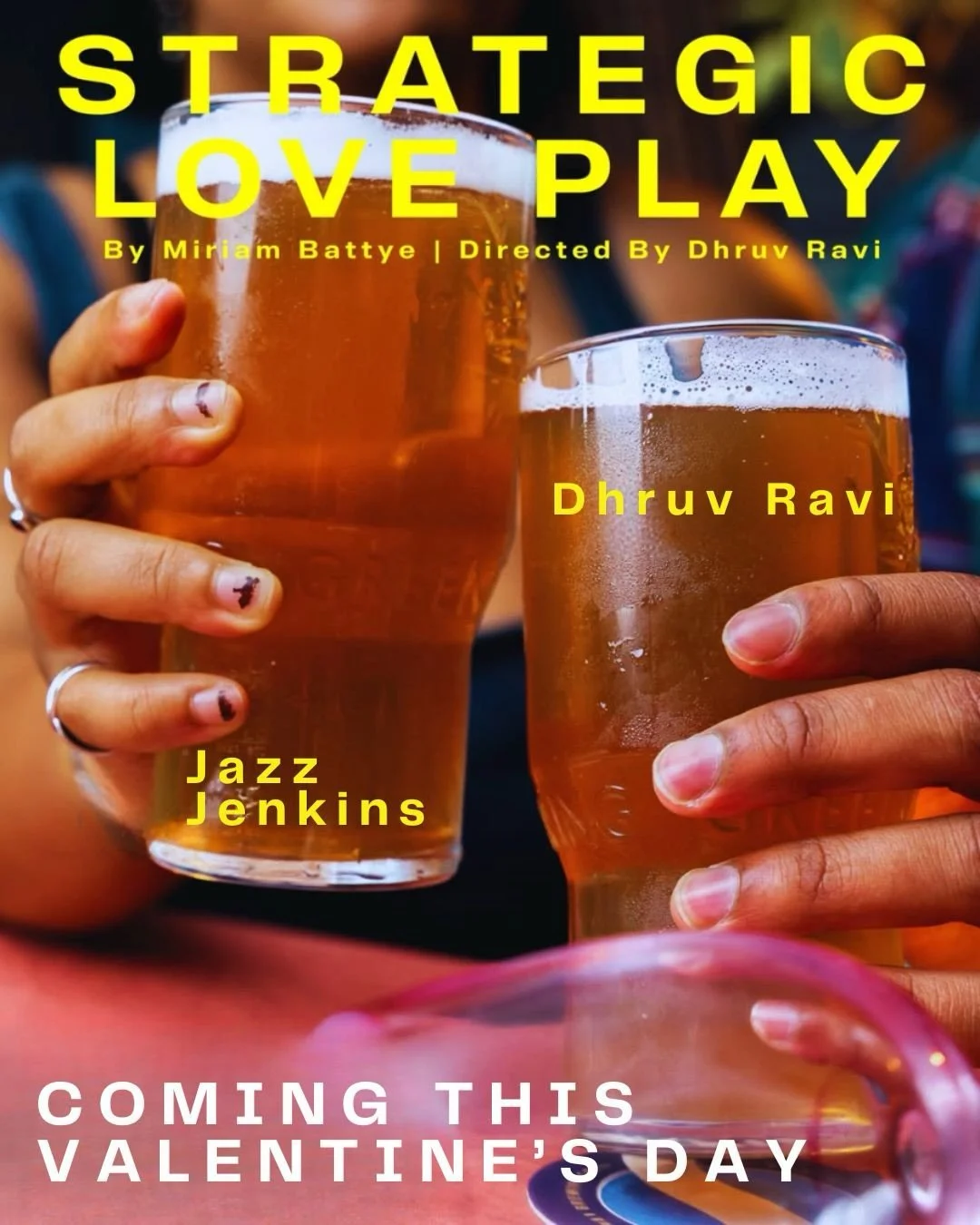

Art & photography courtesy of Teatro Dallas
—Teresa Marrero
Teatro Dallas presented the second play of its 22nd International Theatre Festival in a one-night-only performance of Strategic Love Play: Intimacy That Dissipates into Oblivion, directed by Dhruv Ravi for Purāna Productions, England, and performed on February 14, with actors Jazz Jenkins and Dhruv Ravi as the cast.
Up front: I do admit that I love listening to British English spoken in all its variations, including expressions unfamiliar to me.
There is something bracing about watching two actors commit fully to material that resists forward motion, is raw in its observations of contemporary ( in specific, the app-dominated dating scene), and puts them up very close to the audience. What feels real is the first face-to- face meeting around a table at a pub, over rounds of beer, and with two people full of expectations for the meeting (with the dread of another failure lurking in the subtext).
In Strategic Love Play, written by Miriam Battye, a first date becomes a laboratory of strategic vulnerability on the part of Him/Adam (Ravi) and pointed, thinly veiled aggression by Her (Jenkins). The dialogue is sharp, culturally fluent, and attuned to the linguistic choreography of app-age romance: the calibrated disclosures, the defensive irony, the weaponized self-awareness. Battye hears the rhythms of contemporary courtship with precision.
But hearing is not the same as developing.
The script does not unfold; it reiterates. Emotional propositions are introduced, destabilized, then reintroduced in slightly altered phrasing. Attraction turns to caution, caution to flirtation, flirtation to guarded confession—then rejection, and the sequence resets. The pattern is intentional; modern dating is, after all, cyclical if not repetitive. Yet repetition here does not always generate escalation. Instead of spiraling deeper, the conversation frequently annoys by returning to its point of origin. Three quarters into the play, I felt annoyed. Very annoyed. Were they there to meet up or to destroy one another, particularly on Her part?
Redundancy in theatre can be revelatory and character development depends on it. But when redundancy becomes repetition it loses its punch, no matter how committed the actors are. We circle the same anxieties: Who holds power? Who risks more? Who wants more or less? How can She set (as a condition for dating) that He must NOT like her? Yes, her self-hatred and his indeterminate emotional landscape are evident. The questions are potent. The play poses them repeatedly. What it withholds is evolution—and please note that I am not suggesting anything like resolution.
The result is a curious flattening of stakes. Because the emotional temperature spikes and then flattens, the evening risks feeling suspended like smoke in the air. We witness tension and occasional rupture. We observe negotiation, but with no consequence.
The performers generate momentum where the text stalls. They allow micro-pauses to thicken into implication. A laugh arrives half a beat too late and suddenly carries accusation. A still look registers withdrawal before language acknowledges it. They manufacture gradation through embodiment.
Where the writing seems stuck, the actors attempt to climb.
This contrast becomes especially visible in the circular staging. The in-the-round configuration suggests dynamisms such as rotation, shifting perspective, relational geometry in motion. Conceptually, it mirrors the script’s looping architecture. Practically, however, it compounds the sensation of stasis. For the first twenty minutes, I found myself staring at the back of His head — not as metaphor, but as fact. The promise of intimacy was undercut by restricted sightlines. In a play so dependent on facial micro-expression, obscured access diminishes dramaturgical impact.
The spatial inefficiency unintentionally underscores the script’s structural repetition. The actors rotate here and there, and even lay flat on the ground, but not enough to provide visual and emotional fulfillment for the audience. We watch, but not always fully. We remain close yet occasionally excluded.
Still, the performers persevere. They turn repetition into volatility. They allow the same line to land differently on its various iterations. Through physical commitment, they complicate what the text simplifies.
If the script intellectualizes strategy, the actors embody risk.
Strategic Love Play offers incisive observation but limited transcendence. It captures the rhetoric of modern intimacy with acuity; it struggles to build dramatic consequences from it. On the ideological plane, it simply reiterates what is commonly experienced in today´s app-dominated dating scene. What ultimately sustains the evening is not structural surprise but performative rigor — the disciplined, emotionally alert presence of two actors determined to excavate depth from this conversational terrain.
The evening left me admiring the actors´ craft more than the script construction or the staging. And perhaps wondering whether the play confuses repetition with dramatic vigor.
Teresa Marrero is Professor of Latin American and Latinx Theater and Culture in the Department of World Languages Literatures and Cultures at the University of North Texas. Teresa.Marrero@unt.edu
WHEN:l February 14, 2026
WHERE: Latino Cultural Center, 2600 Live Oak, Dallas
WEB: teatrodallas.org