‘The Lion in Winter’ @ Theatre Three

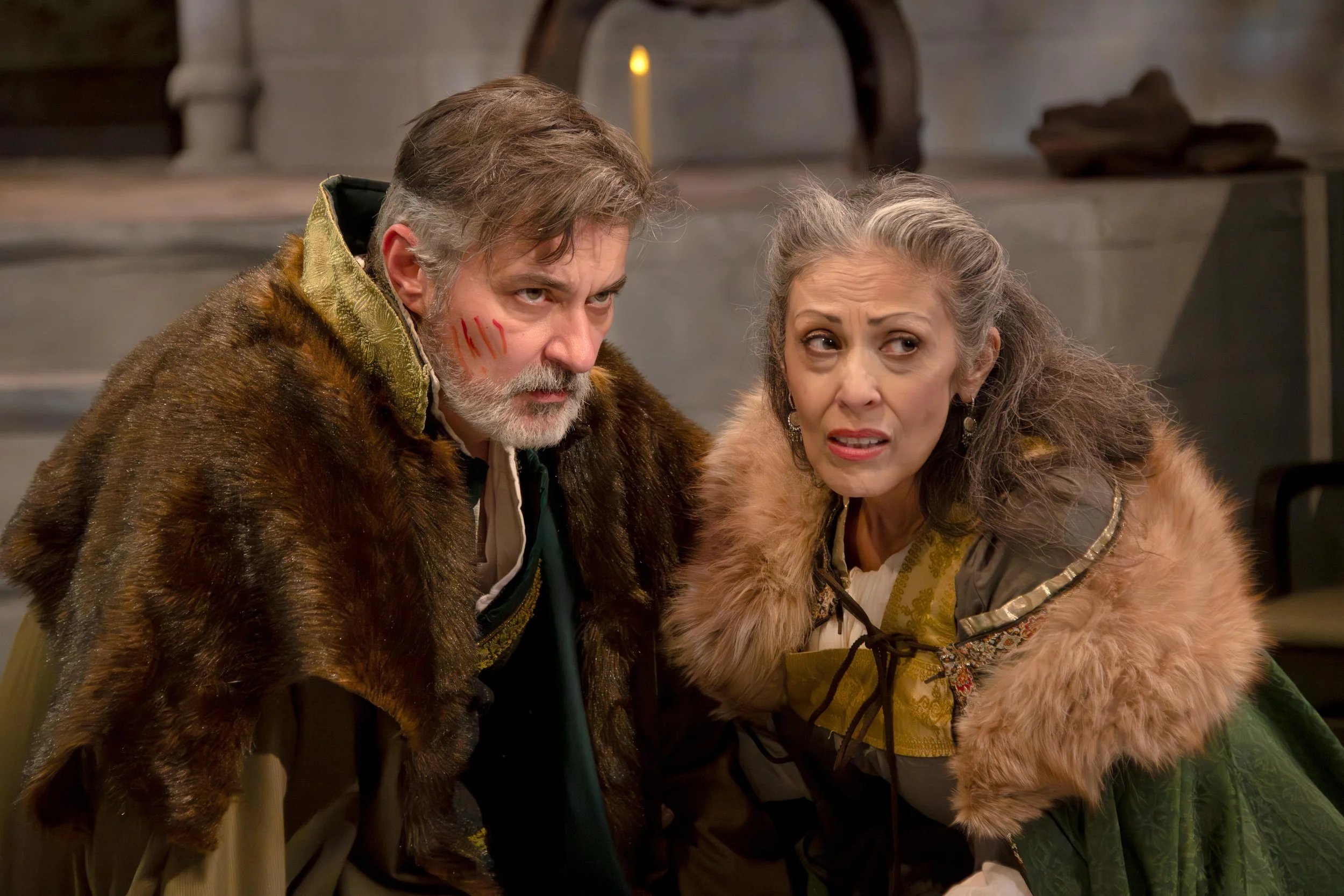


Photos by Jeffrey Schmidt and Linda Blase
—Rickey Wax
Some families pass the gravy at Christmas. This one passes treason. That’s the energy The Lion in Winter by James Goldman is bringing to Theater Three this season, and honestly, I wouldn’t want it any other way. (Pass the goblet and the murder plot, please.) What greets the audience is a holiday gathering and a high-stakes medieval cage match disguised as Christmas dinner, where love is conditional and the weapons are mostly verbal—until they’re not.
Christmas dinner is never complete without a little family drama, and it’s oddly comforting to know that even in 1183, in crowns and furs and the throes of royal madness, the same emotional dysfunction reigned. The difference here is that Mom is released from prison for the holidays, Dad is sleeping with the future daughter-in-law, and the sons are openly calculating which parent they might overthrow first. Your uncle yelling over politics at the table suddenly feels very low-risk by comparison (no dungeon time… we hope).
Goldman drops us into the court of Britain’s King Henry II at his French castle in Chinon. He’s fifty,—old by medieval standards—and obsessed with what becomes of his empire when he’s gone. His wife, the legendary Eleanor of Aquitaine, has been locked away for ten years for attempting to overthrow him; she’s been granted a brief Christmas release. Their three sons—Richard, Geoffrey, and John—arrive circling the throne like sharks at a holiday buffet. Add King Philip of France and his sister Alais, both politically entangled with the family, and suddenly Christmas comes with treaties, threats, and flirting that would absolutely violate royal HR policy (if such a thing existed).
Under the direction of Matthew Gray, with Katie Ibrahim assisting, the production leans fully into the idea of power as performance. Cody Stockstill’s scenic design presents the stage like a chessboard with vertical stakes: the throne perched high in authority, a central octagonal platform acting as neutral ground where strategy is whispered, negotiated, and betrayed. Amy Pedigo-Otto’s costumes carry tremendous narrative weight, signaling rank, psychology, and fate.
Alais moves like a pawn. Eleanor commands like a queen. The sons strike like knights. Henry and Philip operate as opposing kings, rarely unguarded, always layered in manipulation. Even moments of tenderness feel tactical. When Eleanor and Henry decorate the space with holly, there’s warmth for a single breath of time, then the thorns remind us where we are. They spar playfully, but no one forgets that even joy in this room is armed.
Jeffrey Schmidt’s Henry carries authority in his stillness, saving emotional surges for moments when devastation cracks his voice upward. Fresh off his dark horror turn in Incarnate at Second Thought Theatre, Schmidt pivots impressively into this bristling monarch just in time for the holidays. Drew Wall’s Richard stays hunched and coiled, fists often clenched as if ready to punch the world at any moment, rage detonating only when absolutely necessary. Carson Wright’s Geoffrey moves with serpentine calculation, building alliances quietly and watching everyone with unsettling calm. Dustin Parsons’ John flails with erratic charm and youthful arrogance—smug behind a boyish grin that reflects his father’s cruelty—but he remains clueless at some crucial moments (bless his heart).
Kristen Lazarchick’s Alais exists in emotional suspension, visibly pulled by forces she did not choose. She appears almost exclusively in white—outward purity wrapped around internal peril. She even insists, “My advice is pure,” daring us to decide whether she means morally pure or simply powerless (poor thing). Benjamin Stegmair’s Philip slices through scenes with humor sharpened into political steel—French politeness, but dangerous beneath the charm.
The evening’s standout is Christie Vela as Eleanor, who commands the role with chilling duality. Her voice becomes an artifice, soft when it needs to be, sharpened when it must be—while her true intentions stay locked behind a flawless poker face. At any moment, you’re left wondering whether she’s offering love or setting a trap (and I was living for every moment of it).
Costuming (and the lighting of it by Aaron Johansen) does heavy psychological storytelling throughout. Eleanor is drenched in red—sometimes full crimson, sometimes softened into rose and pink even in her night garments—signaling bloodline, rage, passion, and survival. Henry remains wrapped in green, earthy and territorial, decay and renewal in equal measure. Richard wears black, the silhouette of war already orbiting his fate. Philip’s purples and golds shimmer with polished royal danger.
One small technical note: the accents slip in and out at times and aren’t always consistent. It’s a minor issue and one that can easily be smoothed out—but worth mentioning in a play where language is the sharpest weapon.
The opening establishes Henry’s dominance and restlessness as the sons arrive like opposing philosophies. He wants John as heir, even as John seems to recognize his own inadequacy: “Richard is brave. Geoffrey is shrewd. John is nothing.” Eleanor quietly champions Richard.
Philip’s arrival tilts the power balance in the room. He brings the treaty with France, the threat, and a conversational knife he wields well. Presents arrive, but the illusion of tradition tries, and fails, to settle in. Henry pretends to name Richard heir. Eleanor nearly bursts with victory. Then the terms change. Aquitaine must go to John in the deal. Richard refuses. The marriage collapses. Alliances melt. John betrays Henry in secret. Geoffrey betrays everyone in turn. Philip collects promises like debts. Richard threatens war. Eleanor moves through the rooms like a living wildfire, stoking conflict even when she whispers. I don’t think even a family counselor would want to take this job on. “Power is fact.” No debate. Just truth.
Just before intermission, every betrayal surfaces at once. Henry realizes his sons have all turned against him in different ways. He collapses inward under the weight, and the lights fall with the sense that the war has barely begun.
The second half tightens the trap. The wine cellar becomes a confessional. Love is tested against murder. No one leaves clean, (I’ll spare you the emotional ambush.)
It’s a holiday show, sure. Just not the kind you put on while decorating cookies (unless your cookies are filled with betrayal and dusted with moral compromise). By the end, you may find yourself mildly grateful for your own family’s version of chaos.
WHEN: December 4-28, 2025
WHERE: Theatre Three, 2688 Laclede St, Dallas
WEB: theatre3dallas.com