
Photos courtesy of Pilobolus and TITAS / Dance Unbound
—Teresa Marrero
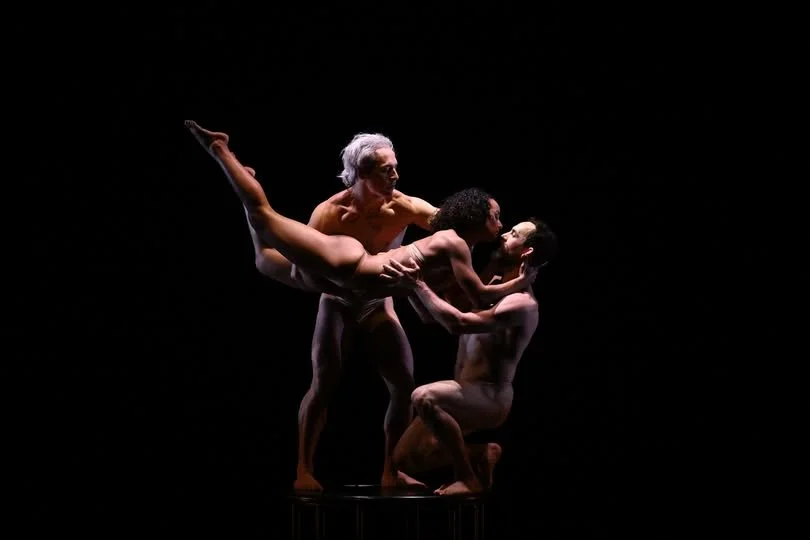
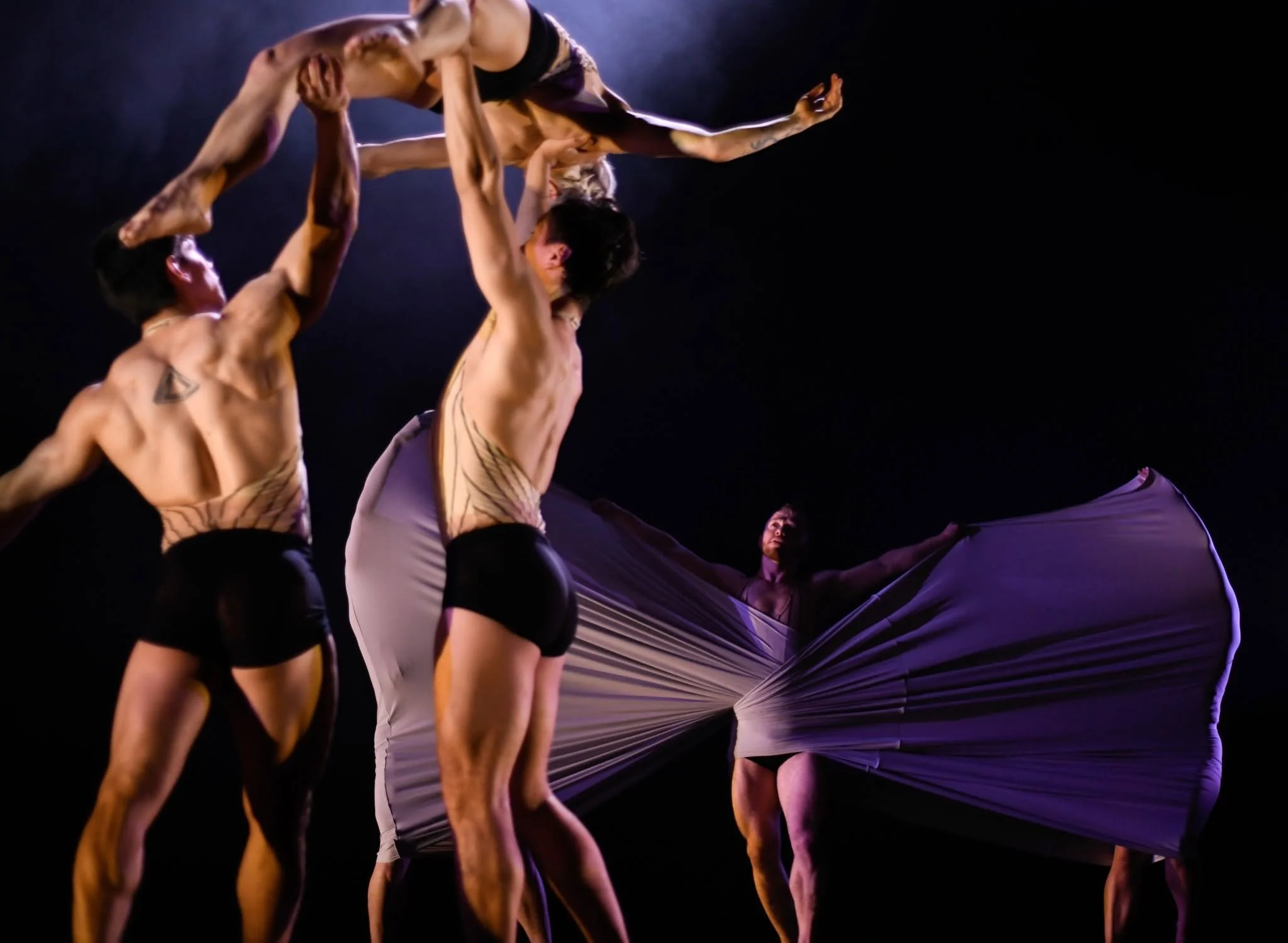
Pilobolus, the acclaimed dance/theater organization, has been reinventing movement (and themselves) since 1971, when as the story goes, four non-dancer guys from Dartmouth got together to explore movements. Inspired by their namesake, the Pilobolus mushroom that explores with spores to exponential distances, the dance collaborative identifies itself through improvisation, nontraditional dance vocabularies, and explosive athletic moves. Usually composed of four men and two women, the company’s gender-neutral choreography and costuming levels the playing field. Collaboration, strength and flexibility are what matters.
The Program:
The November 6-7 performances at the Moody Performance Hall in Dallas headlined under the title of TRIPS. Charles Santos, TITAS/Dance Unbound executive and artistic director, said the company invites the audience to be present and enjoy the (non-psychedelic) journey. The pieces included during the first half were titled BLOODLINES, WALKYNDON, FILGHT, and later in the program PSEUDOPODIA and LAMENTATION VARIATIONS. None of the pieces were new. All belong to the Pilobolus body of works. Some, like WALKLYNDON, FLIGHT, and PSEUDOPODIA are quite old, in fact. LAMENTATION VARIATIONS premiered in 2007 to honor the centennial of legendary modern dancer-choreographer Martha Graham; the piece is based on a film of hers. The film was supposed to have been projected onstage while the live dancers performed. However, in the talkback it was revealed that the projector had malfunctioned. The piece still worked, nonetheless feeling a bit thinner for the lack of this seminal connective device.
When one of the dancers spoke directly to the audience for a show of hands — how many already had seen one of their performances? — by looking around, I would have guessed about 70% had attended before. Knowing this, it is surprising to have a program with so many repeats. Clearly, Mr. Santos has a marvelous relationship with this company, particularly since they did an outstanding performance during the Covid pandemic in the Asher Gardens with Booker T. Washington student dancers in 2020, as discussed in the talkback.
The Dancers:
This iteration of the company is relatively fresh. There were three new members (added since May 2026): one male performer, Alexis Cruz-Castro (from Puerto Rico), and two females, Anouck Otsea (from Alaska) and Kalyan Sayre (from North Carolina). Veteran Quincy Ellis, who joined the company in 2017, came out of retirement two years ago to cover for Connor Chaparro, who is on injury leave. Ryan Hayes (Washington state) joined in January 2025; Isaac Huerta (from California) also joined in 2025 and serves as dance captain. I could not discern a single misstep or flaw in any of the performances, despite their physical complexity. Everyone seemed to be relaxed and enjoying the experience.
The Performance:
In an unusual move by any dance company, the warmup happened onstage, clearly visible to us as we entered the theater and took our seats. Dressed in street clothes and moving spontaneously to David Byrne´s Talking Heads, the dancers do what they do best: related physically to each other and to the soundscape in a playful manner. The audience clearly enjoyed getting this “inside” look — and in their usual manner, dancers introduced themselves to the audience to send the message that, in my own words: ¨We relate to each other in dance, and relate to our audiences in a similar way. ¨
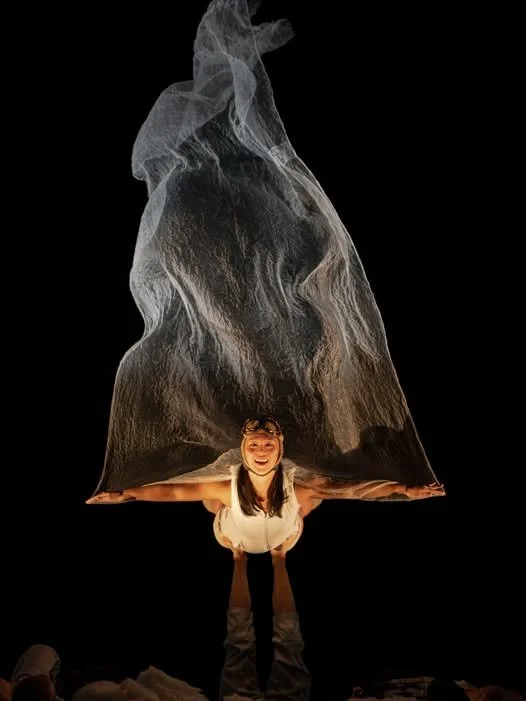
Playfulness is a reiterated notion for the Pilobolus dancers, who create dance pieces collaboratively. There is no top-down choreographer (a prevailing authorial voice) to impose a specific movement vocabulary. Thus, free to incorporate all physically possible (and sometimes seemingly impossible) movements, their work evokes story while prescinding narrative. By this I mean that, while the numbers have evident references to some sort of inspirational starting point (as for example in FLIGHT, which was created out of founding member Lee Harris’ passion for flying, and in recognition of the company´s 50th anniversary), there is no continuous narrative that follows a predictable development.
The Pilobolus’ incorporation of humor is also a trademark that evokes complicity with the audience. For instance, WALKLYNDON pokes fun at joggers. The clean-up of the copious red petals that fall from the rafters after BLOODLINES is hilarious, especially as it includes somewhat reluctant audience participation by those seated in the front row — plus an absurdist “excuse me” banter back and forth. The trope at the beginning of the show (to simulate an airline flight) is the medium used to get us to silence our phones and “tuck them away safely in a comfortable place.” This drew laughs. Their lack of pretentiousness brings dancing down to earth and invites audience members to meet them on their own terms. There is no preciousness to the dance aesthetic: you needn’t know anything about dance or dance history to enjoy Pilobolus.
Some of the pieces were unaccompanied by music. For instance, the opening of FLIGHT incorporates an anthropomorphic twist, whereby the fluffy white mounds of cotton (which simulated clouds) had their own voice in some sort of gibberish talk from off stage. It was so effective! And the odd thing is that we have no idea why those fluffy white lumps are sitting on stage until the very end. Brilliant.
If bodies in motion is the focus of this company, costumes reflect this impulse. They are minimalist, consisting of bodysuits that display the strength of these performers. Lighting is at the service of the dancers and the shapes they generate, rather than as any sort of stage or narrative adornment. This stripped-down aesthetic keeps the focus where it belongs: on the dancers and their movements. I cannot even begin to comment on the music/soundscape; it is so varied (even within each number) as to defy labels. All I can say is that it worked. In the first number after the intermission, PSEUDOPODIA, a piece that has solo dancer Anouk Otsea rolling back and forth on the floor (in my notes I dubbed this piece the ‘rolly poly’) without using her legs, I felt the driving percussion resonate in my chest.
The Dallas audience rewarded Pilobolus a hearty chorus of “bravos” and an immediate and well-deserved standing ovation.
Teresa Marrero, Ph.D. is a writer who specializes in theater and dance performances in English and Spanish. She can be reached at dr.teresa.marrero@gmail.com.
Upcoming in the 2026/2027 season, the TITAS / Dance Unbound series will include: Alonzo King Dance Ballet with live music by Lisa Fischer (Dec. 19) … Step Afrika debut (Jan. 15-15) … Orpheus, Alan Lake Factori(e) (Feb. 5-6) … Social Tango Project, Texas debut, Feb. 26-27) … Hervé Koubi (March 27) … Yue Yin Dance Company (April 2-3) … Philadango, debut (May 8)