7th Annual ‘Latinidades’ Theatre Festival (Cara Mía Theatre): ‘Alien Number’ Las de Allá Dance Collective
—Teresa Marrero
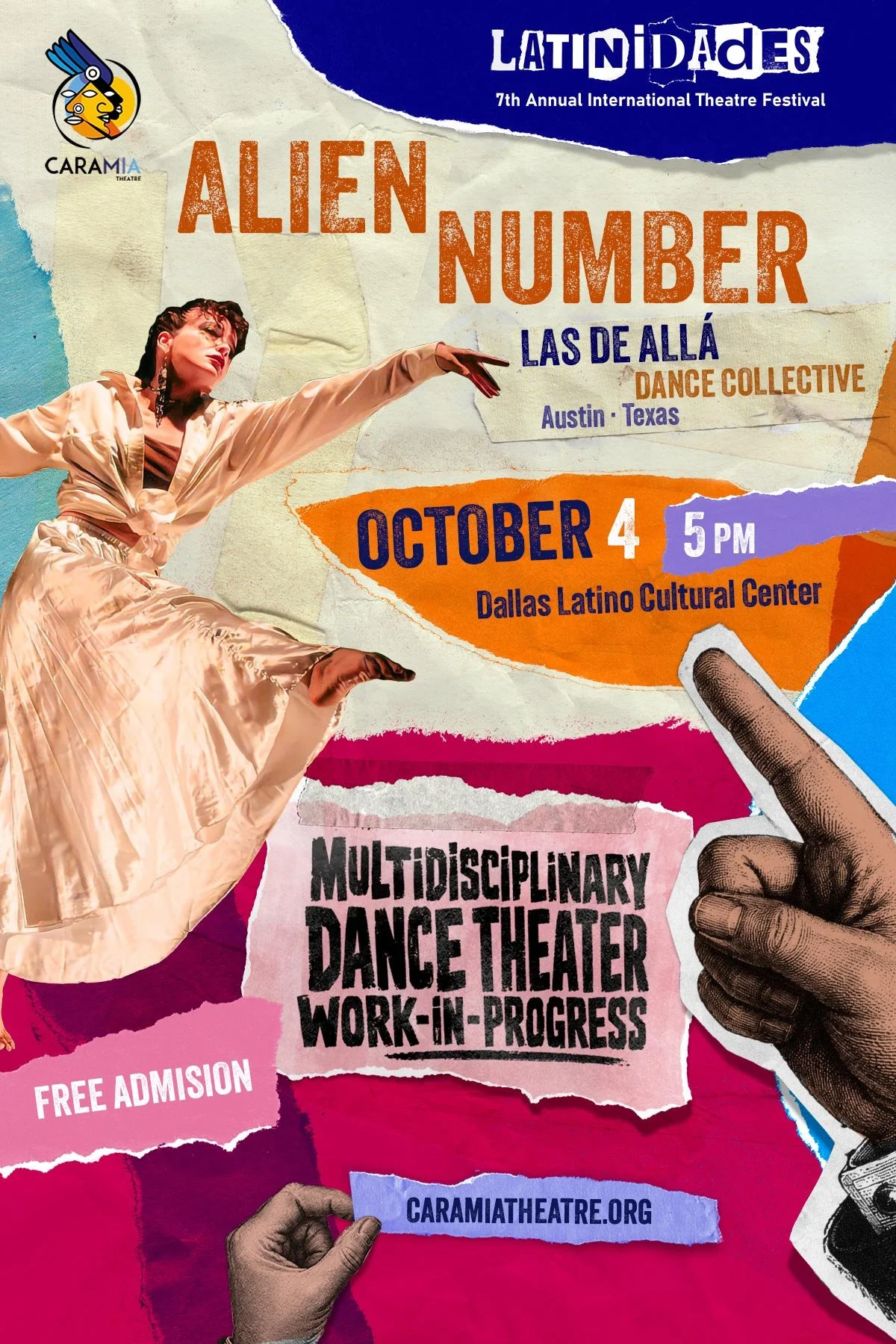
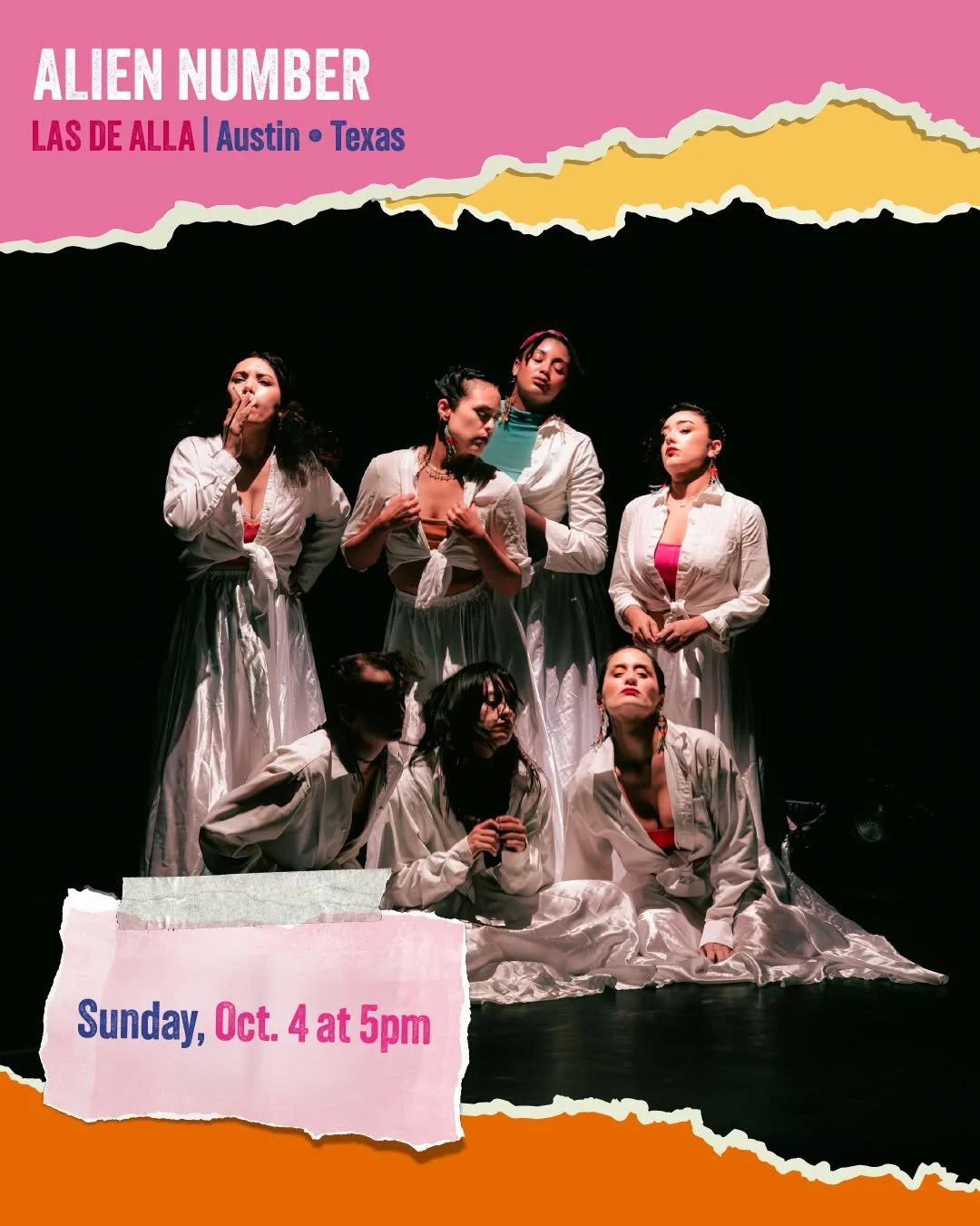
In Alien Number, the Austin-based dance collective Las de Allá, under the creative direction and choreography of Daniela Vargas Calvo, turns the stage into a vibrant dance landscape of migration, displacement, cultural identity, and the search for belonging. Performed in the Latino Cultural Center’s Black Box on October 4, what we saw was polished through a residency at Cara Mía; in particular the collective was openly grateful to fellow resident Teo Castellanos for his input.
Across twelve interconnected scenes, the collective combines contemporary dance, poetry, original music, spoken word, cumbia, salsa, and theatrical imagery to explore what it means to live between cultures and to negotiate one’s place in the U.S.´s recent xenophobic, punishing climate.
For those who have been living under a rock for the past decade, an Alien Registration Number (A-Number) is a unique identification number assigned by U.S. immigration authorities to certain noncitizens. It is typically an A followed by eight or nine digits and is used to identify a person’s immigration record.
For Alien Number, the title carries a deliberate double meaning: “alien” can refer to someone perceived as foreign or outside a community, while the number reduces that individual to an administrative identifier. That tension—a human being transformed into a number within a bureaucratic system—fits particularly well with the production’s concerns about migration, belonging, displacement, and identity. As one of the pieces blatantly states on a cardboard message held overhead, ¨No human is alien on this Earth.¨
Due to the potentially emotional content of the scenes that may trigger the audience, manager Sofía Sánchez welcomed the audience to honor our feelings and possibly triggered reactions, offering permission to get up and step outside during the show, should we feel a need to do so. I thought that was a respectful attitude towards the audience. During the show, I heard a person attempting to suppress sniffles from crying somewhere behind me. I did not turn around.
Rather than presenting migration as a single narrative, Alien Number offers a multiplicity of perspectives, with each dancer contributing a distinct voice, movement vocabulary, and personal artistic vision. The result is a work that moves fluidly between the intimate and the political, from the emotional terrain of migration and separation to the pressures of gentrification, the preservation of culture, and the reclamation of joy.
What gives Alien Number its texture is the collective nature of its creation and the immediacy of the numbers. While the all-woman ensemble of dancers demonstrated agility and a personal physical vocabulary, it was never about technique. Rather, what came across is a rare combination of authentic, truthful and earnest care for the lives and messages of those affected. These were personal testimonies, not some distant hearsay. The fear of deportation and isolation were real.
The twelve scenes function as a series of vignettes, shifting between ensemble choreography and solos, original songs, poetry, spoken word, video, and culturally specific dance forms. Each member of Las de Allá brings something of her own artistic identity to the work: Vanessa Alvarado contributes original music to the exploration of love and migration in “Amores en tiempos de migración” (Love in the Times of Migration¨ a title that reminds us of Gabriel García Marquez´ well- known novel, Love in the Time of Cholera); Diana Ventura combines poetry and movement in “Discusión y revolución” (Discussion and Revolution); Kittie Miranda offers a solo within “Somos cultura, sazón y cumbia” to the self-affirming popular song `¡parate´ by Alaina Castillo; and Victoria Jara and Lilly Wylde choreograph solos that emerge from the scenes “Al borde” and “El camino.”
Gabriela Manzano contributes choreography and video as well as performance, while Daniela Vargas Calvo provides the overarching choreographic and conceptual direction. She is the solo performer of one of the evening´s strongest pieces, ¨Gentrification,¨ which includes the scathing critique of gentrification and neo colonialism, to Bad Bunny´s song ¨Lo que le pasó a Hawaii¨ (What Happened to Hawaii). This multiplicity gives the work the energy of a community creating in real time and less a single choreographer’s vision imposed on a company. These were mosaics of individual voices gathered around shared, although sometimes differing concerns.
The episodic structure ultimately becomes one of Alien Number’s strengths. Rather than forcing the diverse experiences of migration, displacement, cultural memory, and resistance into a single linear narrative, Las de Allá allows each scene to occupy its own emotional and aesthetic space. The shifts in tone from the tenderness of “Amores en tiempos de migración” to the social commentary of “Gentrification,” the dreamlike imagery of “Spirit of the Jungle,” a powerful solo dance by Lilly Wylde with concept by Daniela Vargas and mask by Diana Ventura, to the communal joy of “La Fiesta,” and the self-affirmation of “Somos cultura, sazón y cumbia”—all keep the audience moving through a landscape of experiences that is as varied as the communities the dancers represent.
The recurring movement between individual voices and collective expression is particularly effective: a solo can establish an intimate perspective before the ensemble expands it into something communal. In this sense, Alien Number does not need a conventional plot to achieve coherence. Its coherence emerges instead from the accumulation of voices, bodies, memories, and cultural references, creating a portrait of identity as something continually negotiated, reclaimed, and celebrated.
This promising collective is a mere two years old! I cannot wait to see how their dance/stories grow.
Check out https://caramiatheatre.org/latinidades/ for their upcoming performance schedules. You will certainly enjoy them. There is nothing else like it in DFW!
WHEN: September 26-October 11, 2026
WHERE: Latino Cultural Center, 2600 Live Oak, Dallas
WEB: caramiatheatre.org
Teresa Marrero, Ph.D. writes about dance and theatre. She has been covering the DFW Latina-o theater scene since 2013, both for TheatreJones.com and now for OnstageNTX.com As a free service to the public, readers and researchers can find her archived reviews on the History of Texas Portal at the University of North Texas, https://texashistory.unt.edu/ Search the Private Collection of Dr. Teresa Marrero. dr.teresa.marrero@gmail.com.