Holst’s ‘The Planets’ @ Dallas Symphony Orchestra
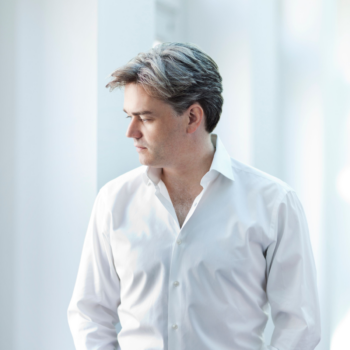
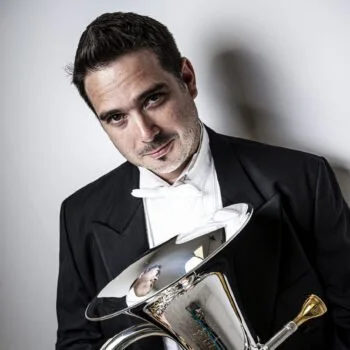
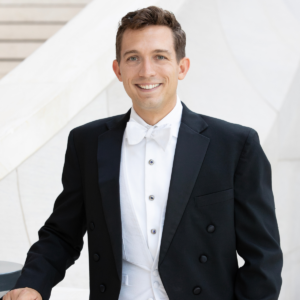
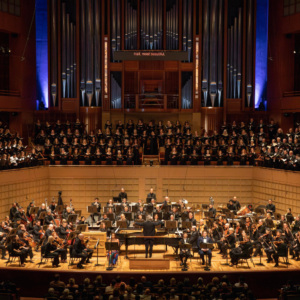
Photos courtesy of DSO: (clockwise, conductor Edward Gardner; euphonium soloist David Childs; Dallas Symphony Chorus; chorus director Anthony Blake Clark
—Wayne Lee Gay
The scheduling of Gustav Holst's immensely popular orchestral suite The Planets brought out a larger-than-usual crowd Thursday night for a concert of the Dallas Symphony Orchestra. Unfortunately, hazardous weather forced the cancellation of the two planned repetitions of the concert on Friday and Saturday.
Edward Gardner, principal conductor of the London Philharmonic Orchestra, opened the all-British concert with William Walton's Te Deum, a grand choral-orchestral work first performed at the coronation of Queen Elizabeth II in 1953 (and repeated at the coronation of Charles III in 2023). The 180-voice Dallas Symphony Chorus, trained by Anthony Blake Clark, as usual proved itself one of the finest large choral ensembles in America, once again showcasing the Meyerson Symphony Center as an acoustically magnificent venue for large-scale choral-orchesral music.
Walton's Te Deum is itself a showy setting of an ancient Latin hymn (in English translation), here presented in an arrangement substituting a large brass ensemble for the original full orchestral accompaniment. Frankly, the orchestral version would definitely have been a better fit, though the effect was still, for this listener, sufficiently thrilling. Although the chorus's diction is superb, the performance would have been even more satisfying with a projection of the complex text, allowing members of the audience not familiar with this text (that would, at a guess, have been about 95 per cent of those in attendance) to more fully appreciate Walton's responses to the subtleties of the words.
British composer James MacMillan's Where the Lugar Meets the Glaisnock for euphonium and orchestra followed (in its American premiere), with British euphoniumist David Childs as soloist. Childs, who currently serves on the faculty at the University of North Texas, displayed a gorgeous tone and magnificent expressiveness on an instrument not usually associated with lyric beauty. The work was written by MacMillan as a tribute to his father, a gifted euphonium amateur; the Lugar and Glaisnock of the title are two rivers that meet in the little town of Cumnock, Scotland, where composer MacMillan grew up. Although largely atonal, this twenty-minute work creates, within the ambivalent tonality, striking moments of beauty, along with others of darkness and occasional nostalgia.
The seven separate movements of The Planets evoke distinct astrological traits associated with each of the planets, and character traits of the gods for whom they are named. For instance, "Mars, the Bringer of War" is muscular and martial, while "Venus, the Bringer of Peace," is seductively languid.
Composed in 1920, Holst’s work has long stood as one of the popular "hits" of twentieth-century music; romantic and pictorial, The Planets is—by any standard—skillfully wrought and deftly original. While one might argue about its relative value compared to the masterpieces of Holst's contemporaries Bartok or Stravinsky, it contains many impressive moments, which Gardner and the DSO produced expertly. And it has had a huge cultural impact as an inspiration for the film scores of the late twentieth century's numerous blockbuster sci-fi movies: Holst basically created what the vast expanses of space and the universe sound like to filmgoers.
Unfortunately, the very enthusiastic audience interrupted the all-important structural flow of the work with applause after each movement. Glad they enjoyed it, but sorry they didn't let the full effect of an uninterrupted performance emerge.
WHEN: January 22, 2026; repeat performances cancelled (weather)
WHERE: Morton H. Meyerson Symphony Center, Dallas
WEB: dallassymphony.org