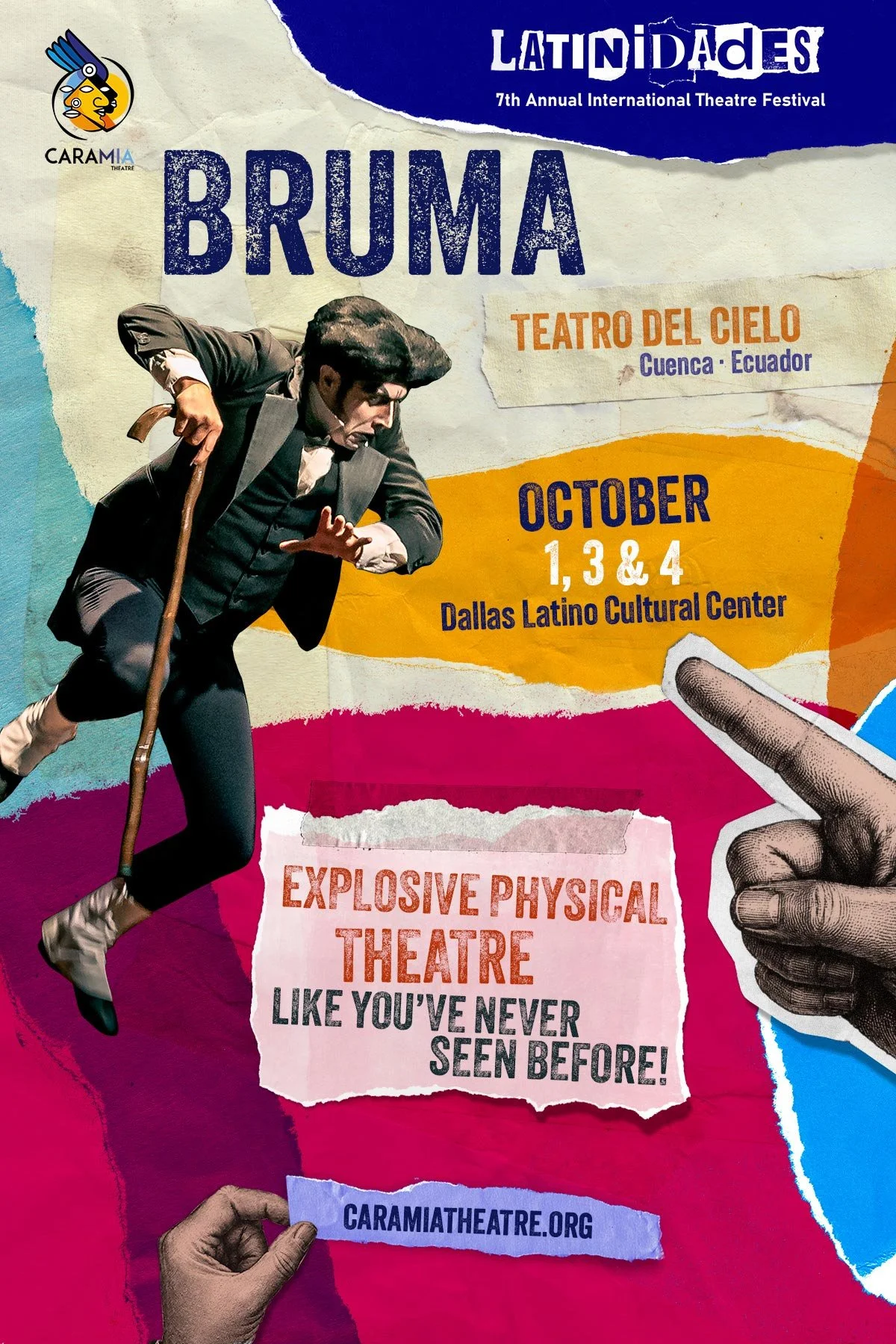
7th Annual Latinidades Festival (Cara Mía Theatre): ‘Bruma’ by Teatro Del Cielo
—Teresa Marrero
Bruma by Teatro del Cielo: Bureaucracy as Choreography:
Teatro del Cielo (Theatre of the Sky, from Cuenca, Ecuador) builds its artistic foundation for their piece, Bruma, on Dramatic Corporeal Mime (in French, Mime Corporel Dramatique), the highly structured physical-theatre system developed by French master Étienne Decroux, who himself taught mime legends such as Marcel Marceau.
Unlike traditional pantomime, which often relies on literal gestures to tell a story or imitate familiar actions, corporeal mime treats the human body as a sculptural and expressive instrument. The body itself becomes the language through which performers explore human conditions. In this very vein, another performer within this ongoing ‘Latinidades’ Festival— Mai Rojas from Barcelona´s Escultores del Aire—also fits within this tradition.
The word bruma in literary English refers to winter, or the winter solstice. It comes from Latin bruma, meaning "winter" or "the shortest day of the year," which is itself a contraction of brevima ("shortest"). In Spanish and Portuguese, it means "mist" or "fog," especially a light haze that forms over the sea or in the air, reducing visibility but less dense than niebla (thick fog). In the case of the performance we saw, I would say this mist or fog provides a liminal space between life and death.
After all, the premise of the implied narrative is: What happens when even death cannot free us from having to jump through the hoops of the administrative labyrinths that govern our lives? The premise turns a universal human experience—the confrontation with death—into a darkly comic encounter with bureaucracy. In this afterlife, apparently, there is still paperwork to be completed. Bureaucracy itself serves not only thematically, but as a choreographic element that organizes movement. According to the playbill, their ¨exploration is directed toward the grammar of movement, where the torso-trunk is the support.¨ From this central axis, the expression of balance, counterbalance, opposition and friction, ludicrous interludes in silence and with music (I identified a short segment by Argentine composer, Astor Piazzola) generate the magic that I call the choreography of bureaucracy.
The play follows Anastasia (Yanet Gómez Gómez), a frail woman who arrives at an office somewhere in the afterlife—or perhaps in an interminable limbo. Dressed in a burgundy, late nineteenth century-style frock, and a headdress, her slim body´s dexterity and flexibility captivate us right from the opening scene.
The staging follows Decroux´s minimalist notion of an (almost) bare stage. Here we see a small desk, a typewriter, and lots of white, crumpled sheets of paper. The disparity between the darkness and focused lighting of the staging, Anastasia´s dark dress and exaggerated makeup contrast against this stark whiteness of this, her greatest impediment into the afterlife: completing the necessary paperwork.
Before Anastasia can move on, she must navigate a series of mandatory bureaucratic procedures, presumably involving all the familiar frustrations of forms, rules, waiting, instructions and institutional absurdity. That contradiction is at the heart of the play's theatrical possibilities. Anastasia has crossed the ultimate threshold, yet she remains trapped in a system that prevents her from moving on. The eternal has collided with the administrative. What should be a passage into whatever comes next becomes another encounter with the machinery of human institutions.
Her nemesis gatekeeper goes by various, ego-aggrandizing names), oscillating among Señor Ministro, Magister, Rey (King)— all coded within patriarchal power structures which Anastasia begs, cajoles, and ultimately openly denounces. He, performed by creator-director and company founder Martín Peña Vázquez, articulates each nuance with amazing dexterity and precision, an accolade that also goes to partner Gómez Gómez. At times dressed in a period black suit and leggings with white spats, a ridiculous oversized black wig and heavy makeup, frankly, I later failed to recognize the same actor without makeup, so drastic was the transformation!
Staged in the intimate ambiance of the Black Box at the Latino Cultural Center, the idea of movement as bureaucracy highlights some of the following elements: rigid and fluid corporal patterns, waiting, interruption, submission, resistance. Rhythm and repetition: whether recurring physical actions make the bureaucratic world feel oppressive, ridiculous, or both. Music and movement: how the musical pieces interact with the corporeal-mime vocabulary rather than simply accompanying it, and humor whereby the physical comedy deepens the pathos of the thematic critique rather than merely producing laughs. And ultimately, the irony of the ending.
While the language used was Spanish with a spattering of English and no supertitles, the corporality of the performance made it comprehensible in the most fundamental of ways.
Truly. This was a wonderous experience, as demonstrated by the audience´s several minute standing ovations, along with copious ´bravos.’ Cara Mía Theatre Company continuous to deliver high-quality, world-class entertainment.
Check out https://caramiatheatre.org/latinidades/ for their upcoming performance schedules. You will certainly enjoy them. There is nothing else like it in DFW!
WHEN: September 26-October 11, 2026
WHERE: Latino Cultural Center, 2600 Live Oak, Dallas
WEB: caramiatheatre.org
Teresa Marrero, Ph.D. writes about dance and theatre. She has been covering the DFW Latina-o theater scene since 2013, both for TheatreJones.com and now for OnstageNTX.com As a free service to the public, readers and researchers can find her archived reviews on the History of Texas Portal at the University of North Texas, https://texashistory.unt.edu/ Search the Private Collection of Dr. Teresa Marrero.