‘7th Annual Latinidades Festival: Creating New Worlds (Cara Mia Theatre Company)
—Teresa Marrero
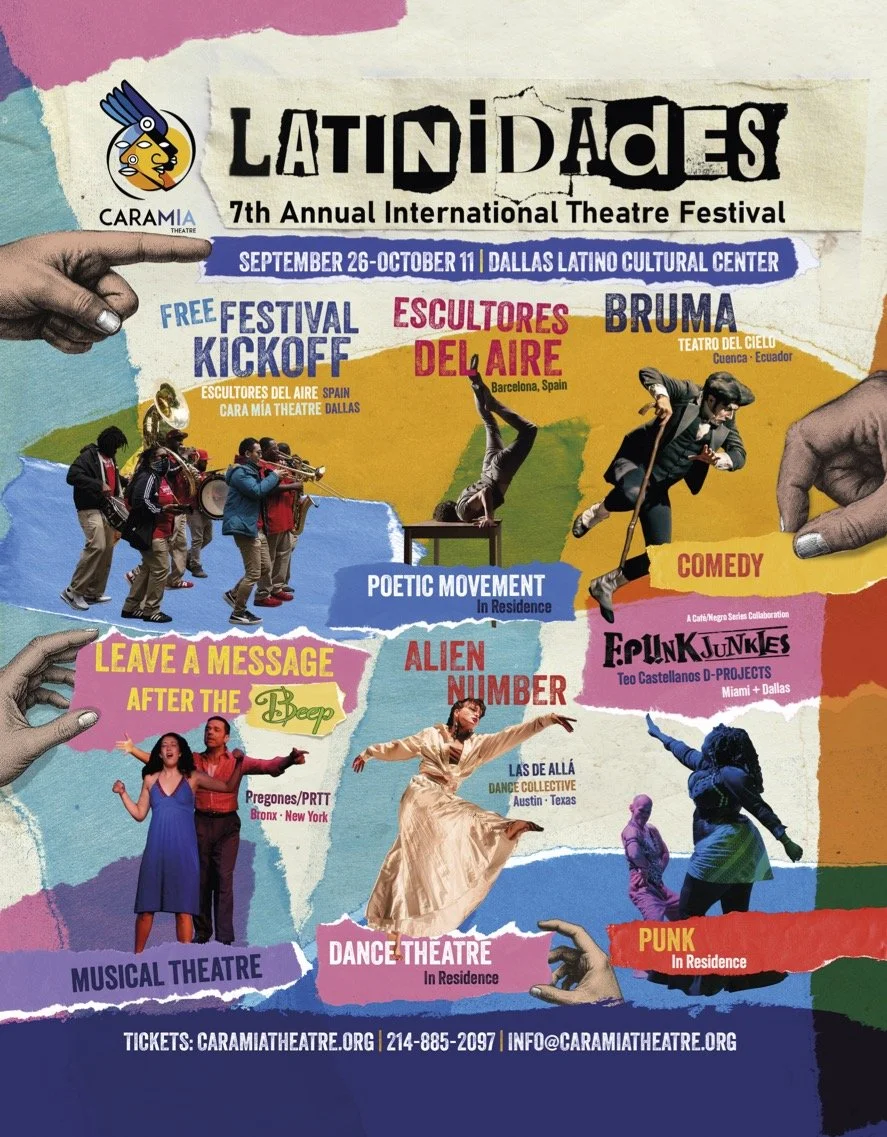
Cara Mía Theatre opened its seventh annual Latinidades Theatre Festival on Saturday, September 26, 2026, with a free celebration that brought an international as well as regional dimension to the Latino Cultural Center.
The celebration began at 5:30 p.m. with a street procession, carnival-style, outside the Latino Cultural Center, led along the neighboring streets by the returning Mai Rojas, from the Barcelona-based company Los Escultores del Aire (Sculptors of the Air). While I missed the parading, I heard the participants truly enjoyed this public and joyous romp through the city.
At the heart of the celebration were the food vendors and later the cumbia band (situated at the Latino Cultural Center Plaza) that allowed folks to sit, eat, and gather together.
The indoor performances in the LCC’s black box theatre started at 7:30 pm on a first-come, first served basis. The place was packed. Then the lights went off and the magic began!
At the heart of the kickoff were seven solo physical-theatre performances, each drawing on the techniques of Mai Rojas´ physical theater aesthetics and techniques. Rojas himself appeared three times. During the week before opening, artists from Austin's Las de Allá dance company and Dallas's Cara Mía Theatre Company already had joined him in a workshop exploring the expressive possibilities of the body in works ranging from memory and anxiety to gentrification, displacement, war, and transformation.
And the results were seen and heard in the performance pieces we saw, all created within that one week. Amazing!
What made the program particularly intriguing was the opportunity to see a shared physical vocabulary refracted through seven very different performers—and to consider how successfully each artist turned movement into character, narrative, and theatrical meaning.
There were seven short pieces:
Frida Espinosa Müller (Cara Mía Theatre Company) — Voces del Tiempo
Mai Rojas (Los Escultores del Aire) — Ansiedad
Daniela Vargas (Las de Allá) — Gentrification
Mai Rojas — El Viaje
Miranda Kitty (Las de Allá) — Párate
David Lozano (Cara Mía Theatre Company) — Been There, Done That
Mai Rojas — Shock
Suitcases appeared in several of the pieces, starting with an intriguing entrance by Espinosa Müller inside a suit case, from which she emerged. Her Voces del Tiempo (Voices of Time) felt like a multi-layered travel through what happens within the soul that physically migrates not only in space but in time.
On a similar note, Daniela Vargas’ (Las de Allá) Gentrification evoked that never-ending dilemma of leaving one´s homeland ‘paradise’ (in Vargas´s case the much sought after nirvana of Costa Rica). The work was danced to the driving and appropriate Bad Bunny song, Lo que pasó a Hawaii, a scathing criticism of neo-colonialism. The loss and longing to be present in two places at once, here and there, was punctuated by the nostalgia of not being able to participate in her family´s key moments (sitting with her Abuelita, being there for her nephew’s birthday party, etc.) While there was not a physical suitcase seen on stage, it was deeply felt as an invisible object that carries one´s self in the journey of migration.
In Mai Rojas´ El Viaje (which I loosely subtitled “lots of train tickets and nowhere to go”—as I didn’t initially catch the title) centers the suitcase not within an actual migration or journey, but as a locus where the self chooses (or not) to place their hopes and aspirations to travel—to go beyond their invisible comfort zone—and dares to challenge the self. With many blank tickets, symbolic of wasted opportunities, the resolution occurs when Rojas discovers and honors that one “ticket to ride” a train to somewhere. And takes it.
The remaining four pieces addressed what I perceived to be existential crises, without the trope of travel or suitcases. Miranda Kitty´s Párate correlates to Alaina Castillo´s song by the same name. “Párate” is a Spanish familiar command form that means “get up” or “stand up.” The resonance here is for a woman to pick herself off the floor after whatever life throws at her in love, or otherwise. David Lozano´s Been There, Done That strips the image of the male in the suit and tie against a giant dark wall which he attempts to climb to no avail. This one interrogates society´s mandate of men to play the game of social and economic climbing, to the detriment of the inner self. At the end, he undoes the tie that literally binds him, takes off the suit (strait?) jacket and ascends towards the light. Liberation at last!
In the third work, Rojas´ Ansiedad (Anxiety) we witness the ticks, the nervousness, the physical demonstrations of a person whose body-mind are wired out of control. Rojas´ gift to his audiences is that he not only illustrates states of being, but causes a subtle, parasympathetic emotional response in us. His control over every inch of his now mature body captivates now as much as ever. A truly gifted physical storyteller whose talent only deepens with time.
The final work, Shock—possibly the program’s starkest and strongest socio-political commentary on war’s inhumanity—was again performed by the maestro Mai Rojas. Wearing a raggedy outfit that gave off puffs of dust, with a background in Russian, and a bloodied head, this piece could not be about anything other than the volatile situation in the Ukraine. Shock is what this character is going through after surviving bombings and the destruction of his home. In my opinion, this was the strongest piece in the set, not only due to its evident representation of the human destruction of war, but because Rojas´ emoted through the demanding piece in way that, again, was almost unbearable to watch.
The ending surprised us with a downpour of red sand from the ceiling, alluding to the derrumbe, the collapse not only of physical structures (homes, schools, hospitals) but the collapse of our humanity condoning such atrocities. It is a call to witness the pain of others who, for most of us, only appear on the evening news as something that happens to others, far away. The audience rewarded the performers with an enthusiastic standing ovation, myself one of the first to pop to my feet.
After all this emotional heaviness, we were invited back out to the plaza to shake if off, eat Chef Troy´s delicious hot dogs and tacos , and drink and dance to a wonderful live cumbia band from 9 to 10 pm.
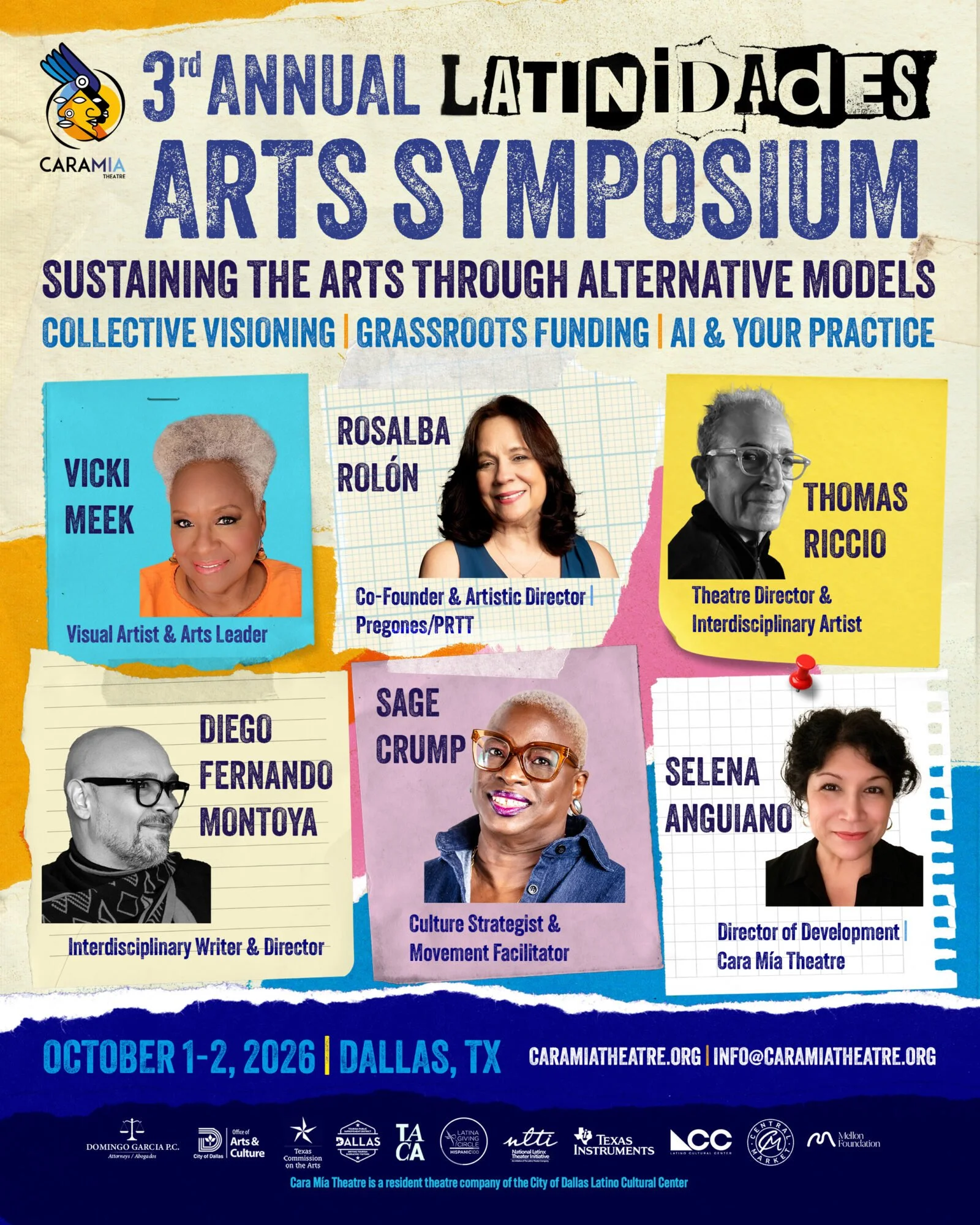
Check out https://caramiatheatre.org/latinidades/ for their upcoming Symposium and performance schedules. You will certainly enjoy them. There is nothing else like it in DFW!
WHEN: September 26-October 11, 2026
WHERE: Latino Cultural Center, 2600 Live Oak, Dallas
WEB: caramiatheatre.org
Teresa Marrero, Ph.D. writes about dance and theatre. She has been covering the DFW Latina-o theater scene since 2013, both for TheatreJones.com and now for OnstageNTX.com As a free service to the public, readers and researchers can find her archived reviews on the History of Texas Portal at the University of North Texas, https://texashistory.unt.edu/ Search the Private Collection of Dr. Teresa Marrero.