—Teresa Marrero
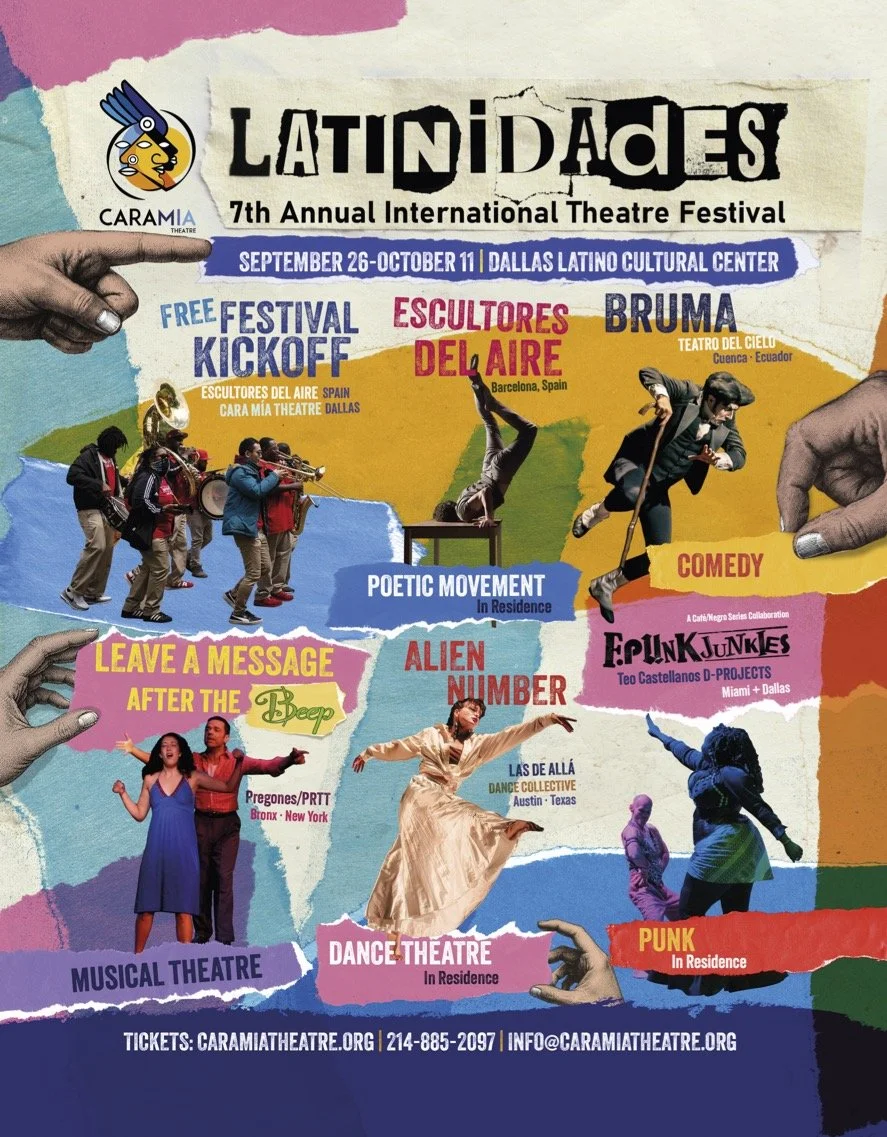
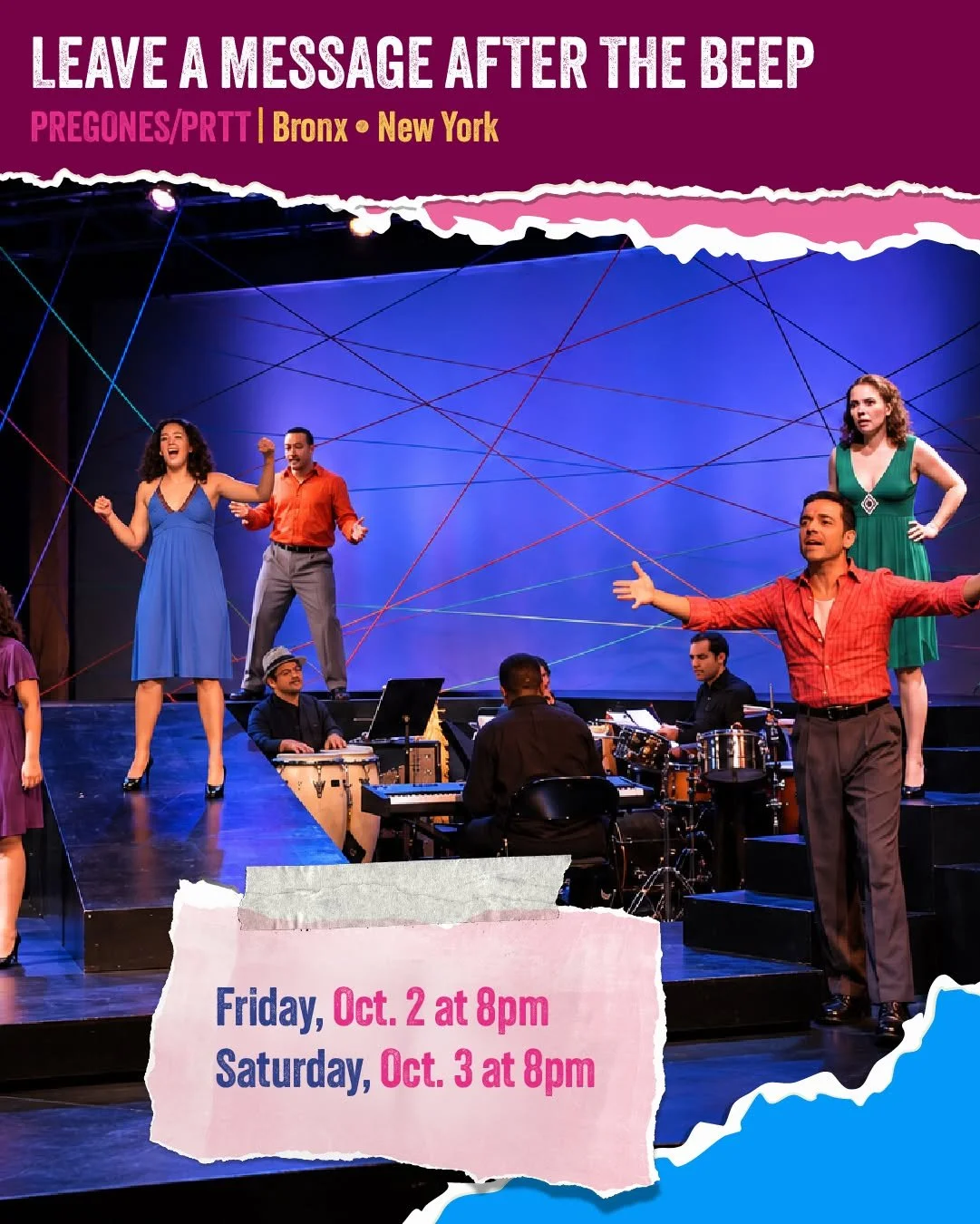
Leave a Message After the Beep, directed by the Puerto Rican Traveling Theater (PRTT) founder Rosalba Rolón (and presented during Cara Mía Theater Company’s 7th Annual festival), is a vibrant, musically rich production built around fourteen musical pieces. It is brought to life by a remarkably versatile ensemble who sing, act, and dance their way through an eclectic portrait of Puerto Rican identity with live music, and realistic backdrop projections of New York City life. On Friday (Oct. 2), the show was followed by a live performance in the lobby by the Afro-Cuban conjunto, Los Rumberos de Dallas.
Staged in the Mainstage Theater, the production of “…Beep¨ begins with a clever and evocative theatrical trope: the telephone message. Moving from the old-fashioned telephone operator to the early tape-reel messaging systems to its cellphone contemporary incarnations, the device immediately suggests communication across distance—the distance between people, between generations, and, more specifically, its diaspora.
That Puerto Rico–New York–diaspora axis provides the production’s central thematic structure. But as the evening progresses, the telephone-message conceit gradually gives way to a succession of very different pieces. The result is an evening that offers considerable theatrical variety and beautiful music but also raises the question of whether these fourteen works ultimately coalesce into a unified theatrical experience or remain, at times, an anthology of individual numbers with theme of the diasporic experience running through them. Holding opposing points of view allows us to accept that coalescing into a unified field may not be an essential component for fine entertainment, despite our human penchant of wanting to impose unity and order.
The subjects range widely. One piece addresses the gentrification of formerly publicly held lands in Puerto Rico that allowed a young boy to play baseball there (and the projection reveals a multi-story parking structure), shifting the production into pointed social commentary. Another takes a decidedly comic and absurdist turn, imagining the proliferation of cockroaches in an apartment and their attempt to organize themselves like human beings—with the wonderfully ironic consequence that their organization ultimately leads to their own extinction. This piece was funny and an original allegory. It also hailed me back to one of my favorite pieces by the PRTT, their 2013 production Dancing in My Coachroach Killers.
Then comes a very different exploration of Puerto Rican identity in New York, built around self-deprecation and the complicated question of belonging. At its heart is a striking idea: “I was not born in Puerto Rico; Puerto Rico was born in me.” The statement captures something essential about diaspora—the possibility that homeland is not merely a geographic place one leaves behind but something carried within oneself, even if accompanied by inherited nostalgia.
The performers’ versatility helps hold these disparate worlds together. They move fluidly among music, acting, dance, comedy, political commentary, and personal reflection. The music provides some of the production’s most beautiful and consistently engaging moments.
One of the pieces that most deviates from both the telephone message ´beep´ and the diasporic identity tropes is ¨Christian,¨ a solo narration that centers the voice of an openly white racist male in center stage. The anti-immigrant sentiment is there exposed as the open wound of the current political situation on our country.
The original telephone-message metaphor, which establishes such a promising theatrical framework at the beginning, disappears as the evening unfolds. By the time the production returns to the phone-message device near the end, the trope has become somewhat lost along the way. The return provides a sense of circularity, but it also draws attention to how far the production has wandered from the conceit that initially gave the piece its title.
That may ultimately be the central question raised by Leave a Message After the Beep: Can fourteen individual pieces about Puerto Rican life, identity, politics, humor, memory, and diaspora become something more than the sum of their parts? Winding back to my previous thought, while unity may not be a necessary component of a successful performance, this piece does offer us the opportunity to question the notion. To me, the strongest message is not about communication across time or place, but about proudly reaffirming a Puerto Rican identity, no matter where its people may be in place or time.
What is consistently excellent and much admired is the performers’ energy and versatility, the beauty of the music and the professionalism of the production.
Ensemble (according to the playbill): Anna Malavé, John Cencio Burgos, Juan Luis Espinal, Jackie Leon, and Diana Pou. Musical director and keyboard: Desmar Guevara, Violin and Assistant Musical Director: Sergio Reyes. Percussion: Anthony Carrillo. Bass: Alvaro Benavides.
————————————-
Also presented October 2-3 at the festival were Los Rumberos de Dallas, who provided a unique experience of authentic Afro-Cuban music, the guaguancó, featuring a seven-piece ensemble of percussion musicians in the traditional Yoruba-based incantation of the Orishas (spirit-energetic, pantheistic entities of the Cuban syncretized religion of Santería).
While the purity and complexity of these songs may be unfamiliar to those of non-Afro derived cultures, it did indeed drive some of the audience members to feel their way and move to the elemental rhythms of this sacred and secular tradition (myself included as a Cuban-born person), as well as others of Mexican, Colombian and Argentinean background! There is nothing like a good rumba! (FYI, there is no ´h´ in the Cuban version of the word. Rhumba is the anglicized version introduced into ballroom dancing, which is a world apart from the original).
Check out https://caramiatheatre.org/latinidades/ for upcoming performance schedules.
There is nothing else like this in DFW!
WHEN: September 26-October 11, 2026
WHERE: Latino Cultural Center, 2600 Live Oak, Dallas
WEB: caramiatheatre.org
Teresa Marrero, Ph.D. writes about dance and theatre. She has been covering the DFW Latina-o theater scene since 2013, both for TheatreJones.com and now for OnstageNTX.com As a free service to the public, readers and researchers can find her archived reviews on the History of Texas Portal at the University of North Texas, https://texashistory.unt.edu/ Search the Private Collection of Dr. Teresa Marrero.