‘True West’ @ Lakeside Community Theatre
—Jan Farrington
Sit with a play long enough—experiencing it every decade or so for most of a lifetime—and it gets to be like a cousin you don’t see too often…and that’s fine by you. Still, you’ve gone through a lot with this piece of work. You’re invested; you care, even when the humans involved tend to push way out there, beyond the boundaries of reality or decency.
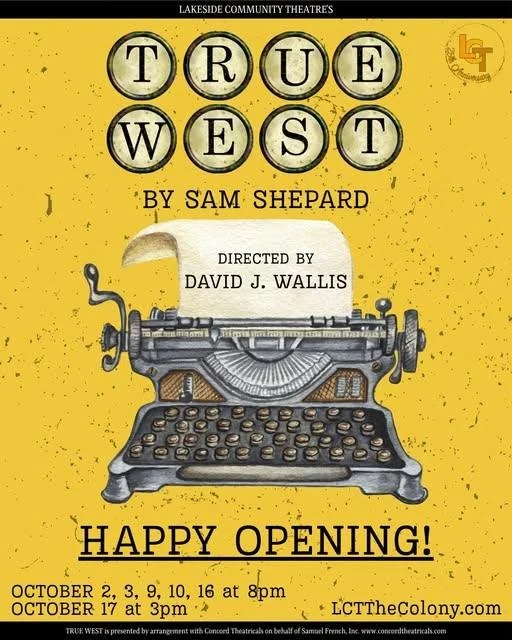
So it is with me (and perhaps more than a few of you) and True West—the rowdy, awful, amazingly human masterpiece that put young playwright Sam Shepard on the theatre map in 1980. Directed at Lakeside Community Theatre by artistic director David Wallis for the company’s 25th season, this production is more than good—layered, revealing, and with a sizzle of angry energy that speeds us through the scenes, pedal to metal.
In their Mom’s empty house (she’s on vacay in Alaska) in the dry country far outside Los Angeles, brother Austin (Wyatt Tompkins) is at the kitchen table, agonizing over a screenplay in progress. Everything’s “riding on it” and he’s visibly annoyed to have older brother Lee (Bryson Peterson) drop in for a visit—leaning over the typewriter, poking him with old insults and quarrels, swilling down 99 bottle of beer.
In a projected “home movie” that begins even before the play, these two are shown as boys, playing with their dogs, exploring the woods with Mom (on film Kristina Morrow, on the night I saw, played by Vivian Reed), their Dad—then as now—literally not in the picture. It’s a poignant beginning, since the warmth of that earlier time has obviously faded.
Shepard sets these two up as a duality, a yin and yang, though it’s not that simple. His Austin and Lee are family after all—with pieces of one another shared or overlapping. Austin’s been to college, makes money as a writer (though never enough), has a wife and kids, a house. Lee is a drifter and a loose cannon—living rough, trolling the surroundings for stuff to boost and sell (TVs, toasters, etc.), on the edge of jail or disaster most of the time. Still, as the story moves along, it becomes ever more clear that each of them envies the other brother’s life. And that sets the stage for hostilities that start small—but move inexorably from misdemeanors toward grievous bodily harm.
Set designers Douglas Gill and Melissa Wallis give us nice hints of a suburban home with a country-ish kitchen ‘70s-style: Early American chairs (the same ones from the boyhood movie), skirted countertop, lace curtain—all lit well for different times of day by Vinchenzo Locascio. Both costumes and sound/music choices are right for the time (Amanda Carson Green, Lindy Englander). The show has a fight director (Sunny Saens) who earns her credit, as does Elise Knox, whose multitude of good props (avocade-green stove, a dial wall phone, a manual typewriter) fill out the atmosphere. The place is tidy, but just wait. (I don’t envy stage manager Carrie Wright, who must have to ramrod the cleanup.)
The two central characters give us a lot to chew on from start to finish. Tompkins’ Austin is soft-spoken and quiet, though easily roused by a brother’s teasing. He steams, and then pulls back repeatedly into banal questions (want some breakfast, etc.) instead of losing his temper. For a while. He weathers Lee’s constant jabs about what a great life Austin had—while Lee got the short end of every stick.
Petersen’s Lee is the fire burning in the room: a jealous, hot-tempered grifter, playing every angle every minute. (Peterson shows remarkable skill at building the character’s intensity bit by bit.) But it’s not until the Hollywood agent Saul (Bart Cowser) comes in for a meeting about Austin’s screenplay that we start to see Lee as more than small-time; he’s a major con artist, revealing himself in a sudden show of polished charm as he schmoozes Saul into a friendly golf game, and starts to pull Austin’s career out from under him—by shopping a great Western story Lee just knows will captivate Saul. Austin can’t believe it.
From then on, the boys worry less about their mostly-invisible family (Dad’s money/health troubles and Mom’s oddities), and dive deep into their own pool of resentments, rage, and irrational grudges. It’s hilarious and terrible, and especially funny as we watch “upper hand” Austin suddenly become a beggar for crumbs from Lee (who has susceptible Saul wrapped around his finger), or rough-spoken Lee trying to peck out some decent dialogue on the typewriter.
This plot screams for an intervention, but Shepard seems inclined to dangle one—-and then yank it away.
LCT’s production does this play—and the company—proud. This might be my 8th or 9th True West over the years; and though I still long for a way-back machine to let me watch Tommy Lee Jones and Peter Boyle play it long ago, this one stands up just fine.
WHEN: October 2-17, 2026
WHERE: 6303 Main Street, The Colony, TX
WEB: LCTTheColony.com