‘Bigger’ @ Arts Mission Oak Cliff

—Rickey Wax
I admit that when I heard about a show called Bigger at Arts Mission Oak Cliff, my interest was piqued. When I learned it took place inside a penis-enlargement clinic, I went ahead and blocked off my Saturday afternoon. After all, most of my theatrical diet this year has consisted of musicals, so the prospect of a new straight play felt like a welcome change of pace—and, if I'm being honest, it also gave me the perfect excuse to stop by one of my favorite soul food spots in Oak Cliff afterward.
What I did not expect was for the clinic to become a microcosm for a much larger conversation about Black masculinity, white supremacy, sexual fetishization, body image and the exhausting pressure to prove one’s worth by becoming more.
Written and directed by Calvin J. Walker, Bigger asks a question far more substantial than its provocative premise initially suggests: What does it mean to be seen as more than a body, a myth, or someone else’s projection?
At a time when many plays centered on Black life foreground police brutality, enslavement, incarceration and violence inflicted upon Black bodies, Bigger turns its attention inward. Yes, those realities remain part of the cultural landscape, but Walker examines the psychological wounds that can develop beneath them.
Black humanity is not a monolith, and neither is Black suffering. Bigger creates space for experiences frequently ignored or treated as punchlines: male body dysmorphia, sexual insecurity, queer isolation, grief, religious expectations, and the fear of never measuring up.
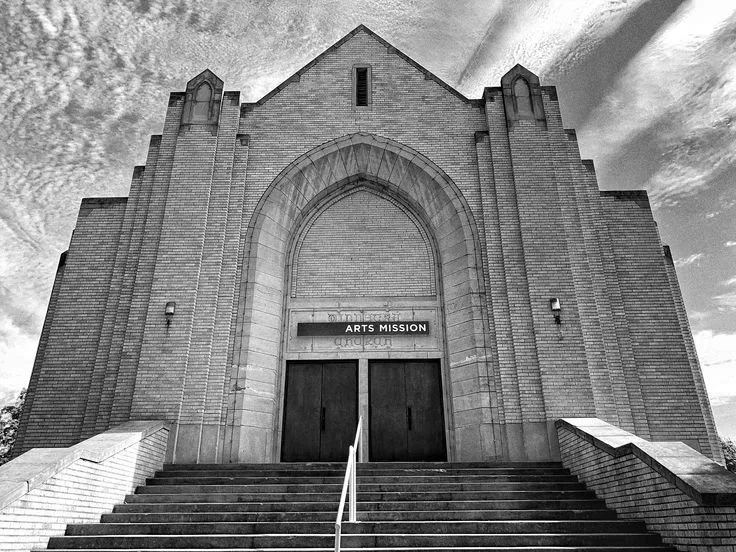
Walker became an artist-in-residence at Arts Mission Oak Cliff in April 2026, and this workshop presentation served as the culminating offering of that residency. Rather than simply presenting a play, he sought to create a safe space for Black men and conversations surrounding mental health. Bigger does exactly that.
The minimalist set consists of cool white lighting, a coffee table, a low raised platform and seven chairs apparently carved from the same material as Stonehenge, their discomfort becoming one of the show’s recurring jokes. Four Black men sit in the waiting room of a penis-enlargement clinic, believing they are there to change their bodies. What transpires is a deeper conversation about who taught them to distrust those bodies in the first place.
DJ, played by Bryson Chalk, is the first man we meet. He represents emotional intelligence, tenderness, and a belief that intimacy requires truly seeing another person.
Roger, played by Bryant Huggins, enters nervous, apologetic and unable to leave silence alone. Beneath his fidgeting lies a man deeply aware of loneliness and the ways fear of rejection can cause people to accept less than they deserve.
Zay, played by Jacobie Thornton, is a hypermasculine fitness influencer whose followers have begun mocking his anatomy. His confidence is revealed to be a performance built for an audience capable of turning on him with a few comments.
Tim Meadows’ Chad arrives suave, religious, and engaged to be married. He appears the most composed, yet he is also pursuing the procedure without his fiancée’s knowledge.
Together, the men represent competing definitions of masculinity: emotional openness, belonging, dominance and respectability. None is presented as wholly correct.
Their initial banter about sex, procedures, pornography and grey sweatpants slowly gives way to confession. Roger reveals that he is gay, causing Zay’s previously easy camaraderie to become conditional. Roger later describes the fetishization he experiences from white men who desire a stereotypical Black body rather than a complete human being.
The most disturbing shift comes when Zay proudly recounts losing his virginity at fourteen to a woman in her twenties. The other men recognize what he cannot: he was abused. To acknowledge that would dismantle the identity he has built around sexual dominance.
DJ offers a different definition of intimacy through advice once given by his brother Rashad: sex should be “into-me-see,” an act of mutual recognition rather than conquest.
The play’s major twist reveals that DJ is not another patient but the physician the men have been waiting to meet. When he asks them to undress and submit to measurement in front of one another, their willingness to undergo surgery collides with their inability to stand vulnerably before their brothers.
They can agree to become objects, but they cannot bear being seen.
Chalk carries DJ with natural charisma and quiet swagger, listening as carefully as he speaks. During the titular “Bigger” monologue, his voice gathers the rhythm and force of a sermon as he connects the men’s insecurities to slavery, Jim Crow, fetishization and generations of pressure placed upon Black bodies. His authority later collapses into grief when DJ reveals that Rashad died by suicide, giving Chalk’s performance considerable gravitas.
Huggins gives Roger a calm demeanor contradicted by nervous gestures, shifting posture and verbal overflow. His restraint makes Roger’s eventual scream, when language can no longer contain his loneliness, especially powerful.
Thornton makes occupation of space central to Zay. He sprawls across chairs, changes levels and moves as though determined to become impossible to overlook. His forceful voice cracks or rises whenever Zay’s manhood is threatened, exposing the insecurity beneath the bravado.
Meadows is a quiet surprise as Chad. His controlled posture and economical movement give the character authority, while flashes of irritation reveal fractures beneath his polished exterior. When Chad finally unleashes his frustration, the moment lands because Meadows has spent so much of the performance withholding it.
The audience eventually becomes participant, functioning first like a congregation and then a jury or circle of witnesses, as DJ commands each man to “name the thing” that brought him there—the small insecurity taking up too much space.
Although Bigger closed its limited workshop engagement on July 18, I have a strong feeling this is not the last time audiences will encounter playwright Walker’s four men, four uncomfortable chairs and one very small thing occupying far too much room.
WHEN: July 17th-18th, 2026
WHERE: Arts Mission Oak Cliff, 410 S. Windomere Ave, Dallas
WEB: www.artsmissionoc.org