‘Bull in a China Shop’ @ Second Thought Theatre

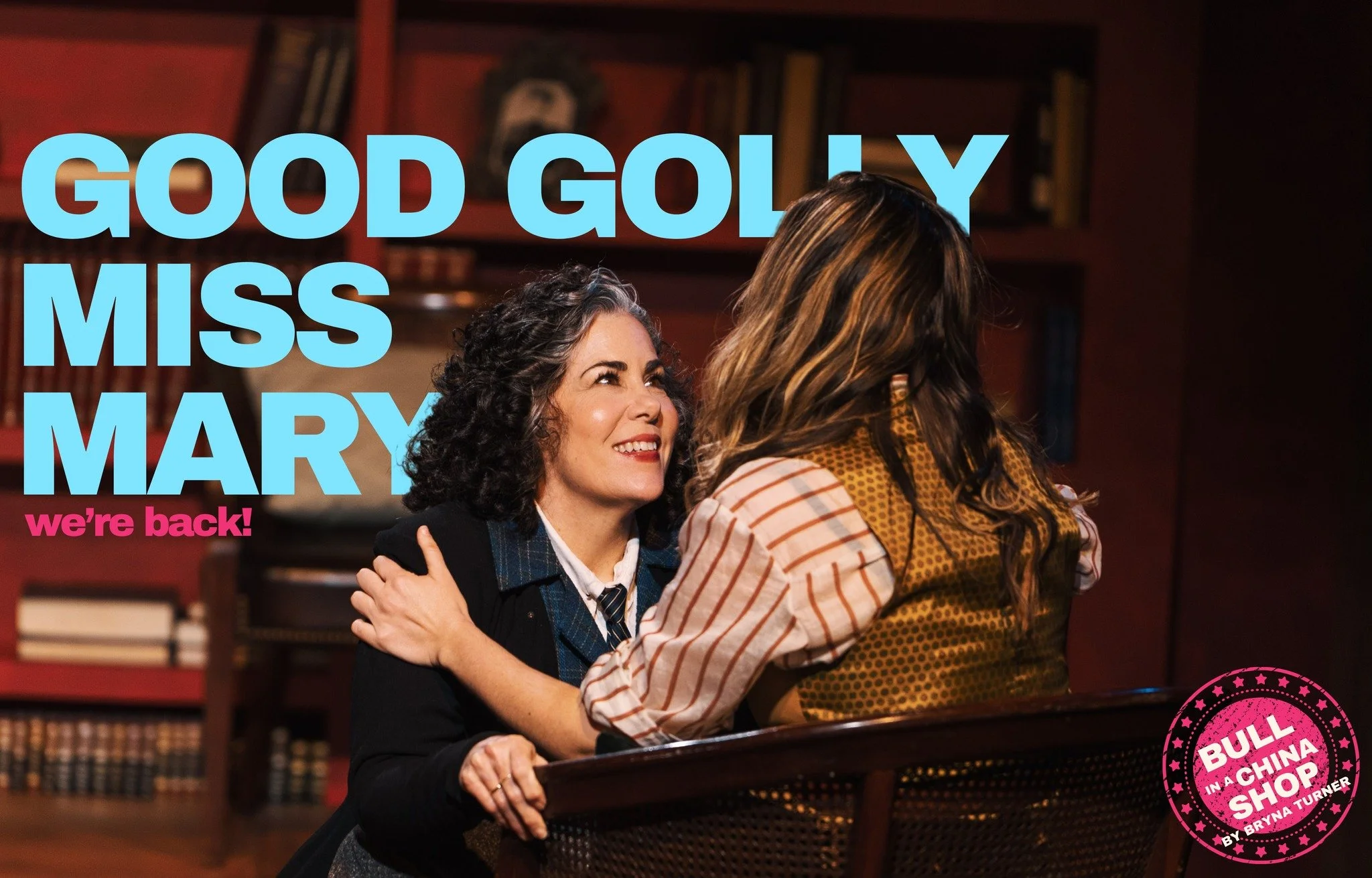
Production photos by Evan Michael Woods
—Ryan Maffei
The Second Thought Theatre coproduction (in partnership with Amphibian Stage) of Bryna Turner’s Bull in a China Shop, directed by Kels Ervi, began its second leg at Bryant Hall last weekend, and comes on with the same righteous fire that roared inside the feminist activist it’s about, 19th-century Mount Holyoke president Mary Woolley.
In times like these, marginalized voices really should crowd others out, and here’s Miss Mary, plunging fearlessly into battle, confidently smirking in oppression’s face. It’s hard to overstate the charge you’ll get from a stage full of five women — no men in sight for the briskly epic 90 minutes — rocking out to the first of numerous queer bangers that sound designer Cresent R. Haynes has cranked all the way up for us.
I and my companion (a queer femme local theatre artist who declined to share a byline, but provided invaluable perspective) were all too excited to see this show — to say “fuck yeah” and bang our heads while it grabbed toxic power structures by the lapels and slapped them hard.
Yet what we experienced felt more like what playwright Turner, if not director Ervi, may have intended. For Bull, under its eye-catching red cape, is less about hitting ideological bullseyes—and more about the messy love story at its center. The play’s solidest acting work, profoundest moments, and most spirit-enflaming text concern love, an experience so universal it’s an equalizing force. Sapphic love, mind you: Woolley had a lifelong relationship with colleague Jeanette Marks, the co-star of the story.
Woolley (Emily Scott Banks) and Marks (Dani Nelson) were once professor and student. Early on, we see Marks develop her own sycophantic coterie, who hang on her every word – chiefly Pearl (Mia Azuaje), who aches to be plucked from innocence’s oyster. The subtle ways Woolley and Marks’ passions diverge is a recurrent element. Per the oft-repeated title, Woolley carries herself with a trailblazing boldness — yet, as the elder in the dynamic, her desire to effect real systemic change collides with Marks’ burn-it-all-down fervor. There are pointed, if increasingly less helpful, discussions about the exhausting challenges of real change, and history’s victory-upending cyclicality. And the script’s lack of criticism of student-teacher relationships is less easy to sit with.
I like that this piece is full of conflict but lacks villains. And as my editor observed to me, this is no Children’s Hour tragedy of shame and personal destruction — there’s a lightness and ease to these proceedings that decades ago might’ve felt many times more provocative than it does now. But the play’s proudest device is its biggest problem: there’s a barrage of stylized transitions, with that insanely loud, gay-themed music (again, zero notes there), and movement that at its weakest trivializes Turner’s arguments, or feels half-baked (“just go crazy for four bars!”). These moments throw light on a questionable structure; even minute-or-less scenes are punctuated by transitions of equivalent length.
Near the end, a series of long monologues (and false endings) occur, and the transitions feel even less unifying, to say nothing of clarifying. Conceptually, the production’s climax — an audio montage of voices from female or female-identifying activists and politicians — might have seemed a strong idea. But as an experience, it’s too close to one of those pushily sincere presentations you sit down to watch at museums or history exhibits, and the cast standing in silent awe somehow makes it emptier. Yes, it’s incredible to see how far we’ve come, but also, look where we are now.
How many of these problems are on Ervi and how many on Turner isn’t always certain. But my co-viewer posited that they should’ve taken a cue from the ardent Pearl, and let the muddy girlboss rave stuff be secondary to the show’s great strength — as a “fanfic” for a deeply compelling love story. That, she offered, “would’ve packed the punch the production’s additions seemed to be trying for.”
The best moments in this show will leave you wrecked. One is an unhinged monologue from a heartbroken Pearl, carrying a boombox (anachronisms cheerfully abound here), and pleading at Marks from below her balcony. As she burns down to ash, Pearl captures so much that’s real about not just heartache but a first lost sapphic love — my better-informed companion noted it as “a canonic first lesbian breakup experience.” Another is a stirring direct address from Marks, a stellar piece of writing about writing, the passion art enflames or instills. Another sees Woolley simply standing in shock, as invisible waves of turmoil crash within her. (It’s lighting designer Caroline Hodge’s best moment in a tricky job — the show shifts time and space across a gloriously detailed Leah Mazur set so big there’s barely any black left in the box.)
In these moments, you really catch that soul-filling sense of identification, of something truly human that in a political tract or novel sends you rushing out the door, alive as you’ve ever felt. The production also gives each actor a chance to show off mad chops. Banks has natural air of dignity she sometimes struggles to temper, yet her Woolley is rife with what’s best about her acting — her perpetual, fruitful search for bursts of absolute life, or loose threads she can pull. Meanwhile, Nelson foregrounds Marks’ quirks, rather than the biting wit or mad intensity the characters perceive, with zephyrs of almost childlike emotion between paper-tiger punches.
One of Azuaje’s great talents is for “guileless beaming,” on strong comic display here — and when she nailed the silent heartbreak behind that beam I almost wanted to stand up and cheer. Confined to a primly limited range of motion (and what may be costume designer Murell Horton’s most restrictive period-accurate ensemble), Laurel Lynn Collins (as the college’s resident old guarder) uncovers endless heroic nuance in wringing hands or twitching pursed lips. And while Nicole Renee Johnson is as subtle and funny as her costars, it comes sharper; every time she appears, the energy goes up.
It’s sometimes easier, when you’re watching an excellent show with immeasurable potential, to get stuck on things that didn’t land — like Marks doing an unconvincing “first time cooking” gag, or an odd, extended intimacy sequence that can’t decide if it’s representational or not. (intimacy coordinator Anne Healy has, for the most part, done really good work, and Banks and Nelson are fully committed, though their chemistry isn’t as reliable as they are.) But the parts I really admired — for instance, a remarkable flashback scene where Woolley recalls past lovers to Marks — was so resonant, so illuminating, I’ll feel the reverberations for a very long time. Second Thought and Amphibian have packed so much good stuff in a barely big-enough space; it’s a patchwork revolution you can only root for. Yet, as Woolley reminds us, one can always finesse one’s methods when fighting the good fight.
WHEN: April 1-18, 2026
WHERE: Bryant Hall (Kalita Humphreys campus), 3636 Turtle Creek Blvd., Dallas
WEB: https://www.secondthoughttheatre.com/