




—Teresa Marrero
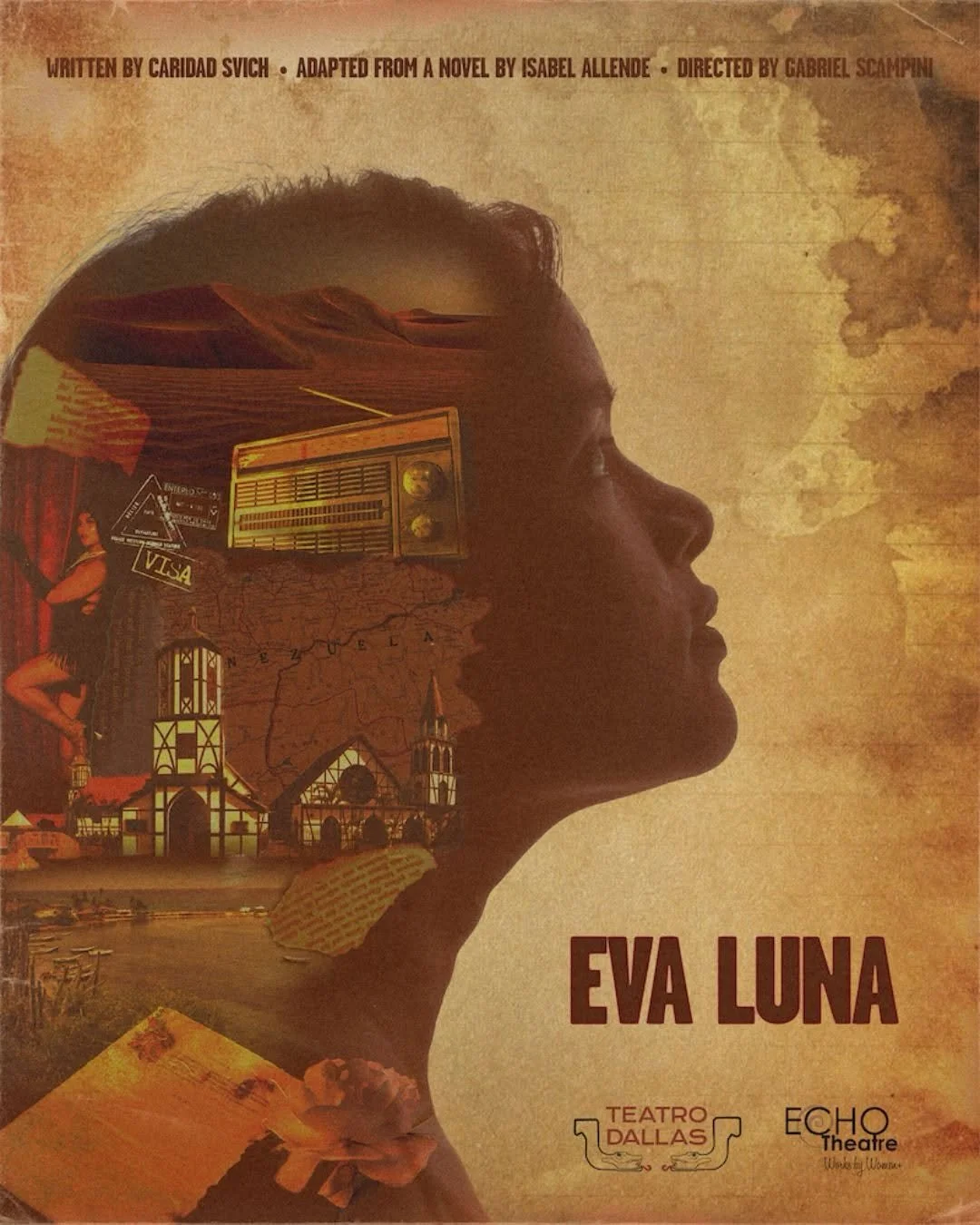
The collaboration between Teatro Dallas and Echo Theatre proves to be a fruitful one, as demonstrated in their November 6-22 production based on Chilean writer Isabel Allende´s famous 1987 novel, Eva Luna. With elements of what is commonly known as magical realism and political commentary, it is predominantly the coming-of-age survival story of a poor, illiterate girl whose ability to learn to read and write and to spin a good tale takes her far and wide. It is not only a story of her discovery of the ability of words as economic and social mobility but of the power a woman´s sensuality in a man´s world.
Let´s backtrack a second first, for we are talking about three different yet overlapping creative components in this one production.
The first, of course, is the novel, which displays all the characteristics of an epic, sweeping saga better suited to a mini-series than a play or a film. I am thinking of the fine job Netflix did with Mexican Angeles Mastretta´s novel Mal de Amores (Lovesick) under the director of her daughter, Carolina Aguilar Mastretta. Allende´s Eva Luna is cut from a similar fabric (less the magical realism, which is lost on the stage version anyway).
The second is Obie winner Caridad Svich´s 2022 theatrical adaptation, commissioned by Repertorio Español in New York City. This is the script used here.
The third is the creative imagination of the Dallas team, headed by producers Stephanie Oustalet (Echo Theatre) and Mac Welch (Teatro Dallas), and under the direction of Venezuelan-born director Gabriel Scampini, who recently also successfully directed another Latin American novel adaptation—Como Agua para Chocolate / Like Water for Chocolate—for Teatro Dallas).
Let´s peel them individually.
As with film adaptations of epic proportions (Eva Luna can be considered an epic tale due to its scope) such as we recently saw in the 2026 film adaptation of Homer´s The Odyssey, readers usually prefer the richness of the written text. I can make the same assertion for Eva Luna: the novel is much richer than the adaptation. I respect tremendously Svich´s immense talent, and the difficult task it must have been to adapt this 300-page Spanish-language novel to a compact two-hour spectacle in both languages. Frankly, looking around the current world of Latiné playwrights, I don´t know anyone who would have done it better. That said, the adaptation stripped away one key component: Eva Luna´s discovery of her own sensuality through various encounters with men along her path.
The play script (and thanks to Echo Theatre for passing it along for me to read), condenses the action, focusing on the timely political and social issues within the novel, sacrificing Eva´s (Fatima Reyes) own sexual awakening. In the script, the second act is dedicated to Zulema´s (Lucila Rojas) sexual frustration with her husband Riad Halabi (John Paul Olsen). An unexpected visit by Riad´s distant cousin from Lebanon, Kamal (Bismark Quintanilla), takes care of that. The staging of this seduction was sublime and well worth the wait.
However, not a hint of Eva´s amorous relationships with revolutionary Huberto Naranjo (also played by Bismark Quintanilla), or with Austrian journalist Rolf Carle (Josua Hires). None of her important trysts with Riad Halabi remained. Therefore, the main character of Eva remains a desexualized and virginal entity despite her many sexual encounters.
Fatima Reyes as Eva Luna narrated the storyline, and performed her role with a rich innocence. Audrey Medrano as Consuelo (Eva´s mother) and Elvira (the nurturing cook) contributed the right amount of emotional support. Lucila Rojas in the triple role of the ornery old Patrona, the sensual yet frustrated Lebanese Zulema, and the Señora (kind Madam of the local whorehouse), was never short of true. By this I mean, each metamorphosis felt as though we were watching a different actor.
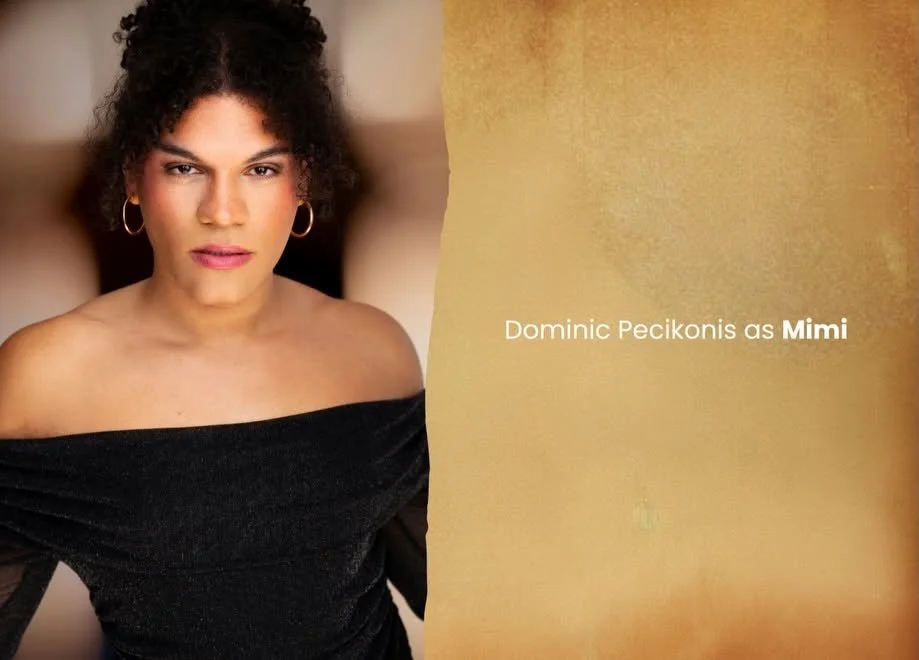
The same goes for Bismark Quintanilla´s double role as Huberto Naranjo and Kamal. It is a pleasure to watch him develop into an actor of nuanced capacity and depth. John Paul Olsen as Riad Halabi left a mark as the imposing yet kind-hearted man and husband. His slight Middle Eastern accent felt unobtrusive, yet informative. Dominic Pecikonis, a trans actor, portrayed the also transgender role of the singer, actress Mimi-school teacher Melesio, whose singing and performance stole our hearts.
And the same goes to the well-cast Joshua Hire in his rendition of the Austrian journalist Rolf Carle. In the script, he is rendered as a central character in the story line, one which parallels Eva´s, and to a lesser degree Huberto Naranjo´s. In the novel all three shared an even influence on the narrative structure. However, only Eva had a central, protagonist role in the novel. In the theatrical version, we see more of a multi-focal approach.
This complexity is astutely and economically directed by Scampini, whose emphasis on movement energized several of Rolf´s lengthy and potentially static monologues. The scenic design on all three sides of the Latino Cultural Center´s Blackbox theatre offered multi-level entries and exits, whereby the actors appeared from various heights and disappeared under the platform layers, suggesting different chronological moments. The scene where Humberto dares Eva to catch a fish from a pond with her bare hands is a priceless piece of subtle physical acting combined with imagination. Thus, given the parameters of the script, kudos go to the cast, to Gabriel Scampini´s direction and to the magic created by Gabrielle Malborough´s scenic design and the entire design team.
Other creatives on that team were: Nick Lafluer on costumes (which suggested Eva´s growth from a girl to a successful TV-novela screen writer); Oso Padilla on lighting (his design was pivotal in signaling the movements from space to space); Jasmine Suarez, Gabrielle Malborourgh and Gabriel Scampini on sound design; Eduardo Vélez III, who composed original music; Harper Caroline Lee, intimacy director; Taylor Post, projections design; and David Saldivar, fight choreographer.
The performance is entirely in English with very good Spanish supertitle translations—a nice role switch! You can still catch this lovely production until November 22 by contacting: https://buy.ticketstothecity.com/purchase.php?event_id=20022 And a heads up: Keep an eye out for the forthcoming Echo Theatre original production of the Short Stories of Eva Luna, scheduled for March 2027.
WHEN: November 6-22, 2026
WHERE: Latino Cultural Center, 2600 Live Oak Street, Dallas
WEB: For tickets, see link in text. For info on the producing companies, go to: echotheatre.org and teatrodallas.org
Teresa Marrero, Ph.D. writes about dance and theatre. She has been covering the DFW Latina-o theater scene since 2013, both for TheatreJones.com and now for OnstageNTX.com As a free service to the public, readers and researchers can find her archived reviews on the History of Texas Portal at the University of North Texas at: https://texashistory.unt.edu/ or search the Private Collection of Dr. Teresa Marrero dr.teresa.marrero@gmail.com.