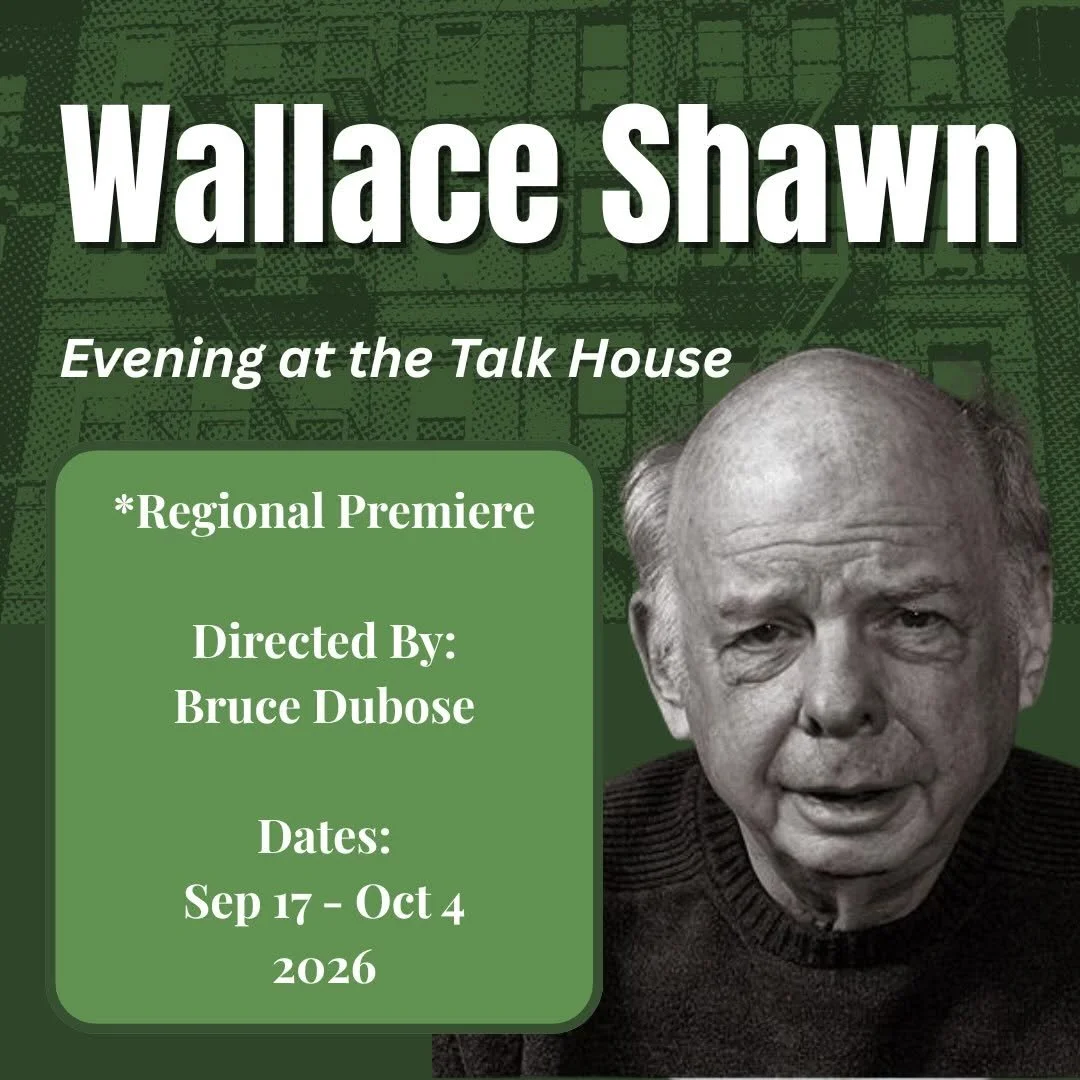
‘Evening at the Talk House’ @ Undermain Theatre
Photos by Tay/Stan Photography
—Rickey Wax
Apparently, the end of civilization comes with cocktails.
There is no great alarm sounding in Wallace Shawn’s Evening at the Talk House. No one is storming the barricades. Instead, old friends gather around a well-stocked bar, reminisce about their theater days, compare careers and discuss killing people with roughly the same urgency one might reserve for deciding what to order for dinner.
Therein lies the nasty little trick at the center of Shawn’s deliciously dark play, now receiving its regional premiere at Undermain Theatre under the direction of producing artistic director Bruce DuBose. The world has gone mad…but people have simply gotten used to it.
Shawn finds something sinister in how easily comfort can coexist with corruption. First produced in London in 2015, Evening at the Talk House imagines a world where serious art has nearly disappeared while mindless entertainment has taken its place.
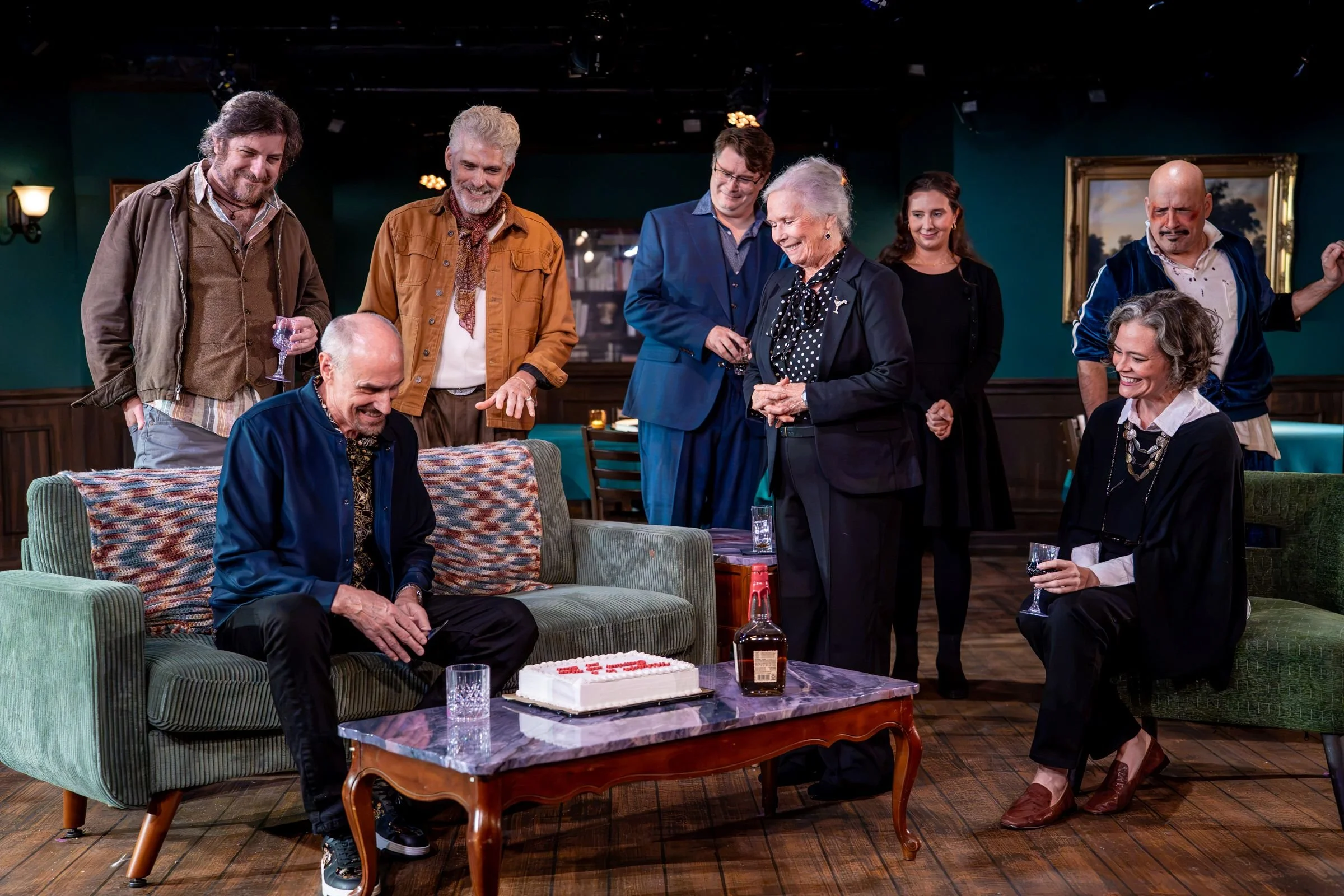
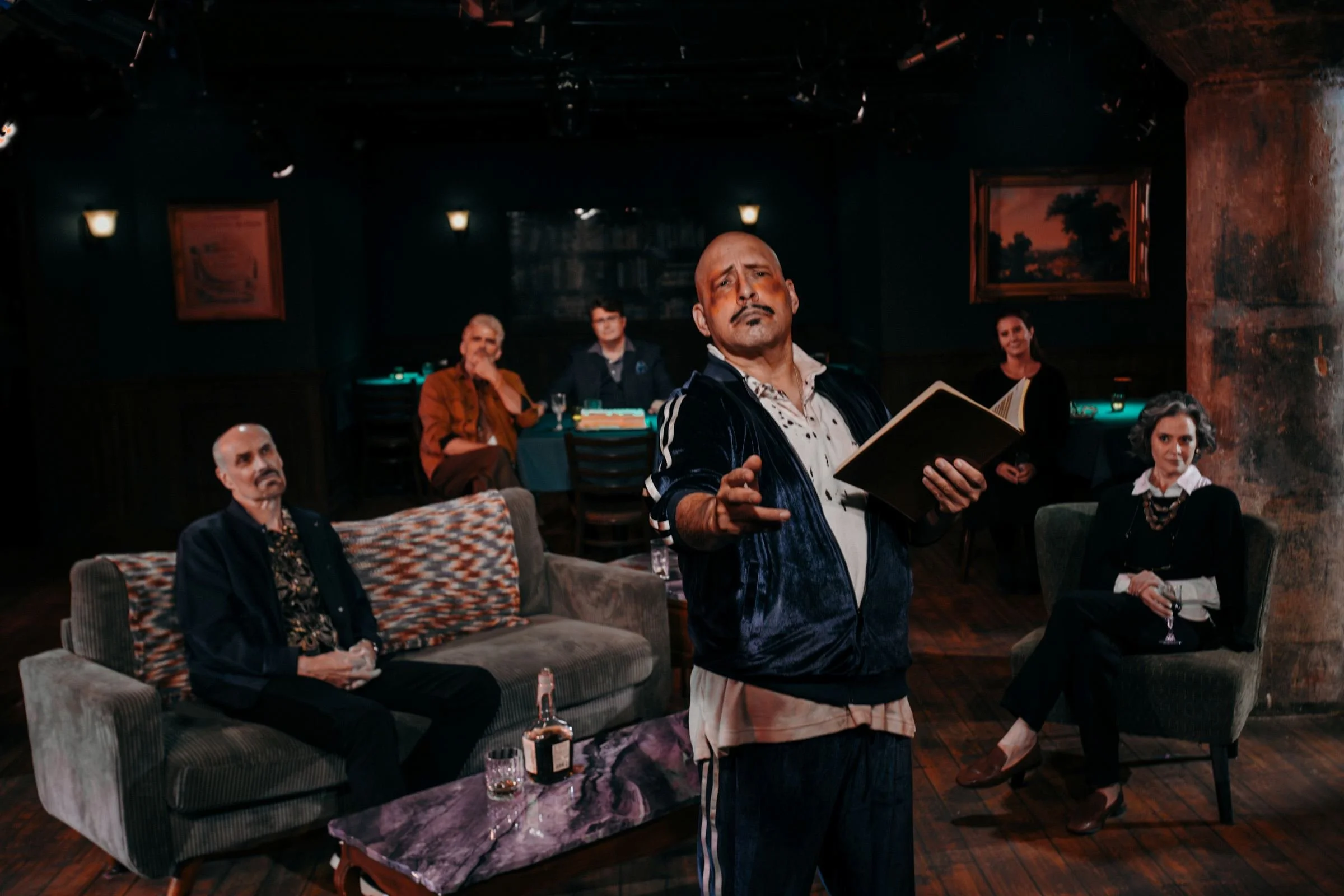
Robert Winn’s scenic design establishes the play’s contradictions from the top of the show. AI-generated jazz from sound designer Paul Semrad welcomes us into a world that feels familiar, but slightly off. Yet Winn’s set is warm and lived-in, with a sofa and marbled coffee table, a library nestled at the rear, candlelit tables draped in green, and a stocked bar at stage left. It is an inviting place to spend an evening, which makes what eventually surfaces there all the more unsettling.
The occasion is a reunion. Ten years earlier, Robert (Jim Jorgensen) wrote Midnight in a Clearing with Moon and Stars, a medieval drama that brought everyone in the room together. The production was a failure, but time has apparently made it worthy of an anniversary. Ted (Marcus Stimac), the play’s composer, has summoned the old gang back to the Talk House, the bar where they once gathered after performances.
Robert opens the evening by filling us in on what became of everyone. Some careers soared while others barely got off the ground. Robert escaped theater for television and now writes a wildly successful show starring his leading man in Midnight, Tom (Tyagi Schwartz). Bill (Ben Bryant) is a high-powered talent agent. Nellie (Elly Lindsay) still presides over the Talk House, while Jane (Samantha Potrykus) has returned to working there after her acting ambitions failed to materialize. Annette (Amber Bonasso), once the wardrobe mistress, now spends part of her time tailoring clothes for wealthy clients. The rest of her résumé is considerably more troubling.
What makes DuBose’s production so effective is its refusal to let anyone behave as though they’ve wandered into a dystopian thriller. The drinks keep flowing and conversations continue, even as Annette begins describing her other line of work, one that should probably stop everyone in their tracks—yet somehow doesn’t.
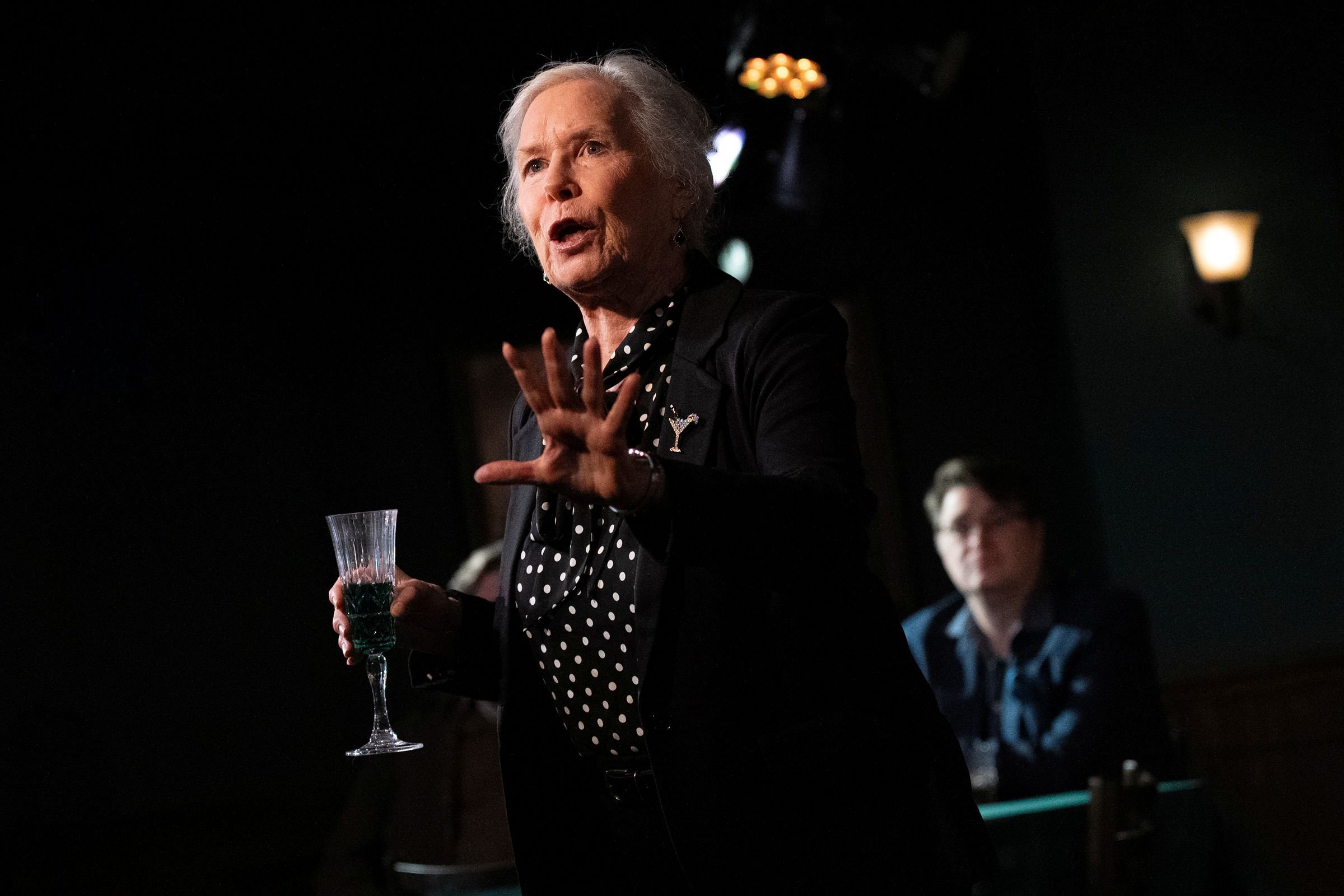
Amber Bonasso makes us understands exactly how dangerous that casualness is. Her Annette speaks with chilling practicality about her “targeting”—at one point comparing the aftermath to using the bathroom. The politics of this world are handled with the same shrug. Does democracy still exist here? Nobody bothers to examine things too closely.
Then Anthony L. Ramirez enters as the uninvited Dick, and the production gets considerably stranger.
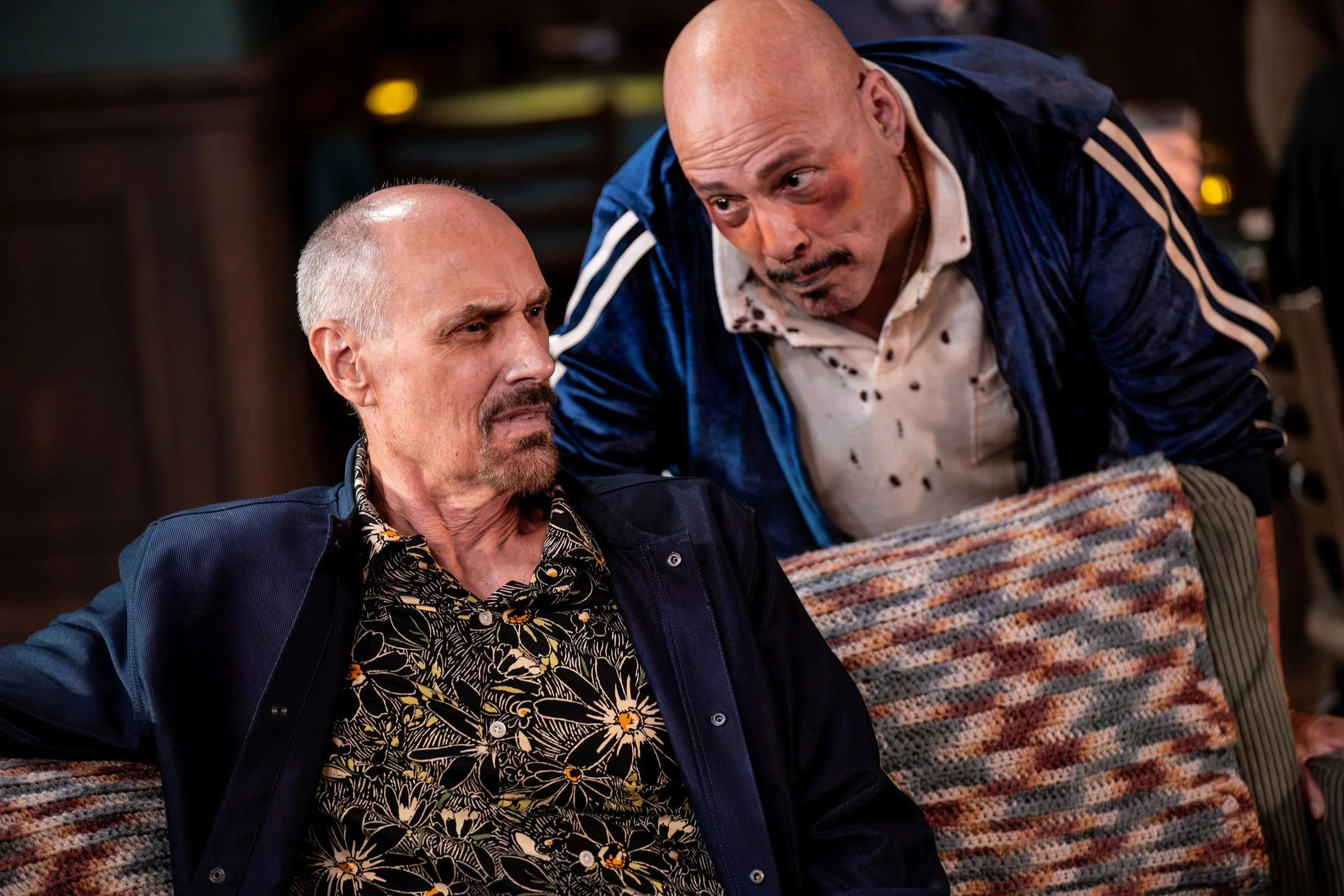
Dick was once a successful actor. Now he arrives bruised, disheveled and hiding out at the Talk House after being badly beaten by people he describes as friends. He insists he is fine. More than fine, actually. He says he loved the beating, which, for a moment, had me wondering if we had wandered into some kind of kink. Then I heard the rest of the play.
Ramirez is marvelous at making Dick impossible to categorize. He is pathetic without becoming pitiable, grandiose while visibly falling apart, and funny until suddenly he isn’t. Even in his wreckage, the performer he used to be refuses to surrender the spotlight.
Steve Woods’ lighting captures the tension beautifully. His most beautiful work comes when Dick performs a monologue from Midnight about a bowl of raspberries. As the room recedes, reds and greens settle over the listening characters, while Dick is held in a warm glow. Ramirez seems to grow inside it. For a few minutes the battered man who walked into the Talk House disappears, and we glimpse the actor he must once have been.
They’re watching someone relive his glory days in real time, and everyone is captivated.
Robert watches a little differently. Jorgensen lets something uncomfortable pass across his face as Dick finishes. After all the conversation about state killings and a society gone numb to them, Robert seems genuinely more rattled by the possibility that Dick may have been a better actor than he remembered.
Leave it to theater people to carry professional jealousy into the apocalypse. But is that so shocking to anyone who’s worked in theater?
The joke lands because this ensemble never asks us to particularly like these characters. Ben Bryant gives Bill the crisp assurance of someone accustomed to operating in more successful circles; he allows flashes of discomfort with what his friends have become. Samantha Potrykus and Elly Lindsay ground The Talk House, and Marcus Stimac and Tyagi Schwartz fill out a group whose shared history is always hovering somewhere beneath the conversation.
Kaetlyn Jackson’s costumes do some sly character work of their own: Bryant’s Bill looks every inch the successful talent agent in his crisp, tailored suit and glasses; Dick’s knockoff Adidas tracksuit has the unmistakable sheen of his determination to convince himself he can still hang with the cool kids. Bonasso’s Annette wears an elegant flowing top with dramatic dolman sleeves that cascade around her arms, giving her a theatrical silhouette that amusingly contradicts the brutality of her side profession.
By now, we know. “Targeting” is Annette’s word (and Shawn's, of course) for what she does for the government, and she speaks of it with an ease more disturbing than any grand confession could ever be.
Shawn isn’t particularly interested in villains. Villains would be easier. These are ordinary people who have become extraordinarily good at explaining things to themselves, and DuBose wisely keeps his actors from advertising their depravity as they drink and reminisce.
Nobody at the Talk House seems to know exactly when things went this far, perhaps because there was never one dramatic moment when they did. Something once unthinkable simply became explainable, then chillingly familiar enough that eventually it barely interrupted the conversation.
Which is probably why Evening at the Talk House doesn’t feel safely tucked away in some imaginary dystopian future. We’ve gotten awfully good at watching distant violence unfold on our screens, haven’t we? At absorbing images that might once have stopped us cold, then looking away, scrolling to the next TikTok, or quietly training our algorithms to spare us anything too political or violent. At the Talk House, they’ve simply gotten better at it than us.
Oh, and did I mention the complimentary tea served in very cool tiki mugs, and the cake we had at intermission? I don’t think that’s a nightly occurrence, but please send my regards to whoever at Undermain decided to…let us eat cake.
Now, where were we?
WHEN: September 17-October 4, 2026
WHERE: 3200 Main St, Dallas, TX 75226
WEB: www.undermain.org