‘Los Tres Cabezones’ @ Artstillery / Manifesto Poetico (Spain)
Production photos by Stephen Brodie; group photo by Paris Brown
—Teresa Marrero
What happens when you take three actors, strip away the conventional apparatus of theatre (the proscenium stage, the curtains, etc.) and give them nothing but their bodies, a space, and a deeply personal story to conjure up the imagination for ninety minutes?
That is the intriguing proposition behind Los Tres Cabezones (which means The Three Big-Headed Ones in Spanish) a three-part art festival presented by Artstillery in collaboration with Spain's Manifesto Poético. And “intriguing” may be an understatement. This is theatre reduced to some of its most elemental components: the performer, the space, the audience—and the imagination that connects us all.
The three solo performances, all predominantly in Spanish (by Armando Monsivais, Bismark Quintanilla Jr., and Meagan Harris), are stylistically different, but emerge from the same source: Manifesto Poético's three decades of research into physical theatrical performance. At the center is the company's concept of “spatial dramaturgy,” the idea that the architecture of a performance space and the human body can become partners in telling a story. Manifesto Poético is an international theatre research and production laboratory founded in 1998 by Spanish theatre artist Carlos García Estévez. It describes itself as a theatre "for and with the people," with an emphasis on research, experimentation, and the creation of new theatrical languages. The trio of actors at Artstillery had enjoyed the privilege of a three-week laboratory workshop in Spain with García Estévez.
Under his direction the three performers were asked to do something deceptively simple: occupy a space and generate a story fully enough (but only providing about 75% of the tale) so that we, the audience, could fill in the rest. No elaborate scenery to establish a world. No large ensemble to create momentum. No cinematic machinery to rescue a moment that isn't working. There is simply the actor.
This sounds theoretical and deceptively simple (it isn’t) until you actually see the process at work—and makes Los Tres Cabezones an interesting theatrical encounter. We are accustomed to thinking of a solo performance as a stand-up actor articulating a story. But these works ask us to watch something more physical and more immediate—the transformation of space and storytelling through movement, gesture, rhythm, voice and presence.
It is also a fascinating meeting of artistic traditions. García Estévez brings to Dallas the international experience of Manifesto Poético; the three North Texas performers bring their own theatrical histories and sensibilities to the methodology. The result is anything but three identical exercises in Spanish theatrical technique. Rather, each performer seems to find a different way into their own physical and emotional vocabulary.
For instance, in Armando Monsivais’ piece "El Camino" (the Road or Path) he is seated on a plain chair the entire time as he tells the story of Ximena’s migration, as she begins the journey toward a new life. His amazing talent as a vocal artist and musician shines through and makes us see and hear a butterfly, a train, a helicopter, a taxi and a paletero (the people who sell paletas, or ice cream popsicles). He takes us from a rural village across the desert, and on to her uncertain future in La Bestia (the Beast, which alludes to the U.S.). Using his upper body only, his arms extended, Monsivais flew! He draws us close at times; at other moments he generates panoramic mental images in an extraordinarily economical way. Pure poetry! Poetry is the most economical of the arts; it says much with few words. His story was short ( he noted that it is the opening of a larger piece), and it left me wanting more. This felt like a small diamond, not in the rough, but as a valuable jewel.
The second piece by Bismark Quintanilla Jr., "Punto Sin Regreso or Point of No Return," took us on anautobiographical young man’s journey back to his ancentral home, El Salvador. This was the most literal of the three storytelling techniques. As the character moves about, we travel with him from the DFW airport to San Salvador and back. Meanwhile, family dynamics (including a strained father/son relationship) unravel as he re-connects with his now-deceased Abuelita and with himself. I loved the scene where he attempts to light a church candle and the matches won’t work, until one does! Brilliant! This piece felt longer and was more linear in structure than the other two. Quintanilla offered us a two-fold happy ending, which in the talk back, he mentioned was not resolved: we don’t know what is next for his character: Is this really an ending, or just another step along the way?
The third piece engaged the talented Meagan Harris as clown Sally deLux in "Lux: A Solo Show." The overall arc of this story is that of a manic and extremely introverted person, who lives inside herself yet attempts to make contact with the world. After drinking several cups of coffee (not to say courage) with five sugars per cup as rocket fuel, she takes us on her journey as she attempts to cope with everyday life—sceanarios that include a hilarious elevator ride and a job interview. At the beginning, she hands the audience members a small rubber duck. (She has one too, set on a saucer full of water, so it can float and look her way!) We are invited to squeeze the duckie whenever we like during the performance. It was uncanny the way some audience members seemed to know when to squeeze it and make a sound, as she reacted to each one with a shudder of wide-eyed surprise. I still have my duckie in the car and squeeze it whenever I am about to drive. It brings me a smile to read “You are ducking awesome” written on it!
Harris also employed the intriguing trope of using a puppet as an alter ego, one that frequently shuddered—as frightened of the world as she was. There was also a cell phone scene in which a woman from the audience was called on stage to haggle with her over the phone. During the Sunday matinee we experienced the participation of a woman who frankly was so into her role that I was sure she was a member of the cast. Surprise: she wasn’t!
Ultimately it is pure theatrical magic that makes this theatrical experiment worth seeing: three actors, three very different theatrical personalities, and three demonstrations of just how much an actor can accomplish with body, voice and imagination (theirs and ours). All of this in the only way it could happen: during a live performance!
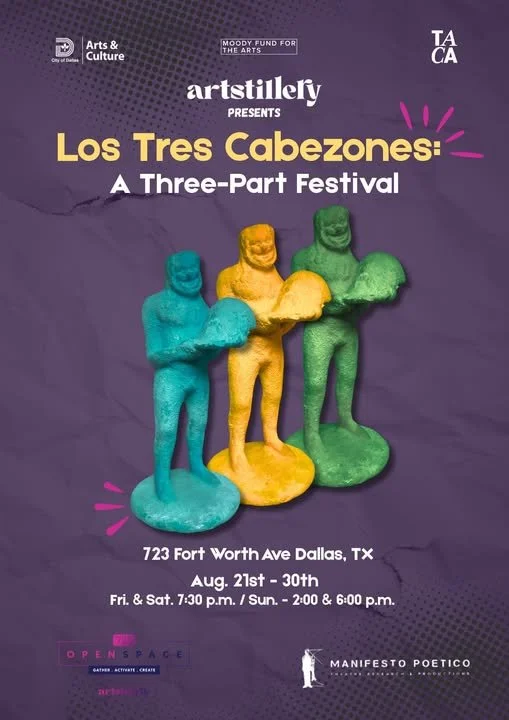
Los Tres Cabezones: A Three-Part Festival
WHEN: August 21–30, 2026
WHERE: Artstillery, 723 Fort Worth Ave., Dallas
Teresa Marrero, Ph.D. is a writer who specializes in theater and dance performances in English and Spanish. She can be reached at dr.teresa.marrero@gmail.com.