
—Ryan Maffei
Ah, the Scottish play. Well, an English idea of the auld country; the Scots themselves aren’t crazy about this classic. But you, you know and love it, or are wrong (or Scottish). For Shakespeare, it’s short, sharp, and shocking, and also, you can’t say the word backstage. I actually did let it slip that I was planning to review this during a recent closing weekend, drawing scandalized glares – and then we had our best run. So I say give it a try. What’s the worst that could happen? The world we live in feels like one big backstage where the word has been uttered over and over.
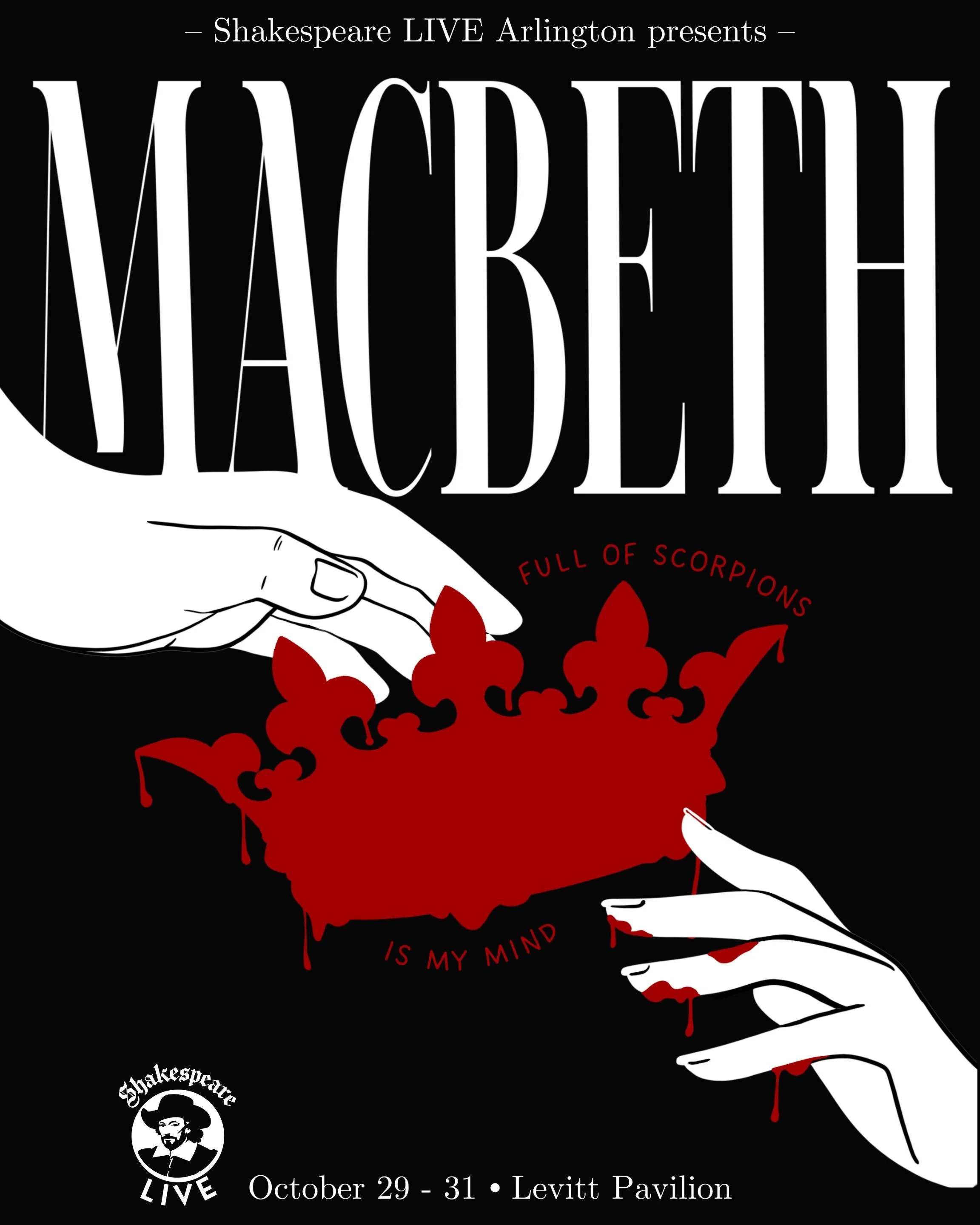
This newest Macbeth from Arlington-based Shakespeare LIVE is the third version I’ve seen in about a year, and I’ve missed a few too (a Pegasus Black & White update, a recent one starring the fabulous Michael Miller). All are destined to fall short of Circle Theatre’s 2025 Mac Beth, Erica Schmidt’s sweet, funny, unsettling adaptation starring a troupe of precocious-to-psychotic schoolgirls – one of whom reappears in this production, whose opening night I went to see Thursday.
I was familiar with too much of its talent – Mia Azjuaje, Ash Vance, Noelle Saul, Joseph Tully, Adia Best, Nicole Delarosa – to want to miss it. But my main takeaway is that this is a triumph for directors Raphael and Claire Parry. Working outdoors against an amphitheater space that seems built to swallow everything in it – the players look far away no matter how close you sit – they cultivate a palpable intimacy and keen connective tissue within a diverse set of acting styles, and have even fashioned a few new beats so clever they should be pilfered for future productions.
The play kicks off with a burst of battlefield chaos, a furious preview of David Saldivar’s excellent fight choreography. This deepens the soldier’s testimony early in the proceedings; the Parry directorial duo quietly plant reminders of the stakes throughout, constantly conscious of the emotional and physical cost to come. Their heightened attention to the onstage relationships soon yields payoffs both wrenching (a sweet “bird-call” game between doomed Banquo and young Fleance, eerie wordless calm between verses) and triumphant (the last laugh from a Donalbain at death’s door).
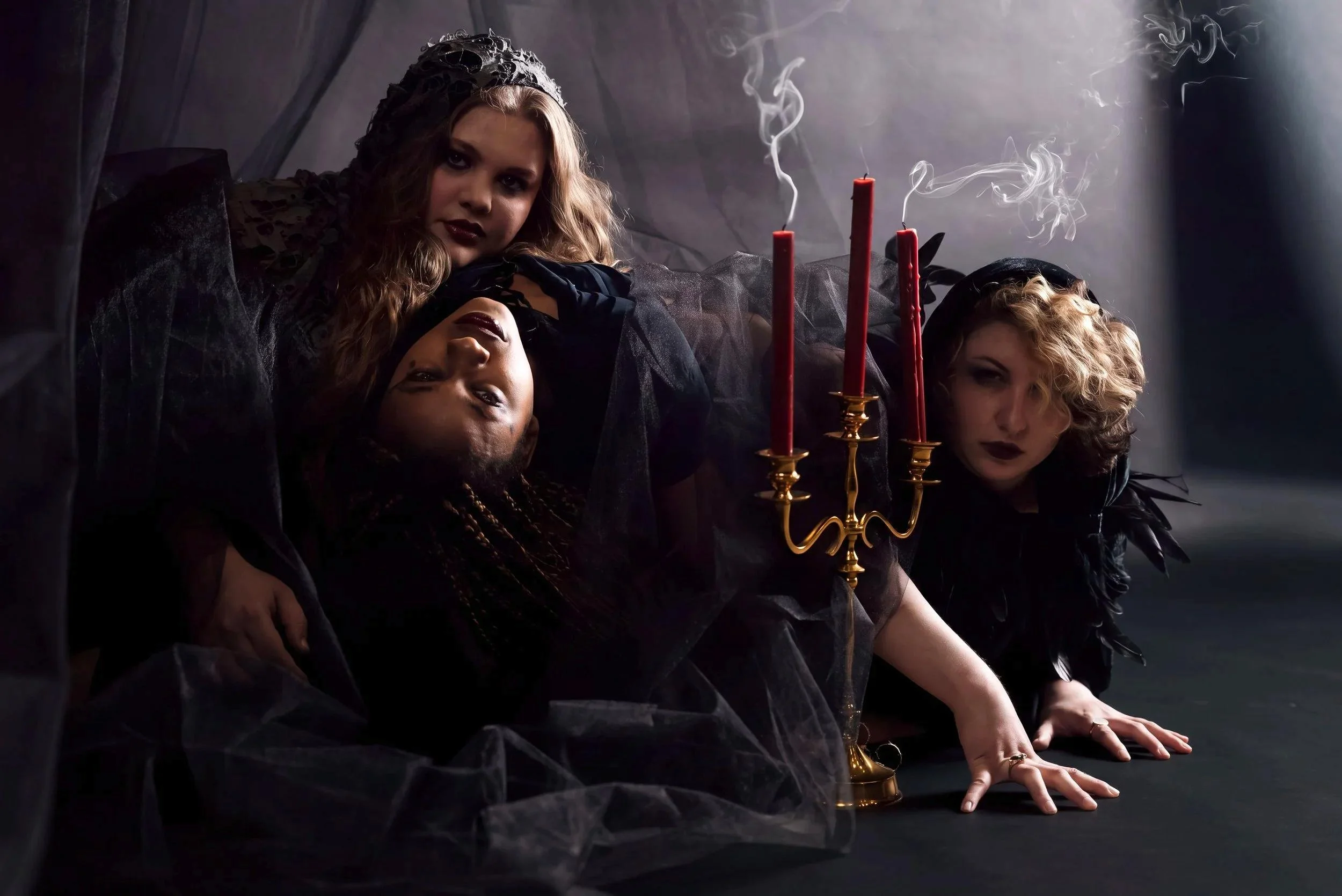
And of course there are the witches, no-holds-barred and Halloween-ready, portrayed here by Lauren Conover-Jordan, Adia Best and Cameron Hilliard. All three actors savor the movement opportunities these roles offer, while the Parrys weave the trio savvily through the action, at times in surprising ways (all three take on other roles). Best (the Circle Mac Beth veteran) lives up to her last name, but the fun is in the group interplay, their bold indulgences and shared mischief. Their eyes flash with enough wicked intent to unnerve you all the way to the back rows.
The set, designed by David Chrane, is a large scrim with an illustration of a cavernous hall; in certain moments there’s spare, striking shadow work behind it. The lighting is quite limited, a horizontal row of traffic-light fixtures above the action, simple colors and patterns (like a strobe for lightning). I found this occasionally distracting, but blame the space’s limitations more than I do designer Aaron Johanson. Rob Menzel’s sound design is also simple, to commendable effect. Costumes, by Margaret Monostory, are uniformly excellent, and Zareen Afzaal’s props measure up, even if designing a realistic severed head often eludes the efforts of those who must attempt it.
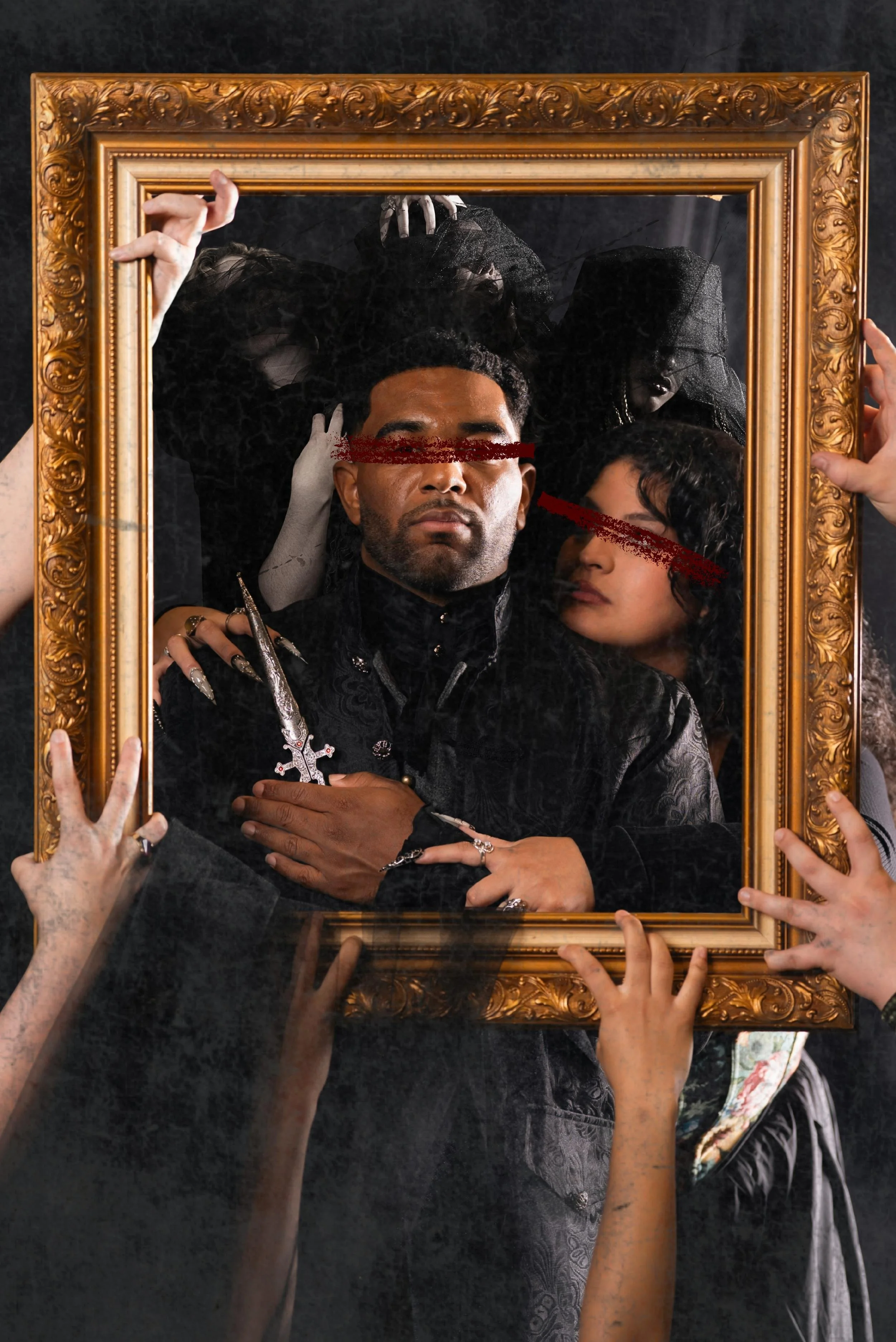
Among the mostly stellar cast, the king on whom that head is modeled is a bit of a problem. After the Shakes Dallas production, I was glad to see an emotionally unbound Mac, and one tapped into a wide range of levels. But though when he was quiet, the breadth of his talent became arrestingly evident, IJ Jordan tended to favor larynx-ruining hysterics, which as he raged on betrayed an increasing neglect of the text. He’s a braver presence than many of his fellows, but left too little nuance in his speeches; as he stumbled tormented about the stage, the rest were left to do damage control. He also grew more British the more upset he got, a strange and unnecessary affectation. You can tell he’s capable of great work these choices undermine.
His Lady M, meanwhile, is just right. Nicole Delarosa doesn’t waste a beat of this gift of a role, and doesn’t hinder her juiciest instincts by crafting it in the likeness of any hallowed predecessors. Winningly textured on the icy surface and brittle at her buried core, this is a more unique and captivating Lady M than we usually get. Delarosa tempers her character’s youthful anxiety and messy uncertainty (fresh angles), only to let it out in sharp breaths, between the cracks of words she never merely recites. She’s ready for responsibilities of this magnitude on stages across North TX. Kudos as well to intimacy director Harper C. Lee, who finds powerfully sensual beats that help bridge the divide between the lead and his lady.
My favorite, though, was a latecomer to her role. Madeleine Norton’s Banquo is a marvel – so grounded yet so powerful, so measured yet so moving. It’s the clearest, most effective work onstage, and though you’re sorry to lose her so early in the plot, she and the directors find a deliciously unconventional physical approach for her banquet-crashing. Pronouns are flipped for her (and for the rest of the abundant gender-benders), but she elects to strike a balance, neither masculine nor feminine characteristics ruling the day. The whole production is commendably diverse, and this element especially is starkly progressive, without drawing extra attention to itself.
Joseph Tully does heroic work as Macduff, who much unlike Norton’s steely Banquo can’t help but wear his burning heart on his sleeve. Counterposed against Noelle Saul’s delightful Malcolm – hers is a swaggering, exciting, inventive interpretation, albeit an eccentrically stylized one – his Macduff only ever takes power for the greater good, with glory just something that comes with the victory. The force Tully summons melts away shatteringly when he discovers his horrible loss, the actor barely emitting broken words into his microphone. His work slays you.
It’s fun to watch Mia Marie Azuaje adapt familiar mannerisms to an agitated soldier, before she wipes the table utterly clean with a remarkable and flawlessly distinct Lady Macduff. As Ross, John Hughes Marshall has to assert a military strength through his innate sweetness, and does a manful job of it. Gabriel Hawthorne is nearly the quietest presences onstage, yet really sticks with you as one of the murderers. Peyton Scroggins (also fight captain) does wonderful work which also refuses to court the spotlight. Jenna Carlton, the picture of precocity, is the resident wunderkind, leaning into a double role; it’s impossible to miss how bright her future is.
Ash Vance, one of the best actors anywhere, is spread a little thin over four parts – for a guy who’d kill as any of the leads, he only has so much space to assert himself, but certainly fulfills his duties. Sean Massey makes more than a meal of every line as Duncan, and resurrects this characterization as the doctor before dialing it further up as Young Siward; I would rather some of his thrusts had been a bit better Parried. The elder Parry has a great time in a goofy cameo as the Porter. Swing Isaac Morales has fantastic glasses, and gamely fills in his onstage space.
Though the sound and fury of the lead takes up a lot of room onstage, and leaves the production a little destabilized, overall this is a winningly cohesive Scottish Play. Great work abounds, and while I’d love to witness its nuances in a more intimate space, this is free Shakespeare in the park – a genuine gift in a perilous moment, and arriving just in time for the season of the witch.
WHEN: October 29-31
WHERE: Levitt Pavilion, downtown Arlington TX
WEB: shakespearelive.org