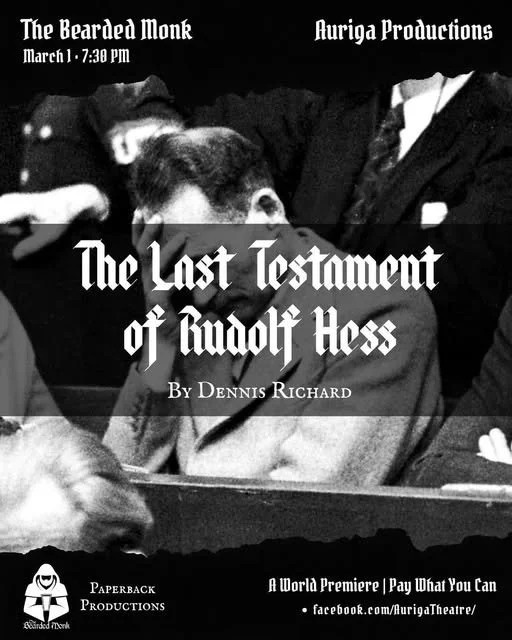
‘The Last Testament of Rudolph Hess’ @ Auriga Productions


Photos courtesy of Auriga Productions
—Jan Farrington
What happens when the shell of a man is visited by a ghost—or perhaps by himself?—and held up to the light as a wriggling monster? If that question serves up a bafflement of similes, that should feel right.
He is an endless enigma. Hints and revelations float toward us, and then twist away from our grasp. Who was Rudolph Hess, Hitler’s right hand man until he broke ranks in a spectacular way? Who is he, prisoner #7 in Berlin’s Spandau prison (its only prisoner, in fact), and the last man standing some forty years after the end of the war? Who is he to us, now? A case study become flesh, certainly, of a man with some talents who used them to aid and abet a horror story—and now a frail and very old man who still feels dangerous.
The facts of Hess are easier to sort out than the truths of him in Dennis Richard’s not-quite hour long play The Last Testament of Rudolph Hess. From beginning to end, he remains a known unknown, as some waffling politico once said. But nonetheless, we find ourselves seared by this brief but intense encounter with the man.
The play is being presented in various venues across Dallas and Fort Worth by Auriga Productions, and is directed with strong pacing and energy by Bert Pigg, who’s been at the helm for most (all?) of Auriga’s prior shows here (Terra Nova, Richard III, Hamlet, ) over the past several years. (For ticket information on the play’s remaining performances, see below.)
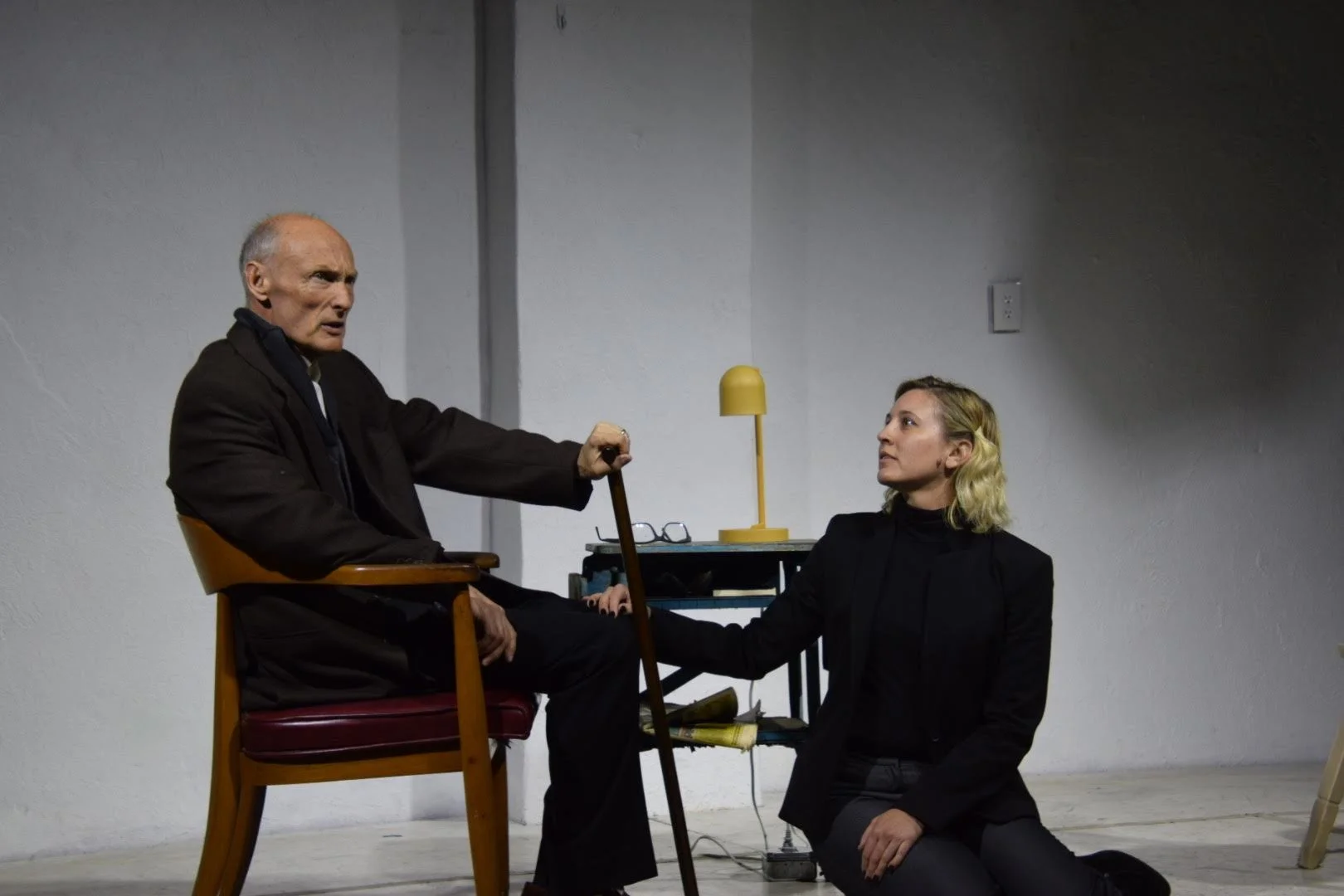
What I’m sure of is that Dennis Richard’s packed script and live-wire dialogue between the play’s two characters—Hess, played by Stephen Gruwell, and the mysteriously appearing Elsa, played by Sara Rashelle—provide plenty of drama even in this short span of time. Both actors give fine, unexpected performances, bursting with sudden shifts of tone. And though Richard’s concept seems less a story “arc” than a jigsaw puzzle of Hess’s history, we come to a certain clarity about him by the end. Still, it can never be The Truth…only what we make of him. Any conclusions are ours alone, to chew on during the drive home.
Both performances are vivid, and the audience sticks with the characters. Gruwell expertly plays Hess for the contraditions: Is he the frail husk of the man he was? Still the half-mad Hess plotting in his summer-house prison? The radically cult-bonded disciple of Hitler? The idealistic “save the world” Hess who hoped to end the war in one day of peacemaking? (That sounds familiar.) He was , and perhaps is, all these things, and Elsa adds the devil’s own temptation: Could all of it come again—with himself as a new Fuhrer?
With increasing alarm, we follow Rashelle’s twisting versions of Elsa: comforting and hard-as-nails, prosecutor and admirer; avatar of Germany’s past and fulture glory, Russian spy or lady with a file hidden in the cake? She hectors Hess both about his past crimes (he was a part of the death machine) and his betrayal of Hitler (pick a side, Elsa), but proposes extraordinary possibilities for the frail old man’s “future.” What in heaven or hell (or Hess’s galloping mind) is she up to? Rashelle’s strident tones and military posture are unsettling, and carry over into Gruwell’s Hess at times—as if their two energies are deeply connected.
As was said in discussions before and after the play, the Hess name and history, though notorious in and after the WWII years, is unlikely to be familiar to many younger theatergoers. The Last Testament is both an introduction to an historical figure and a fierce, many-layered look into the lures and self-delusion that make unthinkable actions seem…thinkable. A wolf howl punctuates the play twice, and that seems fitting as well, for an ideology (and both human and canine creatures) who stop at nothing in their quest for power and glory—and all too accepting of the carnage and devastation required to get them there.
WHERE: Artes de la Rosa Cultural Center for the Arts, 1440 North Main, Fort Worth
Remaining performances March 13 and 14 at 7:30
TICKETS: ticketleap