‘Brahms & Weill’ @ The Dallas Symphony

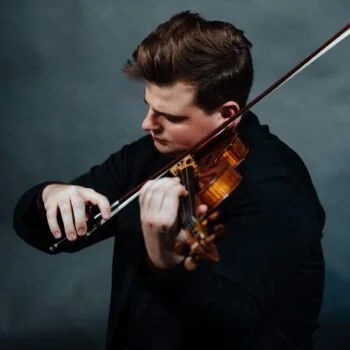
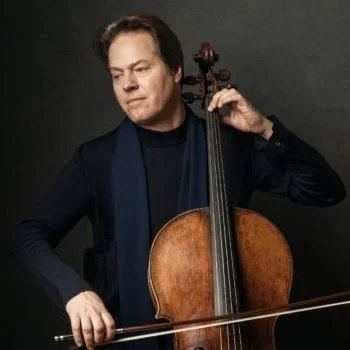
Left to right: conductor Maurice Cohn, guest artists Chad Hoopes and Jan Vogler
—Wayne Lee Gay
Johannes Brahms (the titan of classic German romanticism) faced off (figuratively) against Kurt Weill (the musical personification of Weimar-era German decadence) in an intriguing musical agenda for the concert program of the Dallas Symphony Orchestra this weekend.
Maurice Cohn, former assistant conductor of the DSO and current music director of the West Virginia Symphony Orchestra, returned to the podium for the concert.
The concert opened, however, with an innovation in orchestral programing, instigated by DSO music director Fabio Luisi: a "Surprise Opening Work" performed without giving the audience the name of the work or its composer. This week's "Surprise" was a cheerfully noisy ten-minute long piece; the composer and title, announced after intermission, is embargoed at the time of this writing. [Note: It was “Timber and Steel” by Bulgarian composer Dobrinka Tabakova.] This experiment in programing is definitely an effective way to open audience ears in readiness for the concert, and to give a hearing to new composers. Conductor Cohn and the orchestra reveled in the work's muscular ostinatos and busy impetus.
Following the opening "Surprise," the concert’s guest artists, violinist Chad Hoopes and cellist Jan Vogler, joined Cohn and the orchestra for a superb rendition of Brahms' Concerto in A minor for violin and cello (sometimes called the “Double Concerto.”) Here, as Brahms intended, sheer technical expertise on the part of the two guest soloists melds in a first movement where moments of majestic furor interlace with a sublime, sighing lyricism. The two soloists joined in the haunting unison introduction of the second movement, which gradually evolved into an almost operatic duet. In the third and final movement, new intricacies mingle with more moments of Brahmsian grandeur as well as some showy passagework, all brilliantly presented here in a remarkable collaboration of orchestra and conductor with two outstanding soloists.
Listeners from the older generation may know the heady marriage of simple melody with a murderous text in Weill's most famous song, "Mack the Knife"; they likewise may be familiar with the reflective, not-quite-sentimental "September Song." But before Weill set out, as a holocaust refugee, to put an enduring stamp on musical theater and pop music, he trained meticulously as a classical composer. His Symphony No. 2, from 1934, though rarely heard (this is its first performance in Dallas), can hold its own in the ranks of symphonic masterpieces of the twentieth century. The same sturdy lyricism and almost indefinable energy that characterize Weill's well-known songs was evident here, in a worthy and devoted rendition by the Dallas Symphony and conductor Cohn.
WHEN: March 5-8, 2026
WHERE: Meyerson Symphony Center
WEB: dallassymphony.org