‘The Trojan Woman’ @ InVerse Theatre
—Ryan Maffei
The recent blockbuster horror film Obsession sparked a debate. Written and directed by a man, but nominally feminist, the film subjects its female lead (who gives a brilliant performance) to a litany of brutalities. As she’s also the plot’s chaos agent, this content feels neither indulgent nor completely disempowering; when it’s most uncomfortable, the point seems to be to force toxic men in the audience to sit through an ironic inverse of what they’ve put women through. But a portion of viewers wondered how thin the line was between “pointed” and “torture porn.” How necessary is it to portray her pain so graphically, if the purpose is in fact to criticize its inflictors?
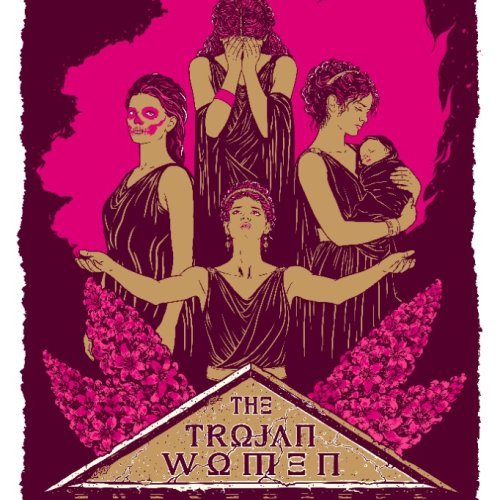
At Arts Mission Oak Cliff, Bradford J. Reilly’s The Trojan Women—he wrote, produced and directed—is, like the Euripides source it tartly remixes, an exploration of female suffering. (The company is InVerse Theatre, and what it’s an inverse of is a mystery—the status quo, maybe?) Portrayed by a quartet of brilliant actors who shift from victim to victim, the horrors of war’s human cost are on relentless display. Yet, though this is interspersed with stirring moments of strength, the show circumvents what a film like Obsession cannot. Watching four femme forces of nature playacting male brutality produces an entirely different effect. And while the piece is so powerful you feel every bit of portrayed pain, these aggressors become absurd shadows, without their sense of real-life threat ever vanishing.
Reilly is indeed dialed-in to how bygone the devastation portrayed in The Trojan Women is not in these hateful, war-torn times. I needn’t invoke the specters of Gaza, or our inability to elect (or respect) female leaders, for you to know what I mean. The show turns on a very neat trick, achieved in tandem between director and company: it is absolutely drawn from Greek drama—declarative, stylized, portentous—but infused with such skillful realism it lands right in between ancient and modern. Reilly told me it was important to him that the contact between his actors was all tender; in a strikingly effective stroke, violence is spoken in comic-book words such as “kick” and “bash.” In a truly unsettling scene, it escalates to one awful verb: “FORCE. FORCE. FORCE.”
The staging is modestly brilliant, and uniquely suited to Arts Mission Oak Cliff’s repurposed church nave. The set is appropriately stark. Lovely-looking fake flowers are strewn about, and beyond a pedestal and a vessel (by bowl artist/ceramicist Danna Miller Pyke of Dreamclay Studio) and two bookending hat racks (holding shawls and coats for character shifts), that’s all, folks. The costumes, with no designer credited, are four smart, simple dresses; naturally, the actors are barefoot. (And though you’ll see curls this good in other shows, these are highly competitive.) Lights are always a challenge in the AMOC space, and no designer is credited for the simple settings—the only element that smacks of compromise. I also would’ve added intro and outro music, but this show uses silence smartly.
Not that there’s much of it. You’ll hear wails and screams and pleas and bellowing anger, each of them flawlessly executed. As for Reilly’s script, it’s a fascinating beast. The play is highly verbal, but you sometimes lose words between moments you’ll never forget. It isn’t too comic—though when it is, it turns vicious and subtle. Thursday night’s audience didn’t seem to feel attuned to the vibe.
It’s also peppered with in-jokes both old (“my kingdom for a horse”) and new (“‘pick me’ energy”); with the latter, the actors are usually what makes it work. The lyricism flows freely at times and stops cold at others. There’s a jarring use of “cunt” that I’m not sure how I feel about. But other phrases cut like razors—“always a fucking prize”, or “we can rest?”—and I appreciate how the language favors the matter-of-fact over the poetic. In some situations, “this is bullshit” is all you can say.
This is a dream set of actors: Molly Rose, Rhonda Sue Rose (no relation, I think), Octavia Thomas and Kim Winnubst. (For those of you who need full disclosures, I’ve worked with Winnubst and one of the Roses.) All are interchanging MVPs, and everyone gets their moment. Molly Rose is a pillar of ache through most of the show, used as its softest presence until a wrenching sequence as Helen of Troy. Winnubst has a talent for looking haunted, and for summoning tidal waves of deep-seated emotion, but rattles us in divergent ways as a macho soldier and a doomed young mother. The other Rose, Rhonda Sue, holds the most court; she’s compellingly complex—nuance rippling across her face, confidence laced with comedy and critique. Thomas sustains a thrilling, grounded authority through a range of tones, the most consistent, if not the finest, of the four.
As the women issue futile-feeling pleas to the gods, it’s intriguing to contemplate the religious fervor of the time. But hope is the show’s foremost spiritual current—and the most arresting sequence is pure paganism. Suddenly, in the shifting time and tides of its tacitly linear plot, the women are the weird sisters (the fourth is recovering, as all must, briefly, throughout the play), dancing around Prometheus’ fire. In the most stunning piece of staging in a show that’s all great staging, they hurl themselves into the flames, burning and screaming. What would be horrifying—rendered realistically here—functions as a strange cry of victory in the face of oppression and despair.
The Trojan Women is not designed to offer solutions for our war-torn world, only reflections of it. But it serves to remind that, though “Its” rescue is on all of us, women will surely be the ones to save it.
“It will be, one day… perhaps.”
WHEN: September 17-19, 2026
WHERE: AMOC, 410 S. Windomere Ave, Dallas
WEB: artsmissionoc.org