‘Broadway Nation’ by David Armstrong
—Cathy Ritchie
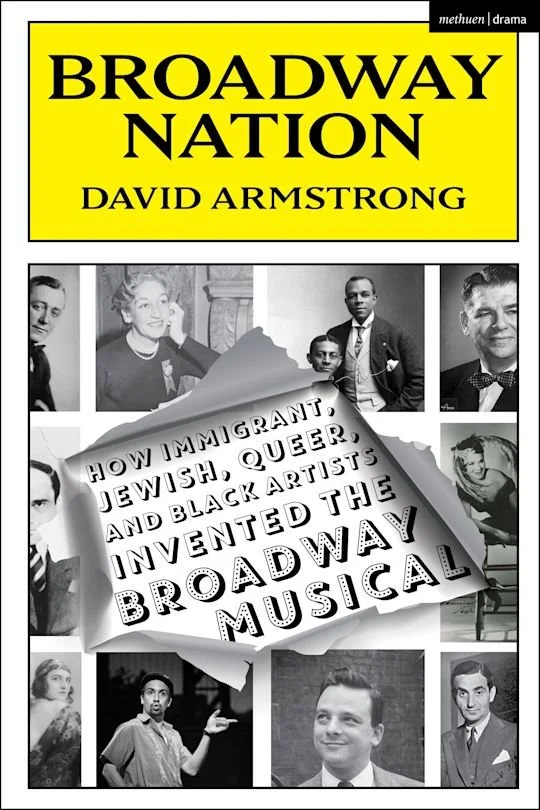
Broadway Nation: How Immigrant, Jewish, Queer and
Black Artists Invented the Broadway Musical
By David Armstrong, Methuen, 2025
It's not often that a book challenges my powers of description, but here it is.
With Broadway Nation, theatrical podcaster David Armstrong has produced an immense yet approachable history of the Broadway musical. It's massively detailed and has the heft of a doorstop, but details the evolution of this joyous entertainment form in impressively accessible fashion.
As Armstrong puts it in his Introduction, the book "examines the diverse cultural and historical forces" that ultimately brought us the American musical. An opening section on "How To Use This Book" is a reader's first clue that fully grasping the book’s content won't be a leisurely stroll in the park—bur it's a project worth undertaking.
Thanks to his use of icons and other finding tools, Armstrong offers readers a choice of what I would describe as "depth options." For example: one can read the text straight through, chronologically; skim the material with no particular focus in mind; or zero in on a specific "subset" of Broadway history as indicated by Armstrong's inclusive subtitle. (And for the record: while he doesn't mention "women" directly in his title's "sub" list, much of the book's content does indeed pay tribute to the creative ladies of Broadway. )
Armstrong's goal is clearly far-reaching: to highlight the musical contributions of several marginalized groups while also illustrating the art form's evolution—from the end of the 19th into the start of the 21st century, including the aftermath of the pandemic. And he somewhat uniquely reconfigures (and re-names) some of the so-called historical "ages" of musical theater—for example, tossing in some “Silver” periods along with the accepted “Golden” eras.
Within each chapter is a general history of the time period under discussion, followed by the author's chosen highlights: specific composers and songs, with a blending of familiar and more obscure names. Along the way, Armstrong offers "legacy chains" of his own devising that connect eras and influences.
Most sections are ideal for simple browsing, while the full chapters read like entertaining mini-textbooks. Vintage photos are inserted throughout, and a well-constructed bibliography is provided.
Thanks to one author's yeoman efforts, Broadway Nation could be considered an example of Broadway musical one-stop shopping; it is an outstandingly "fleshed out" companion to his fine podcasts of the same name. The book may initially appear overwhelming, but David Armstrong has given us a remarkably in-depth performing arts history not likely to be duplicated any time soon.